
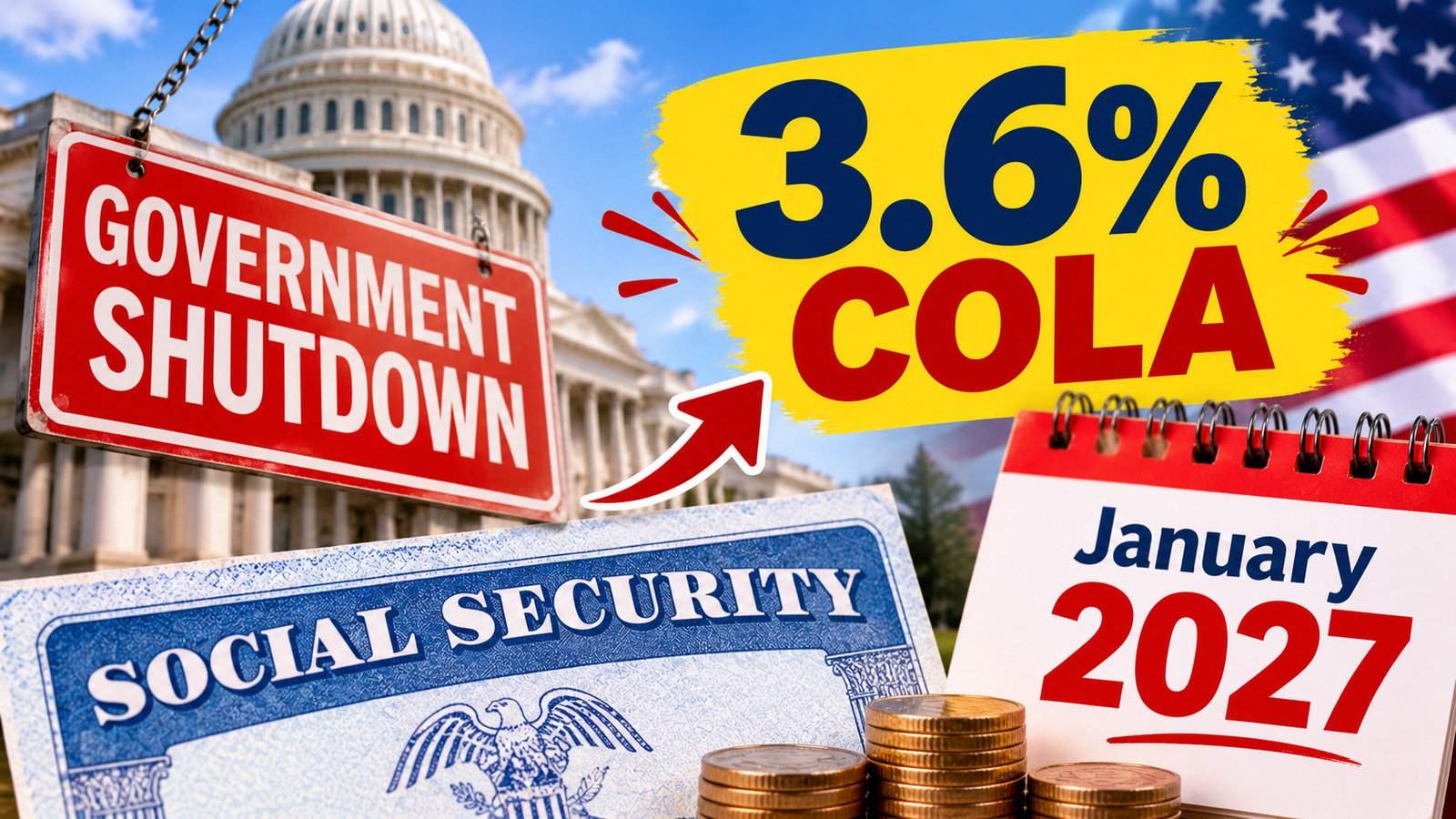
Government Shutdown Cola Delay 2027: Every autumn, millions of American retirees, disabled workers, survivors and SSI recipients ask the same question: “Will my raise actually show up?” In 2026 the worry is sharper than usual, for three reasons. First, the country has just lived through an unusually long run of funding fights. The 2025 shutdown ran for a record 43 days, and 2026 brought two more funding lapses, including a long Homeland Security-only shutdown that ended on April 30. Many retirees watched the news and wondered whether their checks were next.
Second, the COLA this year is bigger than the last few. The Social Security Administration (SSA) announced a 3.6% increase on October 14, 2026, which is the largest since 2023. People are counting on that money.
Government Shutdown in 2027
Third, a new deadline is approaching. Federal funding runs out on December 11, 2026, and a lapse would begin the next day. That falls just three weeks before the first COLA payments go out.
This article on Government Shutdown explains what the 3.6% COLA means, why benefit checks are legally insulated from shutdowns, which services can slow down, and exactly which dates to circle on your calendar.
The 3.6% COLA for 2027: What SSA Announced?
SSA announced that Social Security and SSI payments for 76 million Americans will rise 3.6% in 2027, and average retirement benefits will go up by about $75 a month starting in January. That is an average rise for retired workers from roughly $2,095 to $2,170.
A few other points:
- It is the biggest raise in years. The 2027 COLA is the largest since 2023 and marks a sixth straight year of increases at or above 2.5%. For comparison, the 2026 COLA was 2.8%.
- The taxable maximum is also rising. The maximum earnings subject to Social Security tax goes up to $192,300 from $184,500 in 2027.
- It matched expert forecasts. The 3.6% figure was in line with projections of 3.5% to 3.6% made the month before.
How the COLA is calculated?
SSA uses the Consumer Price Index for Urban Wage Earners and Clerical Workers (CPI-W) and compares third-quarter data with the same period a year earlier. The law has tied general benefit increases to the cost of living since 1975, so the raise is automatic. Neither Congress nor the President has to approve it each year. That is the main reason a funding fight cannot touch it.
Why a Government Shutdown Cannot Stop Your Social Security Check?
Benefits are mandatory spending
Social Security benefits count as “mandatory spending.” They have a permanent funding source, mainly payroll taxes, and the annual appropriations process does not affect them. A Government Shutdown is a lapse in appropriations, meaning the yearly bills that fund agency operations. Benefit payments never depended on those bills in the first place.
The record from past shutdowns
The best evidence is what actually happened. Even during the record 43-day Government Shutdown in October and November 2025, Social Security recipients kept receiving their monthly payments. During the funding lapse earlier in 2026, SSA said existing Social Security and SSI payments would continue with no change in payment dates.
The COLA itself is not at risk
Government Shutdown have not stopped the COLA from being announced either. During the 2025 Government Shutdown, the September inflation report was released on a special schedule so SSA could announce the COLA on time, and SSA is legally required to announce it before November 1. This year the announcement came on October 14, with no disruption.
What a Government Shutdown Could Affect?
“Payments continue” does not mean nothing changes. SSA is affected by Government Shutdown because Congress sets how much Social Security revenue can be spent on operating costs such as processing applications, renting local offices and paying staff. Some services, such as phone or in-person benefit verification, can pause during a lapse.
In practice, a longer lapse could mean:
- Longer waits on SSA phone lines and at field offices
- Slower processing of new applications and some appeals
- Delays in letters, replacement cards and similar routine services
- Slower responses to non-urgent record corrections
The money going out to existing beneficiaries is the part that is protected. The service around it is the part that can slow down.
Where Government Funding Stands Right Now?
There is no Government Shutdown today. Congress enacted a continuing resolution (CR) in September, and it expires on December 11. That law is H.R. 6500, the Continuing Appropriations and Extensions Act, 2027, now Public Law 119-103. If no new funding law passes by then, a lapse would begin on December 12.
So far the House has passed 3 of the 12 appropriations bills for fiscal year 2027, and the Senate has passed none. Congress returned from the midterm elections on November 9 for a lame-duck session. Analysts describe three options: a full-year package of the 12 bills, another stopgap, or letting some agencies lapse. Given how little time is left, lawmakers will most likely pass another CR if Democrats cooperate.
None of this is certain, and Congress can still miss the deadline. Even then, the COLA and your payment dates would not change.
Your January 2027 Payment Dates
Payment dates depend on your birth date and when you started benefits. The January 2027 calendar has an unusual feature: some people are paid in December 2026. Anyone who gets SSI only, gets SSI and Social Security, or started Social Security before May 1997 will be paid January’s benefit on Thursday, December 31, 2026. That is because January 1 is a holiday and January 3 is a Sunday.
| Who you are | Normal payment day | January 2027 payment date |
| SSI only | 1st of the month | Thursday, Dec 31, 2026 |
| SSI + Social Security | 3rd of the month | Thursday, Dec 31, 2026 |
| Started Social Security before May 1997 | 3rd of the month | Thursday, Dec 31, 2026 |
| Born 1st–10th | 2nd Wednesday | Wednesday, Jan 13, 2027 |
| Born 11th–20th | 3rd Wednesday | Wednesday, Jan 20, 2027 |
| Born 21st–31st | 4th Wednesday | Wednesday, Jan 27, 2027 |
These January dates match published 2027 schedules. The SSI payment for January is issued on December 31, 2026, and it already includes the COLA. If you are in the December 31 group, you get two deposits close together in December and none in January. The second one is at the new 3.6% rate, so budget accordingly.
Remaining 2026 dates
For December 2026, the 3rd-of-the-month group is paid Thursday, December 3. The Wednesday groups are paid December 9, 16 and 23 for birth dates 1st–10th, 11th–20th and 21st–31st.
How to Find Your Exact New Amount?
- Online notice: Beneficiaries enrolled in Medicare can see their 2027 benefit amount in the Message Center of their my Social Security account starting in late November.
- Digital notices: People who sign up for digital notices by November 18, 2026 can see their personal COLA online up to three weeks earlier than by mail.
- Paper notices: SSA will send paper notices with updated benefit amounts in early December.
Your notice will show your new gross benefit, any Medicare premium deduction, and your net deposit.
A note on Medicare premiums
Medicare Part B premiums are usually deducted from Social Security checks, and a rise in the premium eats into the raise. Information on 2027 Medicare changes will be available at www.medicare.gov. The “$75 average increase” is before any premium changes, so your take-home gain may be smaller. Check your COLA notice for your exact net figure.
Is 3.6% Enough? The Debate
Experts disagree on whether the COLA keeps up with real costs. Nancy Altman of Social Security Works argues the COLA under-measures inflation. An Allianz Life executive says a COLA is not a bonus that raises a retiree’s standard of living. Both views point to the same fact: the COLA is meant to hold purchasing power steady, not to grow it. For about half of seniors, Social Security provides at least 50% of income, and for roughly 1 in 4, at least 90%.
What You Should Do Now?
- No action is needed for your benefits. Do not apply early or change anything because of the shutdown talk.
- Create or check your my Social Security account. It is the fastest way to see your COLA notice.
- Make sure your direct deposit details are current. Updating them is easier before a lapse than during one.
- Mark your payment date. If you are in the December 31 group, plan for rent and bills due in early January.
- Handle SSA business early. If you need a new card, a record change or an in-person visit, do it before December 11, since services are the part that slows down.
- Beware of scams. Fraudsters often use shutdown news to claim “your payment is suspended” and ask for personal details. SSA does not need money or gift cards from you to release a benefit.
Official and Verified Sources
| Topic | Source | Link |
| Official 2027 COLA announcement | Social Security Administration | CLICK HERE |
| COLA information page | Social Security Administration | CLICK HERE |
| Digital notice deadline (Nov 18) | SSA Advocates update, Oct 14, 2026 | CLICK HERE |
| Medicare 2027 changes | Medicare.gov | CLICK HERE |
| What happens to benefits in a shutdown | AARP | CLICK HERE |
| COLA coverage and average increase | CNBC | CLICK HERE |
| Dec 11 funding deadline and lame-duck agenda | Committee for a Responsible Federal Budget | CLICK HERE |
| 2027 payment schedule | Kiplinger | CLICK HERE |
Frequently Asked Questions :-
Will a government shutdown delay my January 2027 Social Security check?
No. Benefits are mandatory spending with a permanent funding source, so payments continue during a lapse in appropriations. This held during the record 43-day shutdown in 2025.
Could a shutdown cancel or reduce the 3.6% COLA?
No. The COLA is set automatically by law using CPI-W data, and SSA has already announced it. A funding lapse does not change it.
Is the government shut down right now?
No. Federal funding runs through December 11, 2026. A lapse would begin December 12 only if Congress does not pass a new funding law or another stopgap.
When will I see the 3.6% increase?
Retirement, disability and survivor beneficiaries see it with their January 2027 payment: January 13, 20 or 27 depending on birth date. SSI recipients, and people on the 3rd-of-the-month schedule, are paid early on December 31, 2026.
Why is my January payment coming in December?
January 1 is New Year’s Day and January 3 is a Sunday. Payments are never delayed past their due date, so they move to the last business day before, which is December 31, 2026.
Will I get less money in January because of the early payment?
No. It is the same January benefit paid earlier, and it already includes the COLA. You just will not receive another SSI deposit dated in January.
How much will my benefit rise?
The average retired worker’s benefit rises by about $75 a month. Your exact increase depends on your current benefit, so check your COLA notice.
Where can I see my new benefit amount?
In your my Social Security account’s Message Center, starting in late November. Paper notices go out in early December.
What could a shutdown actually slow down?
Customer service, such as phone lines and in-person verification, plus new applications and non-urgent administrative work. Existing payments continue.
Will Medicare premiums reduce my raise?
Possibly. Part B premiums are deducted from most beneficiaries’ checks. Your COLA notice shows the exact net amount, and medicare.gov has 2027 Medicare information.
