SSI Payment Schedule October 2026: The SSI payment October 2026 schedule has an unusual twist this month. Supplemental Security Income recipients get their regular October payment today, Thursday, October 1. They get a second deposit on Friday, October 30. That second payment is not a bonus. It is the November benefit, paid early because November 1 falls on a Sunday and the Social Security Administration does not send SSI money on weekends. If you rely on SSI to cover rent, groceries or medication, the timing matters as much as the amount. Two deposits in the same month can make October feel generous, but it also means there will be no SSI deposit on November 1. Your next payment after October 30 arrives on December 1, 2026. Anyone who spends the October 30 money as if it were extra could find the first weeks of November hard to get through.
Roughly 75 million Americans receive either Social Security or SSI payments in 2026, according to reporting that tracked this year’s calendar. SSI makes up a smaller group within that number. These are older adults, blind people and people with disabilities who have very limited income and resources. Their payments follow a simpler rule than retirement and survivor benefits, but that rule creates months with two deposits and months with none. We will be updating this article monthly, so bookmark it if you want the next date before it arrives. The rest of this guide covers the rule behind the dates, every remaining 2026 payment, the current benefit amounts, how to apply, how long a decision takes, and how to check your status. It also includes a free calculator you can use to see your own deposit date and a rough monthly estimate.
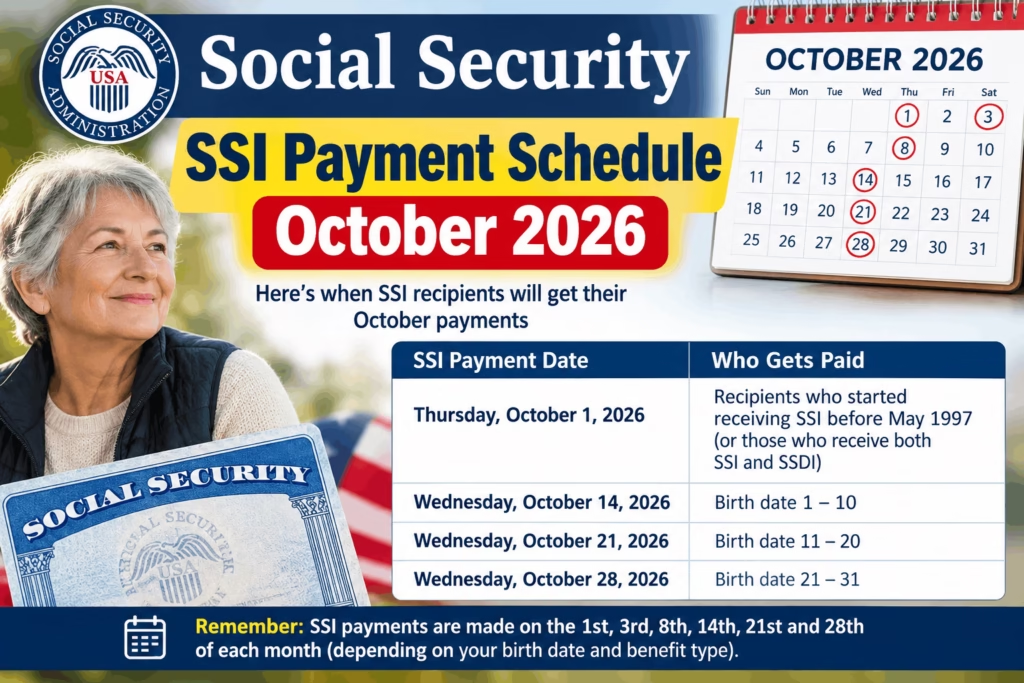
SSI Payment Dates 2026 Full Schedule
The SSA pays SSI on the first day of the month. When the first lands on a Saturday, Sunday or federal holiday, the payment moves to the last business day before it. That one rule explains every odd date this year.
| Benefit month | Deposit date | Day | Why |
|---|---|---|---|
| October 2026 | October 1 | Thursday | Regular first-of-month payment |
| November 2026 | October 30 | Friday | November 1 is a Sunday |
| December 2026 | December 1 | Tuesday | Regular first-of-month payment |
| January 2027 | December 31, 2026 | Thursday | January 1 is a federal holiday |
Earlier this year the same rule moved the February payment to January 30, the March payment to February 27 and the August payment to July 31. Each of those left one calendar month without a deposit and another with two.
Note that a small number of news outlets have published a November 2 date for the November payment. The SSA’s own rule moves weekend payments earlier, not later, so October 30 is the date to plan around. If your money has not arrived by the end of the business day, contact the SSA before assuming something is wrong, because bank posting times vary.
Why SSI Recipients See Two Payments in October 2026?
The calendar is the whole story. October 1 is a Thursday, so the October payment goes out on time. November 1 is a Sunday, so the SSA pulls that payment back to Friday, October 30. Both deposits land in one calendar month, which makes your bank statement look like you were paid twice.
You were not. You received one payment for October and one for November. Over twelve months you still receive twelve payments. The only thing that changes is which calendar month they land in. The year 2026 simply has several of these shifts, so the pattern looks bumpy.
If you receive both SSI and Social Security, you may notice the two programs behave differently. Social Security retirement and disability payments for most people are tied to a birth date, paid on the second, third or fourth Wednesday. In October those Wednesdays are October 14, 21 and 28. In November they are November 11, 18 and 25, with the first group adjusted around the Veterans Day holiday according to the SSA calendar. People who started Social Security before May 1997, or who receive both SSI and Social Security, are paid Social Security on the 3rd of the month and SSI on the 1st.
Social Security Payment Dates for November 2026: SSI, SSDI and Retirement Schedule
Social Security’s Trump Bump-Fueled 2027 COLA Is Set to Make History 2 Different Ways
How Much Is SSI in 2026?
The 2026 cost of living adjustment is 2.8 percent. It raised the maximum federal SSI payment to 994 dollars a month for an eligible individual and 1,491 dollars a month for an eligible couple, up from 967 and 1,450. These are the federal base rates. Some states add a supplement on top, and some people receive less than the maximum because of other income or living arrangements.
| Item | 2026 amount |
|---|---|
| Maximum federal SSI, individual | 994 dollars per month |
| Maximum federal SSI, eligible couple | 1,491 dollars per month |
| Resource limit, individual | 2,000 dollars |
| Resource limit, couple | 3,000 dollars |
| Cost of living adjustment | 2.8 percent |
The resource limit has stayed at 2,000 dollars for an individual and 3,000 dollars for a couple for decades, which is why savings rules remain one of the most common reasons people lose eligibility. Resources include cash, bank balances and most investments. Your home and one vehicle are generally not counted.
What Your Actual Payment Depends On?
The 994 dollar figure is a ceiling, not a promise. The SSA subtracts countable income from the federal rate to arrive at your check. Three things drive the difference.
First is other income. Social Security benefits, pensions, and help from family or friends can reduce your SSI. The SSA ignores the first 20 dollars of most monthly income. If you work, it also ignores the first 65 dollars of earnings and then counts only half of what remains. This is why working a few hours rarely wipes out SSI entirely.
Second is living arrangements. If someone else pays for your food or shelter, the SSA may count that as in-kind support and reduce your payment by up to about one third of the federal rate. People who live in the home of a relative often see this reduction.
Third is where you live. Some states pay a supplement. Others do not. A few states let the SSA administer the supplement, so it arrives in the same deposit.
The calculator at the end of this article applies the federal rules above to give you a quick estimate. It does not replace an SSA determination.
SSI Payment Schedule by Situation
Most people get paid on the first. A few situations change that.
If you receive SSI only, your deposit date is the first of the month, or the prior business day if it falls on a weekend or holiday. If you receive SSI and Social Security together, SSI still arrives on the first, while Social Security arrives on the third or on a Wednesday depending on when you started. If you recently qualified, your first payment may take longer to show up because of processing steps and the SSA’s lookback on the application date.
Electronic payments are the standard now. The federal government has moved away from paper checks, and the SSA encourages direct deposit into a bank or credit union account or onto the Direct Express card. If you still receive a check in the mail, contact the SSA to switch so your money does not depend on postal delivery.
How to Apply for SSI?
You can start your application online, by phone or in person. The easiest first step is to read the SSA’s overview at https://www.ssa.gov/benefits/ssi/ and begin at https://www.ssa.gov/apply. Here is how the process usually works.
- Step one is to confirm you may qualify. You must have limited income and resources and be 65 or older, blind, or have a disability. You also need to be a United States citizen or a qualifying noncitizen and live in the United States.
- Step two is to gather documents. You will want your Social Security number, birth certificate or proof of age, information about where you live and your rent or mortgage, bank statements, payroll records, and medical information if you are applying based on a disability. The more complete your paperwork, the fewer follow up requests you will face.
- Step three is to submit the application. For a disability based claim, the SSA often works with you to complete the application over the phone or in a local office. You can find an office near you at https://www.ssa.gov/locator or call 1-800-772-1213. People who are deaf or hard of hearing can call TTY 1-800-325-0778.
- Step four is to respond quickly to any request. Missing a deadline for medical records or forms is one of the most common reasons claims stall.
- Step five is to wait for the notice. The SSA mails a decision letter. If you are approved, the letter explains your payment amount and when your first deposit is due.
Social Security’s 2027 COLA Could Outpace This Year’s Raise — Here’s How Helpful It Really Is
Social Security COLA 2027 Medicare and Payment Changes in October
SSI Processing Time: What to Expect
Processing time depends on whether your claim is age based or disability based. An application based on age and financial need can move faster, sometimes within a few weeks once the SSA verifies your income and resources. A disability claim takes longer because the agency must collect medical evidence, and a state disability determination office makes the medical decision. Initial decisions on disability claims commonly take roughly three to six months and sometimes more, depending on your state and the complexity of your case.
If you are denied, you can appeal. You have 60 days from the date you receive the decision, and the SSA assumes you receive it five days after the date on the letter. Many claims are approved on reconsideration or at a hearing, so a first denial is not the end. Do not let the deadline pass.
The SSA also has a special track for people in certain situations, such as a terminal illness or a condition on its compassionate allowances list. Those claims can be decided much faster.
If you win an SSI claim after a long wait, you may be owed back payments for the months between your application date and your approval. Unlike Social Security disability, SSI generally starts from the month after you apply, so applying early protects your benefit.
How to Check Your SSI Payment Status?
You have three practical options.
The best is a free my Social Security account at https://www.ssa.gov/myaccount. Once you create an account and verify your identity, you can see your payment history, your next deposit date, your benefit verification letter, and your current benefit amount. You can also change your direct deposit information and mailing address there.
The second option is your bank. Many banks display a pending deposit one day before the official payment date. That is normal and is not a reliable sign that the money is missing.
The third option is to call the SSA. The national number is 1-800-772-1213, and local offices can see payment details if you have an appointment or need urgent help. Keep in mind that busy periods around the first of the month mean longer waits, so try mid month if your question is not urgent.
If your payment is late by more than three business days, the SSA says you should contact them. Have your Social Security number and bank details ready.
Official SSI Resources and Links
| Resource | What it is for | Link |
|---|---|---|
| Social Security Administration home | General information and news | https://www.ssa.gov |
| my Social Security login and registration | Payment status, letters, direct deposit | https://www.ssa.gov/myaccount |
| Apply for benefits | Start an application | https://www.ssa.gov/apply |
| SSI overview | Eligibility and basics | https://www.ssa.gov/benefits/ssi/ |
| SSI amounts and COLA | Current federal rates | https://www.ssa.gov/oact/cola/SSI.html |
| Office locator | Find your nearest office | https://www.ssa.gov/locator |
| Forms | Download SSA forms | https://www.ssa.gov/forms |
| Phone | Main line | 1-800-772-1213 |
How to Avoid Common Problems With SSI Payments
Most payment problems come from reporting issues rather than SSA errors. Report any change in income, living arrangements, marital status, address or resources promptly. The SSA expects changes to be reported by the tenth day of the month after they happen. Late reports can cause overpayments, which the agency may recover by reducing future checks.
Keep your bank balance below the resource limit on the first day of each month. The SSA looks at what you own at that point, so a high balance at the start of the month can affect eligibility even if you spend it quickly afterward. This matters in October this year because the early November deposit arrives on October 30. If you leave that money sitting in your account, it may count toward your resources on November 1. Ask the SSA how it treats that deposit if your balance is close to the limit.
Watch out for scams. The SSA does not call to threaten you with arrest, demand payment in gift cards or ask you to move money to protect it. If someone contacts you claiming to be from the agency, hang up and call the official number yourself. Report fraud at https://oig.ssa.gov.
Finally, make sure your direct deposit details are current. A closed account or a typo can send a payment back and delay it for weeks.
Budgeting Tips for a Two Deposit Month
Because the October 30 payment covers November, treat it as November money. A simple approach is to set aside the portion you need for rent and bills on the day it arrives. Pay rent early if your landlord allows it, and make any scheduled utility payments before the end of October if your bank balance is high enough. That way the money does not disappear on non essential purchases.
If you also receive Social Security, remember that your November Social Security payment comes on its own schedule, which keeps your income steady even though SSI skips November 1.
People who use food assistance or Medicaid should remember that both programs may have their own income checks. A larger deposit in one month can appear on reports, so keep your records handy in case a caseworker asks.
Social Security 2027 COLA Notices: When They Arrive and What They’ll Show
Child Tax Credit 2026 Eligibility: Are You Getting the Full $2,200?
Free SSI Payment Date and Amount Calculator
Use the calculator below to see your deposit date for any month through January 2027 and to estimate your monthly federal SSI amount.
SSI Payment Date and Amount Calculator
FAQs SSI Payments in October 2026
When will SSI be deposited in November 2026?
SSI for November 2026 is deposited on Friday, October 30, 2026. November 1 is a Sunday, so the SSA pays one business day earlier. There is no SSI deposit on November 1 itself.
Why did I get two SSI payments in October?
You received your October payment on October 1 and your November payment on October 30. The second deposit is only early, and it is not additional money.
What day does SSI pay in 2026?
SSI pays on the first of each month. If the first falls on a weekend or federal holiday, the SSA pays on the previous business day.
How much is the SSI payment in 2026?
The maximum federal rate is 994 dollars a month for an individual and 1,491 dollars for a couple. Your actual amount may be lower because of income, living arrangements or state rules.
Will SSI be paid on December 1, 2026?
Yes. December 1 is a Tuesday, so SSI is scheduled for that date.
When is the January 2027 SSI payment?
January 1, 2027 is a federal holiday, so the payment is scheduled for Thursday, December 31, 2026.
How do I know if I will get my SSI payment early?
Look at the first of the month. If it falls on a Saturday, Sunday or federal holiday, expect the deposit on the last business day before it.
Can I get SSI and Social Security at the same time?
Yes. Many people receive both. SSI is paid on the first, and Social Security is paid on the third or on a Wednesday depending on when benefits began and your birth date.
How do I check the status of my SSI payment?
Sign in to your my Social Security account at https://www.ssa.gov/myaccount, or call 1-800-772-1213.
What if my SSI payment does not arrive?
Wait three business days after the scheduled date, then contact the SSA. Confirm that your bank details are correct before you call.
Is the October 30 SSI payment a bonus?
No. It is the November benefit paid early. Your total for the year is unchanged.
Does SSI have a payment on November 1, 2026?
No. Since the November payment is made on October 30, the next one is December 1.
Can I apply for SSI online?
Adults applying based on age can often start online. For disability claims, you may start online, by phone or at a local office. Begin at https://www.ssa.gov/apply.
How long does an SSI application take?
Age based claims can be quicker. Disability based claims commonly take around three to six months for an initial decision, sometimes longer.
What is the SSI resource limit?
It is 2,000 dollars for an individual and 3,000 dollars for a couple, excluding items such as your primary home and one vehicle.
Does working affect SSI?
Yes, but only partly. The SSA ignores some earnings, then counts half of the rest, so working usually does not cancel your benefit all at once.
Do I need to report changes?
Yes. Report changes in income, household, address or resources promptly to avoid overpayments.
Where can I find the official 2026 payment calendar?
The SSA publishes its schedules at https://www.ssa.gov. You can also see your own dates after signing in to your my Social Security account.
Conclusion
The SSI payment October 2026 schedule is simple once you know the rule behind it. You are paid on October 1, and you are paid again on October 30 because November 1 is a Sunday. That second deposit is your November benefit, and your next payment arrives on December 1, followed by the January 2027 payment on December 31. Plan your spending around those dates so your money lasts through the gap.
Beyond the calendar, the best things you can do are keep your direct deposit information current, report changes quickly, stay under the resource limit, and use your my Social Security account to check your status. If you are thinking about applying, start early, because processing can take months and your benefit generally begins after you apply. For anything specific to your case, rely on the SSA directly. We will be updating this article monthly with the next payment date and any program changes.
SSI vs SSDI vs Social Security: What’s the Difference and Who Qualifies?