
SSI vs. SSDI vs. Social Security: “Social Security” is the umbrella term for retirement, survivor and disability benefits that you earn through work. SSDI is the disability part of it and requires enough work credits. SSI is a separate, needs-based program for people with little income and few assets who are 65 or older, blind or disabled, and it requires no work history.
Few government programs cause as much confusion as the ones run by the Social Security Administration (SSA). People say “I’m on Social Security” when they get a monthly disability payment. Others say “I’m on disability” when they actually get SSI. The names are similar, the payments often arrive within days of each other, and the rules for each are quite different.
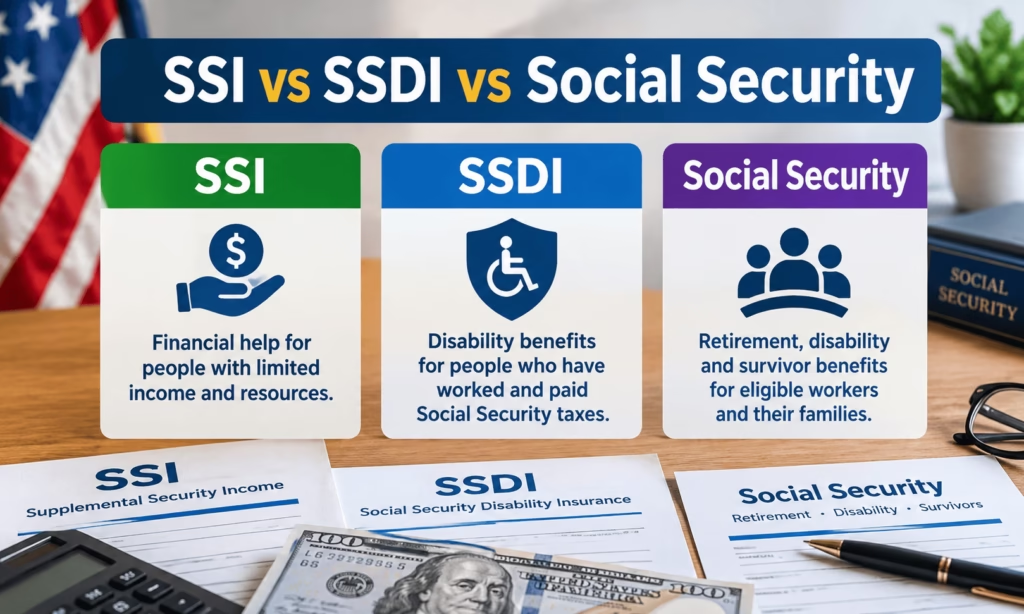
SSI vs SSDI vs Social Security
The distinction matters in practice. Whether you qualify depends on very different things: your work history for SSDI, your finances for SSI. The programs also differ on how much you can earn, which health coverage comes with them, and how quickly payments begin. Picking the wrong program, or not realizing you may qualify for both, can mean months of missed benefits.
The 2027 COLA was announced on October 14, 2026, so both the current 2026 numbers and the new 2027 numbers are shown below. Dollar amounts change every year, so check the official sources listed near the end before you make decisions.
What “Social Security” Means?
When SSA talks about “Social Security,” it usually means the Old-Age, Survivors and Disability Insurance (OASDI) system. It is funded by payroll taxes. Workers and employers each pay 7.65% (Social Security plus Medicare), and self-employed people pay 15.30%. Retirement, survivor and disability benefits are paid from this system, and the amount you get is based on your lifetime earnings.
- Retirement benefits are for workers who have earned at least 40 credits, with age rules that depend on when you claim.
- Survivor benefits go to eligible family members of a deceased worker.
- Disability benefits (SSDI) go to workers who can no longer work because of a long-term medical condition.
SSI is run by the same agency, but it is not part of that payroll-tax system.
SSDI: Social Security Disability Insurance
SSDI is insurance you have paid into through your work. According to SSA, to be eligible you must have worked in jobs covered by Social Security and have a medical condition that meets SSA’s strict definition of disability.
Who qualifies for SSDI?
1. Enough work credits. In 2026, you earn one credit for each $1,890 in wages or self-employment income, up to four credits a year, which means $7,560 for the full four. Generally, you need 40 credits, 20 of them earned in the last 10 years ending with the year your disability begins. SSA calls this the 20/40 rule. Younger workers can qualify with fewer credits. For 2027, the amount for one credit rises to $1,970.
2. A qualifying disability. SSA considers you disabled only if all of the following are true:
- You cannot work at the “substantial gainful activity” (SGA) level because of your medical condition.
- You cannot do your previous work or adjust to other work.
- Your condition has lasted, or is expected to last, at least 12 consecutive months, or is expected to result in death.
SSA pays only for total disability. No benefits are payable for partial or short-term disability. SSA uses a five-step review that looks at whether you are working, how severe your condition is, whether it matches SSA’s list of impairments, and whether you can do past work or any other work. Certain conditions, such as ALS, acute leukemia and pancreatic cancer, can be approved faster through the Compassionate Allowances program.
SSDI timing and health coverage
Generally there is a five-month waiting period, and the first benefit is paid in the sixth full month after SSA finds your disability began. SSDI recipients become eligible for Medicare after 24 months of entitlement to disability benefits. When you reach full retirement age, SSDI automatically converts to retirement benefits at the same amount.
SSI: Supplemental Security Income
SSI is a needs-based program funded by general tax revenue, not payroll taxes. It does not depend on your work history or a family member’s.
Who qualifies for SSI?
According to SSA, adults and children may qualify if they have all three of the following:
- Little or no income. SSA says SSI is generally for people who don’t earn more than $2,073 a month from work. The limit is higher for couples and for parents applying for a child. Other income, such as benefits, unemployment and pensions, is also counted.
- Little or no resources. Resources are things like bank accounts and vehicles. The limits are $2,000 for an individual and $3,000 for a couple, and they stay the same in 2027. A parent applying for a child gets an extra $2,000. Not everything you own counts toward the limit.
- A disability, blindness, or age 65 or older. If you are 64 or younger, the disability must affect your ability to work for a year or more or result in death. For children, it must severely limit daily activity. Adults applying on the basis of disability must also have earned less than $1,690 from work in the month they apply.
Noncitizens face additional eligibility rules. SSI is generally for U.S. citizens, nationals, and certain categories of noncitizens.
SSI payments and health coverage
There is no work-credit requirement and no five-month waiting period. Most SSI recipients are generally eligible for Medicaid, the state-run health program, and some states add a supplement on top of the federal payment. SSI is reduced as other income rises. For example, most unearned income lowers the payment dollar for dollar after a small exclusion.
SSI vs. SSDI vs. Social Security: Side-by-Side
| Feature | Social Security (retirement/survivor) | SSDI | SSI |
| Based on | Work history | Work history | Financial need |
| Funded by | Payroll taxes | Payroll taxes | General tax revenue |
| Age requirement | Retirement: generally 62+ | Under full retirement age | 65+, or any age if blind or disabled |
| Disability required? | No | Yes (strict definition) | Yes, unless 65+ |
| Work credits | Generally 40 | Generally 20 of last 10 years (age-dependent) | None |
| Resource limit | None | None | $2,000 / $3,000 couple |
| Waiting period | None | Generally 5 months | None |
| Health coverage | Medicare at 65 | Medicare after 24 months | Medicaid (generally) |
Some people qualify for both SSDI and SSI at the same time. This happens when the SSDI amount is low enough that the person still meets SSI’s income and resource limits. SSA says about 2.5 million adults and children receive both.
The Latest Numbers: 2026 vs. 2027
SSA announced a 3.6% COLA for 2027, which will reach about 76 million Americans. It applies to nearly 72 million Social Security beneficiaries beginning with January 2027 benefits and about 7.3 million SSI recipients beginning December 31, 2026. No application is needed because the increase is automatic.
| Item | 2026 | 2027 |
| COLA | 2.8% | 3.6% |
| SGA (non-blind) | $1,690/mo. | $1,770/mo. |
| SGA (blind) | $2,830/mo. | $2,950/mo. |
| Trial Work Period month | $1,210/mo. | $1,270/mo. |
| SSI federal payment, individual | $994/mo. | $1,029/mo. |
| SSI federal payment, couple | $1,491/mo. | $1,544/mo. |
| SSI resource limit | $2,000 / $3,000 | $2,000 / $3,000 |
| Credit amount (one credit) | $1,890 | $1,970 |
| Average disabled worker benefit | $1,642 | $1,701 (after COLA) |
| Maximum retirement benefit at full retirement age | $4,152 | $4,188 |
These figures come from SSA’s 2027 COLA fact sheet. The average benefit shown for each year is SSA’s estimate of the amount payable in January 2027, before and after the COLA.
Working While Receiving Benefits
SSDI. SSA runs a Trial Work Period that lets you test your ability to work. Any month you earn above the TWP amount ($1,210 in 2026) counts as a trial month. After the trial period, if your earnings are consistently above the SGA level ($1,690 for non-blind recipients in 2026), SSDI payments can be suspended and eventually end. SSA’s Ticket to Work program is free and voluntary and can help you return to work while protecting your benefits and, in some cases, your Medicare or Medicaid.
SSI. There is no trial work period. SSA excludes a portion of your earnings, then reduces your SSI by $1 for every $2 of remaining countable earned income. You must report changes in earnings, and SSI recipients report wages each month. If you don’t report and get paid too much, you may have to repay benefits.
Payment Dates: November and December 2026
SSDI and retirement benefits are paid by birth date:
- Birthdays 1st to 10th: second Wednesday
- Birthdays 11th to 20th: third Wednesday
- Birthdays 21st to 31st: fourth Wednesday
- Paid before May 1997, or receiving both SSDI and SSI: the 3rd of the month
SSI is paid on the 1st, or earlier when the 1st falls on a weekend or federal holiday. This year, November 1 fell on a Sunday, so November’s SSI payment went out early on Friday, October 30, which means no SSI deposit is dated in November. People on the second-Wednesday schedule were paid Tuesday, November 10, because Veterans Day fell on Wednesday, November 11.
Here is what remains:
| Date | Who is paid |
| Wed., Nov. 18 | SSDI/retirement, birthdays 11th to 20th |
| Wed., Nov. 25 | SSDI/retirement, birthdays 21st to 31st |
| Tue., Dec. 1 | SSI (December) |
| Thu., Dec. 3 | Paid on the 3rd (pre-May 1997 or SSI + Social Security) |
| Wed., Dec. 9 / 16 / 23 | SSDI/retirement by birthday group |
| Thu., Dec. 31 | SSI for January 2027, at the new $1,029 rate, paid early because January 1 is a holiday |
An early payment is not an extra payment. Confirm your own date in your my Social Security account or on SSA’s official calendar.
In the News: Trustees Report and 2027 Changes
The 2026 Trustees Report was released in June. It projects that the retirement trust fund (OASI) can pay full benefits on time until 2032, while the Disability Insurance (DI) trust fund is projected to have enough reserves to pay full benefits throughout the 75-year projection period ending in 2100. If Congress does not act, income at the time of OASI depletion would cover about 78 percent of OASI benefits. If Congress were to combine the two funds, the projected depletion date for the combined funds would be 2034.
For SSDI recipients, the DI fund’s long-term outlook is the more stable part of the picture. Still, these projections depend on legislation that hasn’t been passed, and benefits for current recipients are not changing under current law.
SSA also says COLA notices will be available online in late November 2026 through the Message Center of your my Social Security account, for most beneficiaries who created an account by November 18. Mailed notices follow, and beneficiaries who also get Medicare will see their new 2027 benefit amount, after Medicare premium changes, in December.
How to Apply?
- SSDI: Apply online at ssa.gov/apply, by phone at 1-800-772-1213 (TTY 1-800-325-0778), or at a local office. Gather your medical records, doctor and hospital details, and work history first.
- SSI: Apply through SSA online, by phone, or in person. Children’s SSI applications involve a separate starter kit.
- Unsure which one? SSA screens applicants for both programs. You can apply once and SSA will review which you qualify for.
Services are free. SSA warns that no government agency or reputable company will ask for your personal information or advance fees through wire transfers or gift cards. Report suspected fraud to the Inspector General.
Official Sources
| Topic | Official source (SSA) |
| 2027 COLA and key figures | 2027 COLA Fact Sheet |
| COLA overview and notices | COLA Information |
| October 14, 2026 announcement | Press Release |
| SSDI eligibility and work credits | How Does Someone Become Eligible? |
| SSI eligibility | Who Can Get SSI |
| SSI payment amounts | How Much You Could Get from SSI |
| SSI income/resource exceptions | Exceptions to SSI Limits |
| Payment calendar | Schedule of Payments |
| Work incentives | Ticket to Work |
| Working while disabled | Publication 05-10095 |
| Trust fund outlook | 2026 Trustees Report |
| Apply for benefits | Apply |
| My Social Security account | Sign in or create |
| Report fraud | SSA Inspector General |
| Primary source | SSA: 2027 Cost-of-Living Adjustment Fact Sheet |
Frequently Asked Questions
Is SSDI the same as Social Security?
No. SSDI is one part of Social Security (the disability piece). “Social Security” more broadly includes retirement and survivor benefits too.
Can I get SSI without ever having worked?
Yes. SSI does not depend on work history. You must meet the income, resource and age or disability requirements.
Can I receive SSDI and SSI at once?
Yes, if your SSDI is low enough that you still meet SSI’s financial limits. SSA counts SSDI as income when figuring your SSI.
How much is the SSI payment?
The federal maximum in 2026 is $994 for an individual and $1,491 for a couple. It rises to $1,029 and $1,544 starting with the payment made December 31, 2026. Your actual payment depends on your other income, and some states add a supplement.
What is the SSDI amount?
It is based on your lifetime earnings, not a flat rate. SSA estimates the average disabled worker will receive $1,701 a month after the 2027 COLA.
How long does SSDI take to start?
There is generally a five-month waiting period, and the first benefit is paid in the sixth full month after SSA finds your disability began. SSA may pay up to 12 months of benefits before your application date if you qualify.
What counts as earning too much for SSDI?
Earning above the SGA level, $1,690 a month in 2026 ($2,830 if blind), generally means SSA won’t consider you disabled. In 2027 the limits are $1,770 and $2,950.
What counts toward SSI’s $2,000 limit?
Cash, bank accounts and vehicles are common resources, though SSA doesn’t count everything you own. See SSA’s exceptions page for details.
Do I need to apply for the COLA?
No. It is applied automatically.
Will my benefits be cut because of the trust fund projections?
Under current law, no changes have been made. The Trustees’ projections show what may happen if Congress doesn’t act, and the disability fund’s outlook is stronger than the retirement fund’s.
Where can I check my payment date?
In your my Social Security account or on SSA’s payment calendar.

6 thoughts on “SSI vs SSDI vs Social Security: Who Qualifies?”