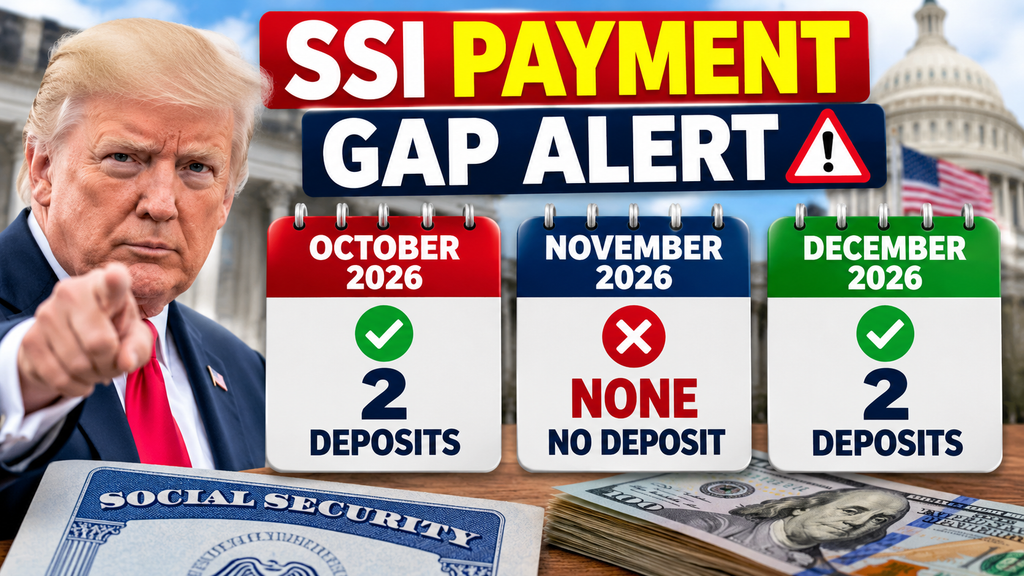
SSI Payment Gap Alert: If you receive Supplemental Security Income, you may have noticed something odd on your bank statement this month. One deposit landed on October 1, and another is scheduled for October 30. Then, if you look ahead at the calendar, November shows no SSI payment at all. A few weeks later, December has two payments again, followed by another empty month in January.
It is easy to see how this causes panic. People search for terms like “double SSI payment in October” and wonder whether they are getting extra money, whether something went wrong, or whether their benefits are about to stop. Others see the empty November and assume a payment is missing. Neither is true. The payments are exactly what they should be, only shifted by the calendar.
The reason is simple. SSI is normally paid on the first of the month. When the first lands on a weekend or a federal holiday, the Social Security Administration pays a day or more early. November 1, 2026 falls on a Sunday, so November’s money goes out on Friday, October 30. That pushes two payments into October and leaves November without one. The same thing happens at the end of the year, because January 1 is a federal holiday.
In this article, we will lay out the full calendar from October 2026 to early 2027, explain exactly why this happens, show you a practical way to budget the early money so it lasts, and flag the one SSI rule, the resource limit, that deserves a careful look when two deposits arrive close together.
Highlights
| How many SSI deposits in October 2026? | Two: Thursday, October 1 and Friday, October 30 |
| Why? | November 1 is a Sunday, so November’s payment is paid early |
| SSI deposits in November 2026? | None |
| SSI deposits in December 2026? | Two: Tuesday, December 1 and Thursday, December 31 |
| SSI deposits in January 2027? | None (the January payment comes December 31) |
| Next SSI payment after December 31? | Monday, February 1, 2027 |
| Is it extra money? | No. Each payment is a normal monthly benefit paid early. |
| Is the amount reduced? | No. |
SSI payments go out on Thursday, October 1, and again on Friday, October 30, because November 1 falls on a Sunday, which means SSI recipients get two payments in October and none in November.
The full calendar: October 2026 to February 2027
| Month | Deposit date | Which month’s benefit is it? | Notes |
|---|---|---|---|
| October | Thursday, Oct 1 | October | Normal payment |
| October | Friday, Oct 30 | November | Paid early (Nov 1 is a Sunday) |
| November | No deposit | n/a | Already paid on Oct 30 |
| December | Tuesday, Dec 1 | December | Normal payment |
| December | Thursday, Dec 31 | January 2027 | Paid early (Jan 1 is a holiday); first check at the 2027 rate |
| January 2027 | No deposit | n/a | Already paid on Dec 31 |
| February 2027 | Monday, Feb 1 | February | Normal payment |
Source: SSA payment calendar, as reported by Kiplinger, USA Today network and others.
The December 31 payment is for January 2027, and it will be the first check at the new 2027 rate. That means the cost-of-living raise that the SSA announces on October 14 will show up in SSI recipients’ hands a few days before it reaches Social Security beneficiaries.
The weekend and holiday rule for SSI Payments Schedule
SSI payments are scheduled for the first of each month. But the government does not issue payments on weekends or federal holidays, so when the first falls on one, the payment is made on the last business day before.
- November 1, 2026 is a Sunday. The last business day before it is Friday, October 30.
- January 1, 2027 is a federal holiday (New Year’s Day). The last business day before it is Thursday, December 31.
The result is a pattern that SSI recipients have seen before. Earlier this year, SSI recipients got payments on July 1 and July 31 and then nothing in August, for the same reason. The shifted months this fall and winter are October/November and December/January.
Is it really a “double payment”?
No, simply it is two deposits in one month. Look at what each deposit actually covers:
- The October 1 deposit is your October benefit.
- The October 30 deposit is your November benefit, paid early.
Nothing extra is added. You get the same total for the year. It is simply bunched differently, so your bank account will look flush on October 30 and then empty of SSI deposits for all of November. The early deposit is the full benefit for the following month, paid ahead of a weekend or holiday, with the amount unchanged.
What about people who also get Social Security?
Some people receive SSI and Social Security. Their Social Security is paid on the 3rd of the month, and SSI on the 1st.
| Month | SSI | Social Security (3rd-of-month group) |
|---|---|---|
| October | Oct 1 and Oct 30 | Oct 2 (Friday, since Oct 3 is Saturday) |
| November | None | Tuesday, Nov 3 |
| December | Dec 1 and Dec 31 | Thursday, Dec 3 |
If you are in this group, you will see an SSI deposit on October 30, and a Social Security deposit on November 3, only a few days apart. Together, the two make up your income for November.
People who started Social Security after May 1997 are paid on Wednesdays by birthday (the 2nd, 3rd or 4th Wednesday). In November those dates are the 10th, 18th and 25th, and in December they are the 9th, 16th and 23rd.
How much is SSI in 2026?
For reference, the confirmed 2026 maximum federal SSI payment is $994 a month for an individual and $1,491 for a couple. These are maximums. Your actual payment can be lower if you have other income or certain living arrangements, and some states add a supplement. About 7.4 million Americans get SSI.
What about VA and other payments?
SSI is not the only payment that follows the same calendar. VA disability compensation is also paid on the first of the month, and for the same reason it is deposited on October 30 and December 31 this year. A veteran who receives both VA compensation and SSI could see two deposits on October 30 and two more on December 31. So if you receive both, plan carefully, because November and January will look empty.
FAQ’s About SSI Payment Gap Alert in Oct and Nov 2026
Why do I have two SSI deposits in October 2026?
Because November 1 is a Sunday, so November’s payment is made on Friday, October 30.
Is the second payment extra money?
No. It is the full November benefit, paid early.
Will I get SSI in November 2026?
No separate deposit. Your November payment arrived on October 30.
When is my next SSI payment after October 30?
Tuesday, December 1, 2026.
Why will I get two SSI payments in December?
December 1 is your December benefit. December 31 is your January 2027 benefit, paid early because January 1 is a federal holiday.
Will I get SSI in January 2027?
No separate deposit. Your next one after December 31 is February 1, 2027.
Does the early payment reduce my benefit?
No. The amount stays the same.
Will the December 31 payment include the COLA raise?
Yes. It is the first SSI payment at the 2027 rate.
Can two deposits push me over the resource limit?
It’s possible if you are near the $2,000 (individual) or $3,000 (couple) limit, because the limit is measured on the first of the month. If you’re close, ask SSA how your early payment will be treated.
What if I get SSI and Social Security?
Your SSI follows the schedule above, and your Social Security follows its own schedule. If you are in the “3rd of the month” group, your November Social Security payment is on November 3.
Where can I see the official schedule?
On ssa.gov, in the Schedule of Social Security Benefit Payments (Publication No. 05-10031).
The October “double payment” and the empty November are a calendar quirk, not a problem with your benefits. Your total for the year stays the same. The only thing that changes is when the money arrives, which means your budget has to stretch a little further in November and again in January. Treat the October 30 deposit as November money, pay your fixed bills first, split the rest into weekly amounts, and keep an eye on your savings if you are close to the SSI resource limit. And if a message promises a bonus or says your payment must be “verified,” skip it and go to ssa.gov yourself.
Disclaimer: This article is for general information only and is not legal or financial advice. SSI rules depend on your personal situation. Confirm details with the Social Security Administration or a benefits counselor.
Sources: Social Security Administration (ssa.gov), including the Schedule of Social Security Benefit Payments (Publication No. 05-10031), the SSI information pages and SSI Federal Payment Amounts for 2026. Payment dates cross-checked against Kiplinger and USA Today network reporting.