
Fed Rate Hike in December: Not long ago, talk of the Federal Reserve cutting rates dominated the conversation. Now the question on every trading desk, mortgage broker and household budget is whether the Fed Rate Hike will raise rates again at its December meeting. Markets have largely made up their minds. The Fed has not, and that gap between market pricing and an actual decision is the heart of this story.
The stakes reach well beyond Wall Street. The federal funds rate sets the tone for borrowing costs across the US economy, from credit cards and car loans to business credit. It also influences the dollar and global capital flows, so decisions in Washington can ripple into emerging markets, including India, in ways that show up in currency moves and foreign investment. Anyone who borrows, saves or invests across borders has reason to care.
Fed Rate Hike in December
This article explains where rates stand, what the Fed has said and done recently, what markets expect for December 8 to 9, why inflation data is driving the debate, and what a hike could mean for ordinary people. Figures are as of November 17, 2026. Market odds change by the hour, so treat any percentage here as a snapshot, not a forecast. This is general information, not financial advice.
Where rates stand today?
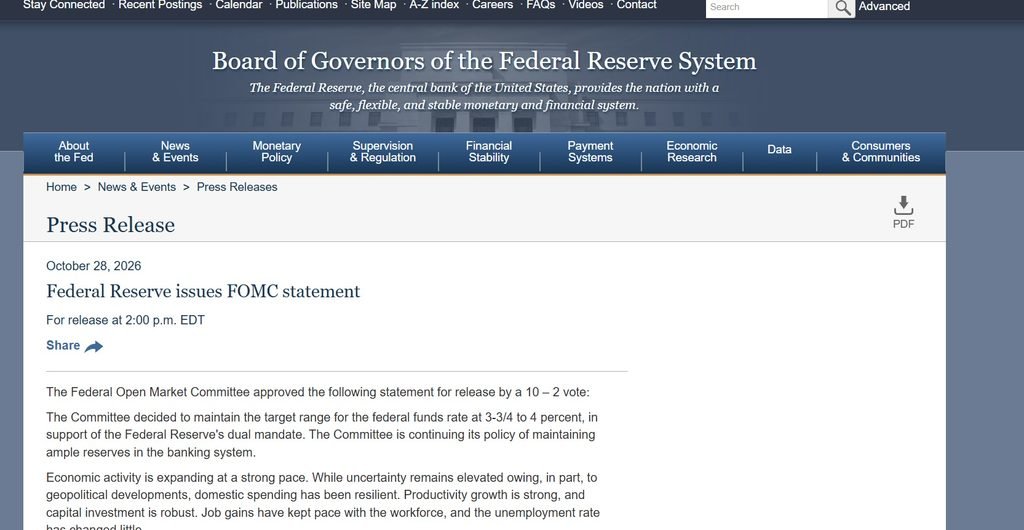
At its October 28 meeting, the Federal Open Market Committee (FOMC) kept the target range for the federal funds rate at 3-3/4 to 4 percent. That range was set in September, when the committee acted to tighten. On September 16 it raised the range by a quarter point to 3-3/4 to 4 percent, in a unanimous 12–0 vote.
The related administered rates moved with it. The interest rate paid on reserve balances stands at 3.90 percent, and the primary credit rate at 4.0 percent. Those are technical settings, but they tell you the policy stance is currently restrictive and sitting near the top of the range.
The October hold was not unanimous
A hold can look like a pause, but the vote shows a committee leaning toward more. The October decision passed 10–2. The two dissenters, Cook and Hammack, preferred to raise the range by a quarter point at that meeting. Two votes for a hike at a meeting that ended in a hold is a meaningful signal about the direction of debate.
The official statement also read cautiously on prices. It said inflation remains elevated, that more information would help the committee set the right stance, and that the committee will deliver price stability. In the press conference, Chair Warsh described economic activity as expanding at a strong pace, with resilient spending, strong productivity growth and robust capital investment. A strong economy plus sticky inflation is the classic setup for tighter policy.
Social Security 2027: 3.6% COLA Explained
COLA by State: Who Gets the Biggest 2027 Raise?
Federal Pay Freeze 2027: Raise or Not?
Bernie Sanders Social Security $2,400 Increase: Who Pays and When?
What markets expect for December?
The Fed meets December 8 to 9, with the decision due Wednesday, December 9 at 2:00 PM ET, alongside updated economic projections. The market read is lopsided. As of November 17, fed funds futures price a 99% chance of a 25 basis point hike, up from 90% a week earlier and 82% a month earlier.
Different gauges give slightly different numbers, which is normal. CME’s FedWatch tool showed roughly a 93% chance of a 25 basis point hike in December. A prediction market put a 25 basis point hike at 91%, with a larger hike at 6%. The message is the same across them: a quarter-point increase is the base case, and a hold has almost disappeared from the pricing.
These are market probabilities, not Fed Rate Hike announcements. Nothing is decided until the FOMC votes, and the prices can move quickly. A surprise in data, or a shift in tone from officials, could change the picture before December 9.
Why inflation is driving the debate?
The recent jump in hike odds followed hotter price data. Consensus among major banks firmed around a 25 basis point hike after October consumer and producer inflation came in hotter than expected. After the October CPI report, one gauge showed hike odds at 100%, up from 84% the day before.
Bond markets reacted too. The US 2-year Treasury yield rose 37 basis points in a week, and the benchmark 10-year yield moved back above 5%. When yields jump like that, it reflects investors repricing how long and how far the Fed may go.
The possibility of a bigger move
The main uncertainty is size, not direction. Fed Governor Waller said a 50 basis point hike should be on the table in December if inflationary pressure persists, and he warned that a smaller move could put the Fed’s credibility at risk. He tied the stronger response to core inflation holding at 0.3 percent or more on a monthly basis. Core CPI then came in at exactly 0.3 percent.
One futures gauge put the odds of a 50 basis point hike at 12.7 percent. Other trackers show lower figures, around 1% to 8%, depending on method. The takeaway is that a half-point move is a minority scenario, but not a fringe one.
What comes after December?
Markets are not treating December as a one-off. FedWatch showed about a 67% probability of another hike in January 2027 and roughly 63% odds of a third consecutive increase in March 2027. Those later-meeting odds are far less certain than December’s and depend on incoming data.
One timing detail matters. The November CPI report is not scheduled until December 10, a day after the decision. So the Fed will decide without seeing the next inflation reading, which raises the weight of the October numbers and the committee’s own projections.
What a hike could mean for you?
Moves in the federal funds rate pass through unevenly. Variable-rate borrowing that tracks short-term benchmarks, such as many credit cards and home equity lines, tends to adjust within weeks. Savings accounts and money market products often follow upward, though banks vary in how fast. Fixed mortgage rates track longer-term yields, so they respond to expectations about the path of rates, not just the next decision. Because markets already price a December hike, some of its effect may already show up in longer yields.
For readers in India, the link is indirect. Higher US rates and yields can strengthen the dollar and draw capital toward US assets, which can pressure emerging-market currencies and portfolio flows. How India responds depends on domestic conditions and the Reserve Bank of India’s own decisions, so check the RBI’s calendar and announcements. This is a general relationship, not a prediction of what will happen to the rupee.
What to watch before December 9?
Three things will matter most. First, any remarks from Fed officials in the coming weeks, since speeches are where tone shifts show up. Second, the minutes of the October meeting, which show how divided the committee was.
Third, the projections released with the December decision, which indicate how many more hikes officials expect. At the October press conference, a reporter noted that the September projections had penciled in another rate hike this year.
Fed Rate Hike Official sources
| Source | Use | Link |
| FOMC statement, Oct 28, 2026 | Latest decision and vote | https://www.federalreserve.gov/newsevents/pressreleases/monetary20261028a.htm |
| Implementation note, Oct 28, 2026 | Reserve balance rate, primary credit rate | https://www.federalreserve.gov/monetarypolicy/files/monetary20261028a1.pdf |
| Press conference transcript, Oct 28, 2026 | Chair’s remarks and Q&A | https://www.federalreserve.gov/mediacenter/files/FOMCpresconf20261028.pdf |
| FOMC statement, Sept 16, 2026 | The most recent rate increase | https://www.federalreserve.gov/newsevents/pressreleases/monetary20260916a.htm |
| Federal Reserve Board | Meeting calendars, statements, minutes | https://www.federalreserve.gov |
Fed Rate Hike – Frequently asked questions
Will the Fed raise rates in December?
Markets say yes, but it isn’t decided. Futures priced a 99% chance of a 25 basis point hike as of November 17. Nothing is decided until the FOMC votes.
When is the decision?
The meeting runs December 8 to 9, with the decision on December 9 at 2:00 PM ET.
What is the current rate?
The target range is 3-3/4 to 4 percent.
Did the Fed Rate Hike earlier this year?
Yes. The committee raised the range by a quarter point on September 16. It then held on October 28.
Was the October vote unanimous?
No. It was 10–2, with two members preferring a hike.
Could the hike be 50 basis points?
It’s possible but less likely. One gauge put those odds at 12.7%, and a governor said the larger move should be on the table if inflation stays hot.
Why is inflation the focus?
Hotter-than-expected October consumer and producer prices pushed expectations toward a hike.
Will there be more hikes after December?
Markets lean that way but with less confidence. FedWatch showed about 67% odds for January and 63% for March.
Will the November inflation data come before the decision?
No. The November CPI report is scheduled for December 10.
Does this affect India?
Possibly, indirectly, through the dollar and capital flows. It depends on many factors, including the RBI’s own policy, so it isn’t a forecast.
Is this financial advice?
No. For decisions about loans, savings or investments, consult a qualified professional.
Also read :-
GOP Convention Fact Check: What Held Up?
$90 Medicare Rebate: Who Got It, Who Didn’t?
Social Security & SSI Pay Dates by Birthday: When you will get your benefit?

1 thought on “Fed Rate Hike in December: Why Markets Treat a Quarter-Point Increase as Nearly Certain?”