
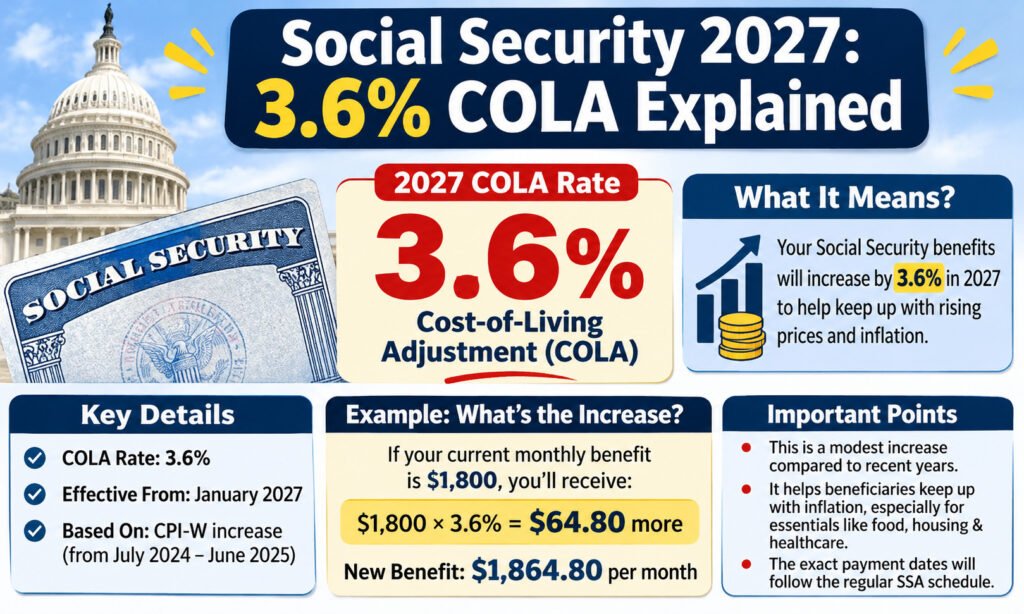
Social Security 2027: The Social Security Administration announced a 3.6 percent benefit increase for 2027 on October 14, 2026. That is a step up from the 2.8% adjustment applied for 2026, and it reaches nearly 72 million beneficiaries. On average, retirement benefits will rise by about $75 per month. For households watching grocery, utility and housing costs, that is a meaningful number, and it arrives automatically.
The COLA is only one part of a larger package of annual changes. SSA also adjusts the maximum earnings subject to Social Security tax, the limits that apply if you work while collecting early retirement benefits, the income thresholds for people with disabilities, and the SSI payment standards. Most of these figures rise together because they are tied to inflation or national wage growth.
Social Security 2027
This article covers the official 2027 numbers, the payment dates to watch, and the steps worth taking before the new year. One piece is still pending: as of mid-November 2026, the official 2027 Medicare Part B premium has not been confirmed in the sources. Because Part B is usually deducted from Social Security checks, that figure determines how much of the COLA you actually keep.
All numbers below come from SSA and other federal sources. Check your own notice for your exact amount.
The 3.6% COLA: How It Works
The COLA is not a vote or a discretionary decision. It is a formula. SSA’s fact sheet says it is based on the rise in the Consumer Price Index for Urban Wage Earners and Clerical Workers (CPI-W) from the third quarter of 2025 through the third quarter of 2026. The announcement came after the Bureau of Labor Statistics released September inflation data, which completed the quarter used in the calculation.
Beneficiaries do not need to register, apply or otherwise activate the increase. It is applied automatically. The adjustment applies to Social Security retirement, survivor and disability benefits, and to Supplemental Security Income (SSI).
There is a timing quirk. The COLA is technically effective for December 2026 benefits, but Social Security pays a month in arrears, so most people first see the higher amount in a payment received in January 2027.
What it means in dollars?
SSA’s estimates for average monthly benefits payable in January 2027 are below.
| Beneficiary group | Before COLA | After 3.6% COLA |
| All retired workers | $2,095 | $2,170 |
| Aged couple, both receiving benefits | $3,238 | $3,355 |
| Widowed mother and two children | $3,932 | $4,074 |
| Aged widow(er) alone | $1,936 | $2,005 |
| Disabled worker, spouse and one or more children | $2,970 | $3,077 |
| All disabled workers | $1,642 | $1,701 |
To estimate your own increase, multiply your current benefit by 0.036. A $1,500 monthly benefit rises by about $54, to roughly $1,554 (my arithmetic). The amount on your notice may differ because of Medicare deductions, taxes withheld or other adjustments.
Key 2027 Numbers at a Glance
SSA’s official fact sheet lists the following figures for 2026 and 2027.
| Item | 2026 | 2027 |
| Maximum taxable earnings (Social Security tax only) | $184,500 | $192,300 |
| Quarter of coverage (earnings per credit) | $1,890 | $1,970 |
| Earnings limit, under full retirement age | $24,480/yr ($2,040/mo) | $25,560/yr ($2,130/mo) |
| Earnings limit, year you reach full retirement age | $65,160/yr ($5,430/mo) | $67,920/yr ($5,660/mo) |
| Disability SGA, non-blind | $1,690/mo | $1,770/mo |
| Disability SGA, blind | $2,830/mo | $2,950/mo |
| Trial Work Period threshold | $1,210/mo | $1,270/mo |
| Maximum benefit at full retirement age | $4,152/mo | $4,188/mo |
| SSI federal payment standard, individual | $994/mo | $1,029/mo |
| SSI federal payment standard, couple | $1,491/mo | $1,544/mo |
The payroll tax rates do not change. The employee rate stays at 7.65% (6.2% Social Security plus 1.45% Medicare), and the self-employed rate stays at 15.30%. The Medicare portion applies to all earnings. People with earned income above $200,000 ($250,000 for married couples filing jointly) pay an additional 0.9% Medicare tax.
Higher Taxable Maximum: Who Pays More
The maximum amount of earnings subject to the 6.2% Social Security tax rises to $192,300. If you earn at or above that level, your maximum Social Security tax for 2027 is $11,922.60, which is $192,300 multiplied by 6.2% (my arithmetic). That is $483.60 more than the 2026 maximum. Employers pay a matching share, and self-employed workers pay both halves.
If you earn less than $192,300, you will not feel a change in the rate. A higher cap does eventually feed into benefit calculations for people who earn above the old limit, because more of their wages count toward their lifetime record.
The Retirement Earnings Test
The earnings test is the rule most likely to affect people who claim before full retirement age and keep working. It does not apply once you reach full retirement age. Here is how it works in 2027, per SSA.
If you are under full retirement age all year: $1 in benefits is withheld for every $2 you earn above $25,560.
In the year you reach full retirement age: $1 is withheld for every $3 you earn above $67,920. This applies only to earnings in months before you reach full retirement age.
From the month you reach full retirement age: there is no limit.
A quick illustration (my arithmetic). Suppose you are 63, claiming benefits, and expect to earn $35,560 in 2027. That is $10,000 above the limit, so about $5,000 in benefits would be withheld. Suppose instead you reach full retirement age during 2027 and earn $73,920 in the months before that month. That is $6,000 above the limit, so about $2,000 would be withheld.
Three things people often get wrong:
- The money is not lost forever. After you reach full retirement age, SSA recalculates your benefit to credit you for the months in which benefits were withheld.
- Only work income counts. Wages and net self-employment earnings count toward the test. Pension income, investment income and similar sources do not.
- Your full retirement age depends on your birth year. SSA has a Retirement Age Calculator, linked in the table below.
If you plan to work while collecting, report your expected earnings to SSA. If your estimate changes during the year, tell them.
Disability Thresholds and SSI
For people receiving disability benefits who want to try working, the thresholds rise as well. The monthly substantial gainful activity (SGA) amount is $1,770 for non-blind people with a determined disability and $2,950 for statutorily blind people. The Trial Work Period threshold rises to $1,270 per month. Earning above these levels can affect whether SSA considers you able to work, so check with SSA before changing your work situation.
For SSI recipients, the federal payment standard rises to $1,029 per month for an individual and $1,544 for a couple. The resource limits do not change: $2,000 for an individual and $3,000 for a couple. The SSI student exclusion rises to $2,500 per month and $10,080 per year.
SSI timing differs from regular Social Security. The SSI payment for January 2027 is made early, on December 31, 2026, because January 1 is a federal holiday. Some SSI recipients will therefore receive two deposits in December and none dated in January. That is a timing shift, not an error or extra money.
Payment Dates to Know
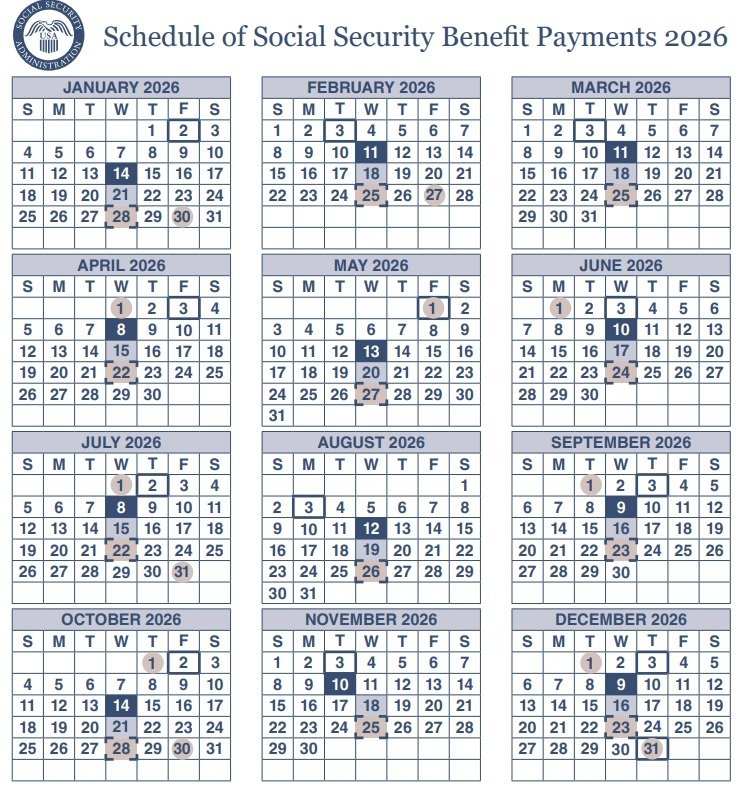
Most Social Security recipients are paid on a Wednesday based on birth date. People who started benefits before May 1997, or who receive both Social Security and SSI, are paid on the 3rd of the month. SSI is paid on the 1st. The dates below follow that rule, so confirm your own date in your award letter or my Social Security account.
December 2026
- December 1: SSI
- December 3: benefits paid on the 3rd
- December 9, 16 and 23: birth dates on the 1st–10th, 11th–20th and 21st–31st, respectively
- December 31: SSI payment for January 2027
January 2027
- The payments for the 3rd-of-month group and for SSI both move to Thursday, December 31, 2026, because January 3 is a Sunday and January 1 is a federal holiday.
- January 13, 20 and 27: birth-date groups, in the same order as above
If your payment does not arrive on the expected date, SSA says to allow three additional mailing days before contacting them.
Medicare: The Piece Still Pending
Medicare Part B premiums are usually deducted from Social Security benefits, so they affect your net check. CMS has historically published them in the fall, and the 2026 figures came out on November 14, 2025.
For reference, the 2026 standard Part B premium is $202.90 per month and the deductible is $283. Projections in the 2026 Medicare Trustees Report put the 2027 premium near $209.50, but that is an estimate, not a confirmed rate. If the final premium lands close to that projection, the increase would absorb roughly $6.60 of the average retiree’s $75 raise (my arithmetic). Wait for the official figure before budgeting around it.
SSA says Medicare enrollees can see their 2027 premium amount in the my Social Security Message Center starting in late November. Medicare open enrollment runs through December 7, so use that window to review your plan.
What Beneficiaries Should Do Now?
Create or check your my Social Security account. SSA says people who are not enrolled in paperless notices will get their COLA notice by mail in December. With an online account, you can read your notice in the Message Center beginning in late November.

Check your net amount, not just the gross. The notice shows your new benefit after Medicare and other deductions. Compare it with your budget.
If you work and collect early benefits, recalculate your earnings. Use the new $25,560 or $67,920 limit, and update SSA if your expected earnings changed.
Verify your direct deposit details. Federal benefit payments must be made electronically with few exceptions. Confirm your bank information is current, especially around the December 31 payment shift.
Review your Medicare coverage before December 7. Premiums, deductibles and plan benefits can change. If your income is higher, ask whether the income-related adjustment applies and how to request a review.
Watch for scams. SSA has warned that scammers try to profit from the COLA announcement. Beneficiaries do not need to pay a fee or provide personal data to receive the increase. Do not respond to calls, texts or emails demanding payment or personal information to “unlock” your raise. Report suspected fraud to the Office of the Inspector General.
Official Sources
| Topic | Link |
| 3.6% COLA announcement | https://www.ssa.gov/news/en/press/releases/2026-10-14.html |
| All 2027 limits and averages | https://www.ssa.gov/news/en/cola/factsheets/2027.html |
| COLA information hub | https://www.ssa.gov/cola |
| COLA data and history | https://www.ssa.gov/oact/cola/index.html |
| Federal Register notice | https://public-inspection.federalregister.gov/2026-21796.pdf |
| 2027 payment dates | https://www.ssa.gov/pubs/EN-05-10031-2027.pdf |
| Online account and notices | https://www.ssa.gov/myaccount |
| Full retirement age | https://www.ssa.gov/benefits/retirement/planner/ageincrease.html |
| SSI program | https://www.ssa.gov/ssi |
| Medicare and Part D Extra Help | https://www.ssa.gov/medicare |
| Lower your IRMAA | https://www.ssa.gov/medicare/lower-irmaa |
| Report fraud | https://oig.ssa.gov/report |
| Find an office | https://www.ssa.gov/locator |
| Primary Source | https://www.ssa.gov/news/en/cola/factsheets/2027.html |
Frequently Asked Questions
Is the 3.6% COLA for 2026 or 2027?
It is for 2027. It was announced October 14, 2026, and appears in payments beginning in January 2027. The 2026 COLA was 2.8%.
Do I have to apply for the increase?
No. It is automatic for Social Security and SSI recipients. Anyone asking for a fee or personal information to process it is running a scam.
How much will my benefit go up?
Multiply your current benefit by 0.036. The average retired worker’s benefit rises from $2,095 to $2,170, about $75 per month.
When will I find out my exact new amount?
SSA says online account holders can see notices in the Message Center in late November, and mailed notices go out in December.
Why might my raise look smaller than 3.6%?
Medicare Part B and other deductions come out of your gross benefit. The official 2027 Part B premium was not confirmed in the sources.
What is the 2027 limit if I work before full retirement age?
$25,560 per year ($2,130 per month). SSA withholds $1 for every $2 above it. In the year you reach full retirement age, the limit is $67,920, with $1 withheld for every $3 above it.
Does the earnings test apply after full retirement age?
No. There is no limit from the month you reach full retirement age.
What is the new maximum taxable earnings amount?
$192,300, up from $184,500. Medicare tax has no cap.

6 thoughts on “Social Security 2027: 3.6% COLA Explained”