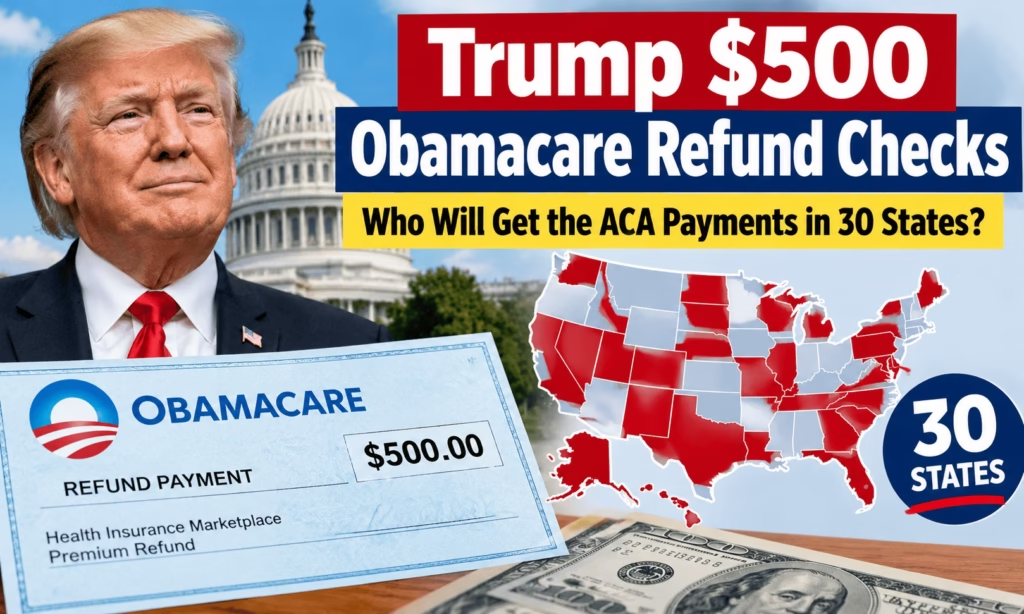
The Trump ACA refund checks began going, and an administration official says more than 950,000 people in 30 states are on the list. Each person gets $500, by paper check or direct deposit, along with a letter signed by the president that blames the Biden administration for overcharging marketplace users. Treasury is sending the money, and some families with more than one affected person will receive more than one payment. There is no form to fill out. The White House says the people who qualify have already been identified, and it describes them mainly as HealthCare.gov customers who paid full price for coverage with no premium subsidy. Whether you are on that list depends heavily on where you live and how you bought your plan. We’ll be updating this article monthly.
The timing is hard to ignore. The checks are landing about five weeks before the November midterm elections, at a moment when health costs are a top worry for voters. Enhanced premium subsidies expired at the end of 2025, and many enrollees now pay thousands of dollars more per year. The administration calls the $500 a return of surplus marketplace fees. Health policy experts say the accounting is more complicated than that, and KFF’s Cynthia Cox says she knows of no precedent for handing marketplace fee revenue back to consumers this way. This report explains who qualifies, which states are included, how the money moves, what we still do not know, and where to verify any payment. We also built a short eligibility checker you can use below.
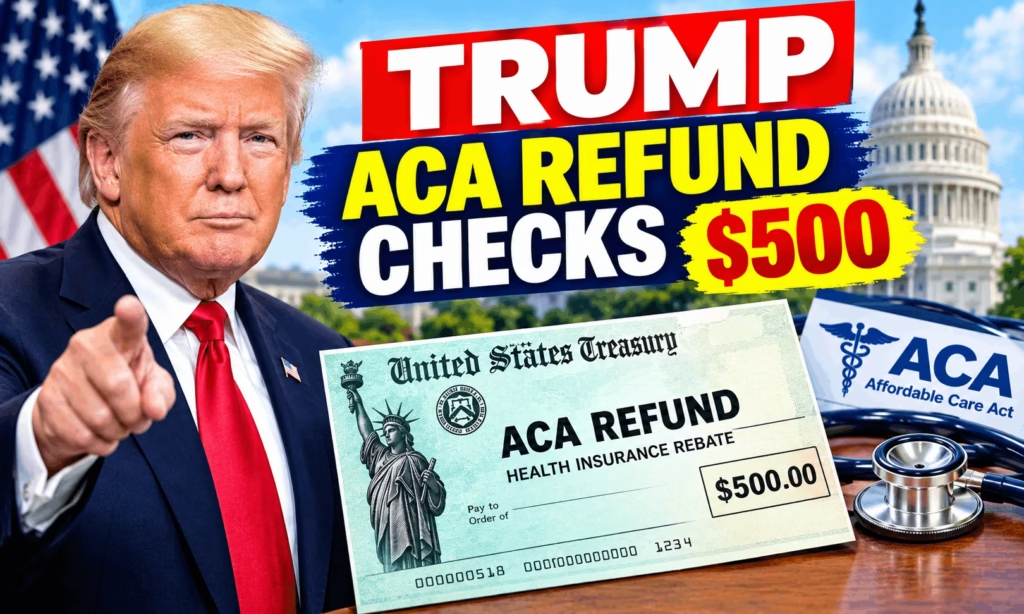
Trump ACA Refund Checks Key Highlights
| Item | Detail |
|---|---|
| Amount | $500 per eligible person |
| Announced | September 10, 2026, in a video and at the Republican midterm convention in Dallas |
| First payments sent | Wednesday, September 30, 2026 |
| Official timeline | White House says checks go out beginning in October 2026 |
| Number of people | More than 950,000, described as nearly 1 million |
| States covered | 30 states that use the federal HealthCare.gov exchange |
| Who sends the money | U.S. Treasury Department |
| Payment method | Check or direct deposit, with a letter |
| Application required | No |
| Estimated total cost | Roughly $500 million, per press estimates |
| 2026 federal exchange user fee | 2.5% of monthly premiums |
| 2025 federal exchange user fee | 1.5% of monthly premiums |
Who Qualifies for the $500 ACA Refund Check?
According to the White House fact sheet, the refunds go to Americans who do not receive premium assistance under the Affordable Care Act and who live in a state that uses the federal exchange. In plain terms, the core group looks like this:
- You bought your plan through HealthCare.gov.
- You live in one of the 30 listed states.
- You paid the full cost of your premium, with no premium tax credit applied.
The administration’s reasoning is that people who receive subsidies are shielded from higher premiums, because the government absorbs most of the increase. People who pay the entire premium themselves feel every dollar of any fee that an insurer builds into its prices.
The picture is not perfectly tidy. A White House official told CNBC that most recipients lost all federal assistance when the enhanced subsidies disappeared this year, but that some people with incomes between 100 percent and 400 percent of the poverty line will also be paid. The White House has said most recipients earn at or around 400 percent of the poverty line, which it put at about $64,000 for a single person and $132,000 for a family of four. Because the full eligibility list has not been published, you cannot rule yourself out based on income alone.
2027 Social Security COLA: Official Announcement and What It Means for Your Check
Which 30 States Are Getting ACA Refund Checks?
The White House named the states that rely on the federal exchange for the operation of their markets. They are Alabama, Alaska, Arizona, Arkansas, Delaware, Florida, Hawaii, Indiana, Iowa, Kansas, Louisiana, Michigan, Mississippi, Missouri, Montana, Nebraska, New Hampshire, North Carolina, North Dakota, Ohio, Oklahoma, Oregon, South Carolina, South Dakota, Tennessee, Texas, Utah, West Virginia, Wisconsin and Wyoming.
People in the other 20 states are not part of this round, because those places run their own exchanges and the federal government did not collect user fees from them in the same way.
The White House also released state counts for the largest groups.
| State | People expected to receive $500 |
|---|---|
| Texas | About 139,000 |
| Florida | About 127,900 |
| Ohio | About 65,700 |
| North Carolina | About 58,200 |
| Wisconsin | About 56,200 |
| Michigan | About 55,100 |
Those six states alone account for roughly half a million of the 950,000 payments.
Who Does Not Qualify for the $500 ACA Refund?
Several large groups are left out, and it helps to know them before you spend time hunting for a check.
People on a state-run exchange are outside the program, even if they paid full price. People covered by an employer, Medicare or Medicaid are not part of it, since those programs do not use the marketplace. Subsidized enrollees are mostly excluded, although officials have said some may be paid. Anyone who dropped coverage after the subsidies expired is also unlikely to receive anything. KFF has found that marketplace enrollment has fallen by nearly 3 million people since 2025, and press reports indicate those who left will not get refunds.
Finally, an enrollee in a listed state who bought a plan off the marketplace directly from an insurer should not expect a payment, because the user fee in question applies to plans sold on the federal exchange.
Trump ACA Refund Check Eligibility Checker
The tool below gives a quick read on whether your household fits the group the administration has described. It does not know anything about your actual file, so treat the answer as a starting point.
$500 ACA refund eligibility checker
Answer four questions to see whether your household fits the group the White House says is receiving refund checks, and estimate the total. This is a screening tool only. Only the government decides who is paid.
Based on White House and press descriptions as of October 1, 2026. Officials have said some enrollees between 100% and 400% of the poverty line may also be paid, and the exact list is not public, so a “not likely” result is not a final answer. If a check arrives, keep the letter that comes with it.
When Will the ACA Refund Check Arrive?
The short answer is that payments started on September 30 and are expected to run through October. The White House fact sheet says checks will be sent beginning in October 2026, while an administration official told several outlets that mailing began a day earlier. No individual delivery date has been published, so two neighbours can reasonably get theirs on different days.
A few things shape when yours shows up:
- Direct deposit is generally faster than a mailed check. The letter that accompanies the payment is a paper mailing either way.
- Mail times differ by region, and Treasury batches large payment runs.
- If the address on file for your HealthCare.gov account is out of date, a check could be returned.
Because the program is new, there is also no official tracking tool at the moment. We will add one here if Treasury launches it.
Trump $500 Obamacare Refund Checks: Who Will Get the ACA Payments in 30 States?
Social Security 2027 COLA Report That Could Change Everything
How to Apply for the ACA Refund Check: No Application Needed
This part is simple, and it is where scams are most likely to creep in. The administration has not announced any application process, and officials say eligible people were already identified. You do not need to apply, sign up, pay a fee or share a bank login to receive the money.
What you can do right now is prepare:
- Sign in to your HealthCare.gov account and confirm that your mailing address and phone number are current.
- Check whether premium tax credits were applied to your 2026 coverage, since that is the main dividing line.
- Watch for a letter from the White House or Treasury in the mail, and for a $500 deposit labelled as a federal payment.
- Keep the letter. It explains the payment and may matter later if tax or reporting questions come up.
If the Marketplace Call Center is your only option, the number on HealthCare.gov is 1-800-318-2596. Be skeptical of anyone who calls you first.
ACA Refund Check Processing Time
Because there is no application, there is no processing queue in the usual sense. The work is on the government’s side, which means the wait is a mailing and banking question, not an approval question. If you believe you qualify and nothing has arrived by the end of October, give it a few more weeks before taking action, then contact the Marketplace Call Center or the office of your member of Congress. Treasury has not yet said how missing or disputed payments will be resolved, and that process remains to be announced.
ACA Refund Check Payment Schedule
| Date | What happens |
|---|---|
| September 10, 2026 | Trump announces the $500 refunds |
| September 29, 2026 | White House fact sheet updated before the mailing starts |
| September 30, 2026 | Treasury begins sending payments |
| October 2026 | Main window for checks and deposits, per the White House |
| November 1, 2026 | Open enrollment for 2027 plans begins on HealthCare.gov |
| November 3, 2026 | Midterm elections |
| Early 2027 | Possible tax guidance, if any, on how to treat the payment |
Why Is the Administration Sending $500 ACA Refund Checks?
The explanation comes down to something called the user fee. Insurers that sell plans on the federal marketplace pay the government a percentage of their premiums, and that money helps run HealthCare.gov, its call centre and the navigator groups that help people enrol. Insurers can build the cost into the prices they charge, so consumers end up paying part of it indirectly.
The White House says the Biden administration collected more than it needed and sat on the surplus. It says returning the money to people who paid full price is simply fair. It also says the president wants the government to pay people directly, so the money does not go through big insurers.
What Critics and Health Experts Say About the $500 Checks
Several health policy researchers dispute that framing, and their points are worth reading before you decide what the checks mean.
Cynthia Cox of KFF said the fee is set about a year in advance and that both the 1.5 percent rate for 2025 and the 2.5 percent rate for 2026 were finalized under the Biden administration, which expected a drop in enrollment when the pandemic-era subsidies ended. She also said a surplus can appear when the government cuts spending on marketplace activities such as enrollment help, while still collecting the fee. KFF estimated that the federal marketplace piled up about $1 billion in unspent user fees at the end of the first Trump term, so surplus balances did not begin with the last administration.
Reports citing KFF’s Larry Levitt say the fees were not a major driver of this year’s price increases. Some analysts noted that $500 exceeds what an individual actually paid in excess fees, and that a larger share of the money goes to people above the 400 percent income line. Jonathan Oberlander of the University of North Carolina told CNBC the move looks more like midterm politics than health policy. Critics have called it a gimmick, and some Democrats have used the word bribe about a separate dividend proposal.
The administration’s answer is that it has legal authority to use the money, according to White House officials quoted by The New York Times. The Associated Press reported that it is not clear whether the payments need approval from Congress. As of September 30, the public record does not lay out the full legal and accounting path from accumulated fees to individual payments. We will report any formal review or challenge as it develops.
Does $500 Cover the Premium Increase After ACA Subsidies Expired?
For most people the answer is no, and that is where the political argument sits. Trump has said in a video that the $500 would cover the premium spike in many cases. KFF’s Cox told CNN the increase could easily be $500 a month for some households.
The enhanced subsidies expired at the end of 2025 after Congress did not extend them. About 19.2 million people were enrolled in marketplace plans as of February 2026, according to federal figures, but enrolment has dropped by nearly 3 million since 2025, per KFF. The refund does not restore any subsidy, and it does not lower the price of a 2027 plan. It is a one-time payment, separate from the premium tax credit system.
Is the ACA Refund Check Taxable?
This is unresolved. Some early press coverage says that because the payment is framed as a return of fees rather than income or a benefit, it is generally not expected to arrive with a tax form such as a 1099. Other reporting says the tax treatment has not been formally announced. Until the IRS says otherwise, treat the question as open, keep the letter and the deposit record, and check IRS guidance before you file next year. If you use a paid preparer, show them the letter.
$500 ACA Refund vs the $5,000 Dividend Trump Has Talked About
People often mix the two. The $500 refund is real, it is being paid now and it is limited to a defined group in 30 states. The $5,000 dividend is a separate idea the president has said he would send to Americans if Republicans keep control of Congress after the midterms. It has not been enacted, and even some Trump allies have voiced doubt about it. Checks you receive this month are not an advance on any future dividend.
How to Spot an ACA Refund Scam
Whenever a payment makes headlines, scammers follow. The real program has no application, no fee and no need for your Social Security number, banking password or a gift card. Be wary of texts, social media posts or calls that offer to get you a refund faster for a charge. A real payment will arrive by mail or direct deposit with a letter. If you are unsure, hang up and look up the official number yourself. You can report fraud to the Federal Trade Commission.
Open Enrollment for 2027 Starts November 1
Whatever happens with the check, the bigger financial decision is next month. Open enrollment for 2027 coverage begins November 1 on HealthCare.gov. Prices and subsidy rules are different from last year, so compare plans and check what financial help you qualify for. A $500 refund will not offset a plan that costs far more than it did a year ago.
Official Links: HealthCare.gov Login, Payment and Fraud Reporting
| Resource | Use it for | Link |
|---|---|---|
| White House fact sheet | Original announcement and the list of 30 states | https://www.whitehouse.gov/fact-sheets/2026/09/fact-sheet-president-donald-j-trump-announces-the-working-families-obamacare-refunds/ |
| HealthCare.gov | Log in, update your address, check subsidy status | https://www.healthcare.gov |
| CMS | Marketplace user fee and program information | https://www.cms.gov |
| U.S. Treasury | Federal payments information | https://home.treasury.gov |
| IRS | Guidance on how to treat the payment on your return | https://www.irs.gov |
| FTC fraud reporting | Report refund scams | https://reportfraud.ftc.gov |
| KFF | Independent analysis of the marketplace | https://www.kff.org |
Trump ACA Refund Checks FAQs
Are Trump ACA refund checks real?
Yes. The White House announced them on September 10, and Treasury began sending them on September 30.
How much is the ACA refund check?
It is $500 per eligible person. A household with more than one affected person can receive more than one payment.
Who qualifies for the $500 ACA refund?
The main group is HealthCare.gov customers in 30 states who paid full premiums with no subsidy, though officials say some subsidized enrollees may also be paid.
When will the ACA refund check arrive?
Payments started September 30, and the White House says they run through October 2026. Your date depends on mail times or your bank.
Do I have to apply for the $500 ACA refund?
No. The administration says eligible people have already been identified and no application is needed.
Which states get ACA refund checks?
The 30 states are listed above, including Texas, Florida, Ohio, North Carolina, Wisconsin and Michigan.
Is the ACA refund check taxable?
That has not been formally settled. Keep your letter and watch for IRS guidance.
Why did I not get a check?
You may live in a state with its own exchange, receive subsidies, have bought off the marketplace, or not be on the government’s list.
Is the $500 Obamacare refund legitimate?
It is a federal program announced by the White House, with payments issued through Treasury. Anyone asking you to pay to receive it is not part of that program.
Will I get a letter with the check?
Officials say recipients get a letter signed by the president explaining the payment.
Can I get the refund if I have a subsidy?
Most subsidized enrollees are not expected to qualify, but an official said some people between 100 and 400 percent of the poverty line will be paid.
Do I get $500 for each family member?
The amount is $500 per eligible person, so families with more than one affected person may get multiple payments.
What if my address changed?
Update it in your HealthCare.gov account, since a check mailed to an old address may be returned.
Is this the same as the tariff refund?
No. Tariff refunds relate to a separate court fight over customs duties and have nothing to do with the marketplace refunds.
Is the $500 check the same as a stimulus payment?
No. It is described as a return of marketplace user fees, not a general stimulus or an economic impact payment.
Conclusion
The Trump ACA refund checks are real, they are rolling out now, and they are narrower than the headlines suggest. If you bought a full-price plan on HealthCare.gov in one of 30 states, a $500 payment per person may be on its way, and you do not need to do anything but watch your mail and bank account. If you are in a state-run exchange, receive subsidies or left the marketplace, the program likely does not reach you. Experts disagree about whether the money is a fair refund or a political gesture, and key questions about funding, taxes and disputed payments remain open. Keep any letter you receive, avoid anyone who charges a fee to help you collect, and prepare now for open enrollment on November 1. We’ll be updating this article as Treasury and the IRS release more guidance.
Sources and verification note: this report draws on the White House fact sheet, Reuters, USA Today, CNBC, CBS News, KFF commentary quoted by those outlets, and the Associated Press. State counts, the roughly $500 million total and the income figures come from the White House or press accounts and have not been independently verified. This article is general information, not tax, legal or financial advice.
2027 COLA Increase Announcement Date, Estimated Raise, Payment Schedule & Calculator