
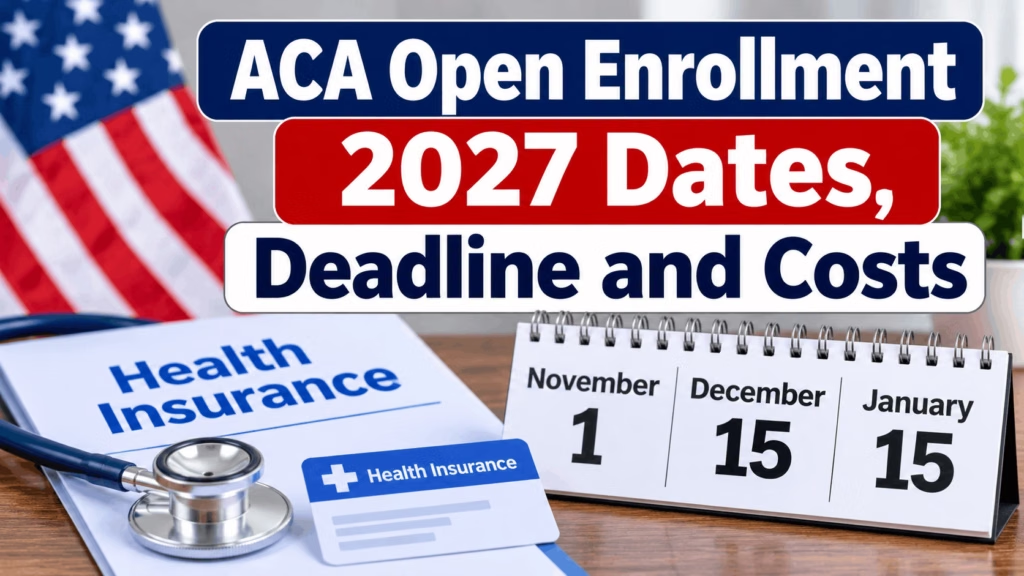
ACA open enrollment 2027 on HealthCare.gov runs from November 1, 2026 to January 15, 2027, but you must pick a plan by December 15, 2026 for coverage that starts January 1. Plans chosen between December 16 and January 15 start February 1. Benchmark premiums are up about 13 percent, the 400 percent poverty level subsidy cliff is back, and the out-of-pocket maximum rises to $12,000 for one person.
ACA open enrollment 2027 is already underway, and this year the calendar matters as much as the price. HealthCare.gov opened on November 1 and stays open through January 15, 2027, but the date that protects you from a gap in coverage is December 15. Pick a plan and pay your first premium by then and your new coverage begins on January 1. Wait until the last week of December or January and your start date slips to February 1. The window is not shorter than it looks, but the cost of waiting is real.
The enhanced premium tax credits that held down costs from 2021 through 2025 are gone, Congress has not revived them, and the benchmark Silver plan is rising roughly 13 percent for 2027 after a jump of about 26 percent last year. The subsidy cliff at 400 percent of the federal poverty level is back, which means a single person earning more than $63,840 gets no tax credit at all. Below are the dates, the numbers, a free estimator, and the steps to enroll. We’ll be updating this article monthly.
ACA Open Enrollment 2027 Key Dates and Highlights
| Item | Detail |
|---|---|
| Open enrollment begins | Sunday, November 1, 2026 |
| Deadline for January 1, 2027 coverage | Tuesday, December 15, 2026 |
| Medicare annual enrollment (separate) | October 15 to December 7, 2026 |
| Open enrollment ends on HealthCare.gov | Friday, January 15, 2027 |
| Coverage start if you enroll December 16 to January 15 | February 1, 2027 |
| Special enrollment window after a life event | 60 days |
| Out-of-pocket maximum, individual | $12,000 (up from $10,600) |
| Out-of-pocket maximum, family | $24,000 (up from $21,200) |
| Average benchmark premium change | Up about 13% |
| Subsidy cliff, single person | $63,840 (400% FPL) |
| Subsidy cliff, family of four | $132,000 |
| Expected contribution range | 2.15% to 10.22% of income |
Is the ACA Open Enrollment Deadline December 15 or January 15?
This is the question causing the most confusion, so here is the short version. A federal rule finalized in 2025 would have ended HealthCare.gov enrollment on December 15 and capped state exchanges at December 31. A federal court ruling in June 2026 struck that change down, and CMS then stated on August 4, 2026 that HealthCare.gov open enrollment for 2027 runs November 1 through January 15.
Some websites still print December 15 as the end of enrollment. That date is real, but it is the cutoff for a January 1 start, not the last day to sign up. State-based exchanges set their own calendars, and a number of them run into late January, so check your state’s marketplace if you do not use HealthCare.gov. Because the legal situation changed during the year, confirm the dates on HealthCare.gov before you rely on any article, including this one.
The practical advice is simple: treat December 15 as your deadline. It costs nothing to finish early and it removes the risk of a gap in January.
What Changed for 2027 Health Insurance?
Three changes drive most of what you will pay.
First, premiums rose again. Insurers proposed a median increase of about 15 percent for 2027, and KFF reports that the average benchmark Silver premium is up about 13 percent. Increases vary widely by state, from roughly 3 percent in Vermont to nearly 28 percent in Arizona, according to healthinsurance.org’s analysis of weighted averages.
Second, subsidies are smaller and stricter. The enhanced credits expired on December 31, 2025. The 400 percent poverty line cliff is back, expected contributions start at 2.15 percent of income and reach 10.22 percent, and there is no cap on how much of an excess credit you must repay at tax time.
Third, out-of-pocket limits climbed. The federal maximum is $12,000 for an individual and $24,000 for a family. A rule that would have let some Bronze plans go as high as $15,600 was stayed by a court in July, so $12,000 is the highest you should see for a single person in 2027.
Subsidy Cliff 2027: Income Limits for ACA Tax Credits
Premium tax credits for 2027 coverage are based on 2026 federal poverty guidelines. If your household income is above 400 percent of the poverty level, you receive no credit.
| Household size | 100% FPL | 400% FPL (cliff) |
|---|---|---|
| 1 | $15,960 | $63,840 |
| 2 | $21,640 | $86,560 |
| 3 | $27,320 | $109,280 |
| 4 | $33,000 | $132,000 |
These figures are for the 48 states and D.C. Alaska and Hawaii use higher thresholds. Crossing the line by even a dollar can cost thousands in lost help, so people near the cliff should look at ways to lower their modified adjusted gross income, such as pre-tax retirement or health savings account contributions, before they file their estimate.
ACA Subsidy Calculator for 2027
ACA 2027 Premium Tax Credit Estimator
Estimate for the 48 states and D.C. Uses 2026 federal poverty guidelines (the basis for 2027 coverage) and the 400% FPL cliff. Estimate only.
The estimator that goes with this article does the math for a typical household. Choose your household size, enter your expected 2027 modified adjusted gross income, and type in the monthly premium of the second-lowest-cost Silver plan that HealthCare.gov shows for you. It estimates your income as a percentage of the poverty level, applies the 2027 expected contribution and shows your estimated monthly tax credit. If you add the price of the plan you want, it also shows what you would pay after the credit.
Here is a worked example. A single person earns $45,000, which is about 282 percent of the poverty level. The expected contribution is roughly 9.8 percent of income, or about $367 a month. If the benchmark plan costs $600 a month, the credit is about $233, and a plan priced at $500 would cost about $267 after the credit.
The estimate is a guide. HealthCare.gov calculates your real credit when you apply, and it depends on your location, ages and the plans in your county.
Who Qualifies for ACA Marketplace Coverage in 2027?
You can generally buy a Marketplace plan if you live in the United States, are not incarcerated and are a citizen, national or lawfully present immigrant. Two eligibility changes are worth noting for 2027. Starting January 1, 2027, only certain immigration statuses qualify for premium tax credits, so some lawfully present immigrants who received help before will lose it. If this applies to you, check HealthCare.gov or your state exchange for the current list.
You may also qualify for Medicaid or the Children’s Health Insurance Program instead. In states that expanded Medicaid, adults with income up to 138 percent of the poverty level are generally eligible, and children can qualify at higher income levels. HealthCare.gov will route you to the right program when you apply.
Employer coverage matters too. If your job offers affordable coverage that meets minimum standards, you generally cannot get a premium tax credit for a Marketplace plan.
How to Enroll in ACA Open Enrollment 2027?
You can apply online, by phone or with a navigator. Here is the process on HealthCare.gov.
- Create an account or log in at HealthCare.gov. Returning users should update their application before they look at plans.
- Enter your household and income information. Use your best estimate for 2027 income, not last year’s, because it sets your subsidy.
- Review your eligibility results, including any premium tax credit or Medicaid referral.
- Compare plans. Look at the premium, the deductible, the out-of-pocket maximum, your doctors and your prescriptions.
- Select a plan and submit your enrollment.
- Pay your first premium to the insurer. Coverage is not active until you do.
Do not rely on auto-renewal. If you do nothing, many people are moved into a similar plan, but the price, network and subsidy can change, and your income information may be out of date. In a year with large premium shifts, window shopping can save real money.
ACA Enrollment Processing Time and When Coverage Starts
After you pick a plan, the Marketplace sends your enrollment to the insurer, and the insurer sends a bill for the first premium. Coverage begins on the start date only after that payment is received.
| When you enroll | Coverage starts |
|---|---|
| November 1 to December 15, 2026 | January 1, 2027 |
| December 16, 2026 to January 15, 2027 | February 1, 2027 |
The Marketplace may ask you to confirm your identity, income or immigration status. If you get a request for documents, answer quickly, because delays can put your subsidy or your coverage at risk. Most people see their confirmation within a short time, but the date that decides your start is the date you pick the plan and pay, not the day the paperwork clears.
ACA Premium Payment Schedule and Grace Periods
Your first premium is due to the insurer, usually shortly after you enroll, and ongoing premiums are due monthly. If you receive an advance premium tax credit, it is paid directly to your insurer each month, so you pay only the remaining amount.
If you miss a payment while receiving an advance tax credit, you generally have a three-month grace period, though the insurer may hold claims after the first month. Without a subsidy, the grace period is usually much shorter and depends on state law. Missing payments can end coverage, so set up automatic payments if you can.
At tax time, you reconcile the advance credit using Form 8962. Because there is no repayment cap for 2027, an inaccurate income estimate can create a large bill. Update your Marketplace application whenever your income or household changes.
Special Enrollment Period: What If You Miss the Deadline?
If you miss open enrollment, you can generally sign up only if you have a qualifying life event. Common examples are losing other coverage, moving to a new area, getting married, having a baby or adopting a child. You usually have 60 days from the event to enroll. Losing coverage because you did not pay your premium does not count. If you are eligible for Medicaid or CHIP, you can usually apply at any time of the year.
ACA Open Enrollment vs Medicare Open Enrollment
The two programs have different calendars. Medicare’s annual enrollment period runs October 15 through December 7, and it closes before ACA open enrollment does. If you are turning 65, you have a separate initial enrollment period around your birthday. Medicare enrollees generally cannot buy a Marketplace plan with subsidies, so do not confuse the two systems.
Official ACA Open Enrollment Resources
| Resource | Use it for | Link |
|---|---|---|
| HealthCare.gov | Apply, login, registration, plan comparison | https://www.healthcare.gov |
| HealthCare.gov dates and deadlines | Official open enrollment dates | https://www.healthcare.gov/quick-guide/dates-and-deadlines/ |
| Find local help | Navigators, agents and assisters | https://localhelp.healthcare.gov |
| Marketplace call center | Enrollment help | 1-800-318-2596 |
| Medicare.gov | Medicare enrollment and plans | https://www.medicare.gov |
| IRS Form 8962 | Reconciling premium tax credits | https://www.irs.gov/forms-pubs/about-form-8962 |
| CMS Marketplace information | Official announcements | https://www.cms.gov/marketplace |
| State exchange directory | Find your state marketplace | https://www.healthcare.gov/marketplace-in-your-state/ |
ACA Open Enrollment 2027 FAQs
When does ACA open enrollment 2027 end?
On HealthCare.gov it ends January 15, 2027. You should enroll by December 15, 2026 for coverage that starts January 1.
What is the deadline for January 1 coverage?
December 15, 2026. After that, coverage starts February 1.
Are ACA premiums going up in 2027?
Yes. Benchmark Silver premiums are up about 13 percent on average, and the median proposed increase was about 15 percent. Increases vary by state.
Did the enhanced ACA subsidies expire?
Yes. They ended after 2025 and Congress has not extended them. The 400 percent poverty level cliff is back.
What is the maximum out-of-pocket cost in 2027?
$12,000 for an individual and $24,000 for a family.
Do I need to reenroll for 2027?
You can let your plan renew, but you should review it. Prices, networks and subsidies can change, and you may find a cheaper plan.
Can I enroll after the deadline?
Only with a qualifying life event, such as losing coverage, moving, marriage or a new baby. You generally have 60 days.
Do state marketplaces have the same dates?
Not always. State exchanges set their own schedules, and some run later than HealthCare.gov.
Is open enrollment ending December 15 or January 15?
For HealthCare.gov, it ends January 15, 2027, after a court vacated the rule that would have moved it to December 15. December 15 is the cutoff for a January 1 start.
How much will health insurance cost in 2027?
It depends on your income, age and location. Average premiums are higher, and a subsidy can offset some of that. Use the calculator above for a quick estimate and HealthCare.gov for your real price.
What happens if I miss ACA open enrollment?
You may have to go without Marketplace coverage until the next open enrollment unless you qualify for a special enrollment period.
Who qualifies for ACA subsidies in 2027?
People with household income from 100 percent to 400 percent of the federal poverty level who are not eligible for Medicaid or affordable employer coverage and who meet immigration rules.
What is the subsidy cliff?
It is the income limit above which you get no premium tax credit. For 2027 it is 400 percent of the poverty level, or $63,840 for a single person.
Conclusion
ACA open enrollment 2027 runs through January 15, 2027 on HealthCare.gov, but December 15 is the date to remember if you want coverage on January 1. Costs are higher, subsidies are smaller and the 400 percent cliff is back, so reviewing your plan matters more than ever. Update your income estimate, use the calculator to see what to expect, compare at least a few plans and pay your first premium on time. Confirm all dates on HealthCare.gov or your state exchange before you act, because rules and calendars can change. We’ll be updating this article monthly.
