
Government Shutdown Coming in December 2026: For millions of Americans, the words “Government Shutdown” are no longer an abstract political phrase. Federal workers, military families, retirees, travelers and small businesses have all lived through repeated funding fights over the past year.
The first 2026 shutdown ran from January 31 to February 3, and a second, much longer one lasted from February 14 to April 30. With the midterm elections now over and a new deadline approaching fast, one question is back at the top of the news: will it happen again in December?
The answer is not simple. Nothing is shut down today, and the government is funded in full. H.R. 6500 became P.L. 119-103 on September 2, 2026, and funds agencies through December 11. If nothing passes by then, a lapse would begin on December 12.
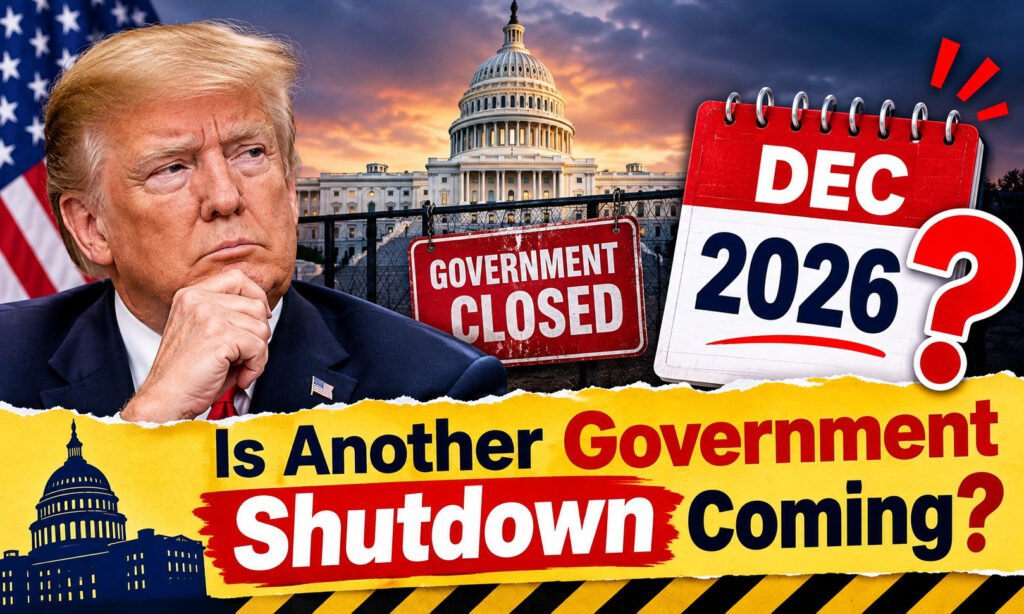
Government Shutdown Coming in December 2026
What makes this deadline different is the timing. Democrats won control of both the House and the Senate in November, but Republicans stay in charge until the next Congress is seated in January. That leaves a lame-duck Congress, some of whose members are on their way out, with only a few working weeks to settle a disagreement over defense spending, health programs and the overall budget.
In this article (Government Shutdown in Dec 2026), we cover where funding stands today, why a shutdown is possible, what could stop one, and what a lapse would mean for Social Security, federal paychecks and other payments. You will also find the key dates, a table of official sources you can check yourself, and answers to the most common questions
Where things stand today?
Federal agencies are fully funded. The continuing resolution (CR) covers all 12 regular appropriations bills from October 1, 2026. The vote history shows how little appetite there was for a shutdown before the election:
- The Senate passed the bill 90–6 in August.
- The House concurred 370–48 on September 1.
- President Trump signed it on Wednesday, September 2, 2026.
The stopgap generally keeps funding at roughly fiscal year 2026 levels. The real work was pushed past Election Day. None of the 12 FY2027 spending bills has become law, and the Senate has not reported one.
What changed after the November 3 midterms?
The politics have shifted. Democrats won control of both the House and the Senate, but Republicans stay in charge until the next Congress is seated in January. Congress returns on November 9 for a lame-duck session expected to run until Christmas, with a Thanksgiving break in between. That leaves only a few full working weeks before December 11.
Reporting also says Democrats denied a potential win to Senator Susan Collins, the Appropriations chair, who lost her reelection bid.
Why a Government Shutdown is possible?
1. The defense topline. The main fight is over defense. The Trump administration wants a record $1.5 trillion, which Senate Democrats reject.
2. Not enough time. House Appropriations Chairman Tom Cole has said the time before the deadline is not enough to finish full-year bills, which raises the odds of another stopgap. Earlier, on September 1, he predicted either a yearlong stopgap in December or a shutdown.
3. The Senate math. Funding would need Democratic votes in the Senate, and the Senate had passed none of the 12 bills as of November 3. Democrats are about to gain power, so they have less reason to accept a deal they dislike.
4. A crowded agenda. Republicans are also weighing a debt-limit increase before Democrats take over. Reports say the debt limit could be reached as soon as February 2027. Judicial nominees, the defense authorization bill and permitting reform compete for the same floor time.
5. Health programs. Any health care legislation this year would almost certainly have to ride on a government funding bill.
Why a Government Shutdown is not certain?
There are three realistic outcomes.
| Scenario | What happens? | Government Shutdown? |
| Another short CR | Funding extended into early 2027, so the new Democratic Congress negotiates | No |
| Full-year CR | Current levels continue through September 2027 | No |
| Omnibus or minibus bills | Full-year spending bills pass | No |
| No agreement by Dec 11 | Funding lapses from Dec 12 | Yes (full or partial) |
Both parties have reasons to avoid a lapse. A short extension lets Republicans hand the hard fight to the new Congress, and lets Democrats negotiate from a stronger position in January.
A private forecasting site, The Political Group, put the chance of a Government Shutdown starting between December 12 and December 31 at roughly one in four. Its page says 24 percent in the body text. Its headline says 27%, and the page was published about 25 days before this article (Government Shutdown). Treat it as a rough estimate, not an official number. The odds will move as the lame-duck talks develop.
2026 has been a Government Shutdown year
Government Shutdown is not a hypothetical this year. The first 2026 Government Shutdown ran from January 31 to February 3 (4 days). The second ran from February 14 to April 30 (76 days), and the DHS shutdown ended when the President signed a funding bill. The fall 2025 shutdown began when government funding expired on October 1, 2025. Failing to replace the stopgap would trigger the fourth shutdown of Trump’s second term.
What a Government Shutdown would mean for payments?
This section matters most for readers who rely on federal money. These are the general rules from past shutdowns. Check each agency’s contingency plan if a lapse looks likely.
Social Security and SSI. The Social Security Administration continues to process and mail checks, and much of that process is automated. Services are slower: SSA suspends many non-critical services, including benefit verification requests, earnings record corrections and overpayment processing.
Federal employee pay. Since 2019, all essential and nonessential federal employees are guaranteed retroactive back pay once funding resumes, but federal contractors are not. Paychecks are still interrupted, and excepted employees work without pay until the government reopens. Military pay is a key reason Congress tends to act: servicemembers do not receive pay during a shutdown but get retroactive pay afterwards.
Federal retirees. OPM pension payments continue, because federal retirement payments are mandatory spending like Social Security.
SNAP and WIC. This is the least predictable area. How long benefits last depends on USDA contingency funds and its decisions at the time, and a December lapse would pose that question again. Watch USDA announcements closely.
Mail, taxes and travel. The Postal Service is not affected. IRS operations continue during a shutdown. Air traffic control and TSA staff are essential workers who work without pay, so staffing strain tends to show up in airports if a lapse drags on.
Key Dates to watch
| Date | Event |
| Nov 9, 2026 | Congress returns for the lame-duck session |
| Nov 26, 2026 | Thanksgiving, with a break in the calendar |
| Dec 9, 2026 | Next FOMC meeting (per GOV.HOUSE’s calendar bar) |
| Dec 11, 2026 (Fri) | Stopgap funding expires at end of day |
| Dec 12, 2026 (Sat) | First possible day of a funding lapse |
| Dec 31, 2026 | Community Health Center Fund due to expire (per a secondary source) |
| Jan 3, 2027 | New Congress sworn in |
Official sources and links
| Topic | Source | Link |
| Bill signing, H.R. 6500 | The White House | https://www.whitehouse.gov/briefings-statements/2026/09/congressional-bill-h-r-6500/ |
| Funding law text (P.L. 119-103) | GovInfo (U.S. Government Publishing Office) | https://www.govinfo.gov (search “Public Law 119-103”) |
| Bill status and votes | Congress.gov | https://www.congress.gov (search “H.R. 6500”) |
| House roll call 286 | Clerk of the U.S. House | https://clerk.house.gov |
| CR analysis, report R49353 | Congressional Research Service | https://crsreports.congress.gov (search “R49353”) |
| Federal employee shutdown guidance | OPM | https://www.opm.gov/policy-data-oversight/pay-leave/furlough-guidance/ |
| Social Security during a shutdown | SSA | https://www.ssa.gov/agency/emergency/ |
| Agency contingency plans | OMB and agency sites | https://www.whitehouse.gov/omb/ |
| SNAP and WIC updates | USDA | https://www.usda.gov |
FAQ’s on Government Shutdown 2026
Is the US government shut down right now?
No. Agencies are funded through December 11, 2026 under P.L. 119-103.
When is the next Government Shutdown deadline?
Funding expires at the end of Friday, December 11, 2026. A lapse would begin on Saturday, December 12.
Will there be a Government Shutdown in December 2026?
It is not certain. A Government Shutdown happens only if Congress and the President fail to enact new funding or another extension by December 11. Another stopgap is a very real possibility, and Chairman Cole has said there may not be enough time for full-year bills.
Why was the deadline set for December 11?
It falls about five weeks after the November 3 midterms, so the lame-duck Congress, not the campaign-season Congress, decides the outcome.
Who controls Congress during the deadline?
Republicans, until the new Congress is sworn in on January 3, 2027. Democrats won both chambers in November, but they cannot act until then.
Will Social Security checks stop in a Government Shutdown?
No. Benefits continue, but SSA suspends many non-critical services, so some requests and corrections are slower.
Will federal employees get paid?
They receive back pay after the shutdown ends under the 2019 law, but paychecks are delayed during the lapse. Contractors are not guaranteed back pay.
Will SNAP benefits continue?
It depends on USDA contingency funds and decisions at the time, so check USDA for updates if a lapse becomes likely.
What is a continuing resolution (CR)?
A temporary law that keeps agencies funded at existing levels when the regular annual spending bills are not finished.
Could the shutdown be partial?
Yes. A lapse can affect only some departments or agencies, depending on which funding has expired.
Where can I check the status safely?
Use Congress.gov for votes, the White House and OMB for official statements, OPM for employee guidance, and SSA and USDA for benefit updates.
