
Medicare Part D 2027: For more than 60 million people on Medicare, prescription drug coverage under Medicare Part D becomes the biggest decision of the fall. The 2027 plan year brings changes to what you pay, what plans charge and which drugs get cheaper, and there is a lot of confusion about what the headline numbers mean.
In its April 2026 Rate Announcement, CMS set the 2027 standard deductible at $700, up from $615, and the annual out-of-pocket cap at $2,400, up from $2,100.
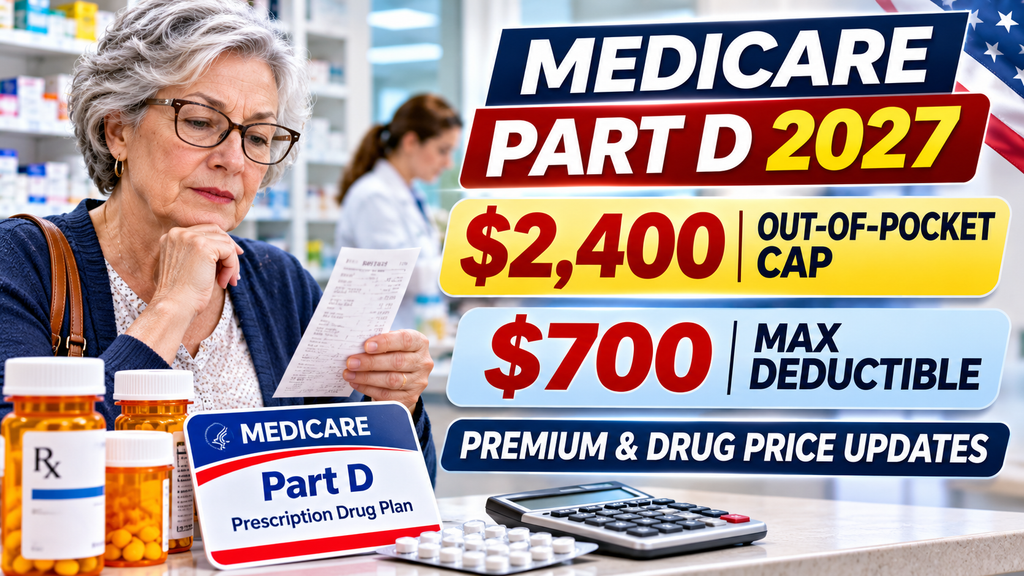
Medicare Part D 2027
On July 28, 2026, CMS announced a base beneficiary premium of $41.33 and confirmed that the Part D Premium Stabilization Demonstration will end after 2026. On September 28, 2026, CMS released the 2027 plan landscape, projecting the average standalone Part D premium at $36 per month. Meanwhile, the second round of Medicare’s negotiated drug prices takes effect on January 1, 2027, covering popular drugs such as Ozempic, Wegovy and Rybelsus. The most urgent point is timing.
Open Enrollment runs from October 15 to December 7, 2026, so as of today you have roughly 25 days left to review and change your plan. This article brings all of these changes together in one place, with official source links and FAQs to help you make a confident decision.
The 2027 Part D Numbers at a Glance
According to the CMS CY 2027 Rate Announcement (April 6, 2026), the standard benefit deductible is $700 and the annual out-of-pocket threshold is $2,400. Here is how that compares with 2026:
| Part D item | 2026 | 2027 | Change |
| Maximum standard deductible | $615 | $700 | +$85 (+13.8%) |
| Annual out-of-pocket threshold (cap) | $2,100 | $2,400 | +$300 (+14.3%) |
| Coinsurance after the deductible | 25% | 25% | No change |
| Cost for covered drugs after reaching the cap | $0 | $0 | No change |
| Covered insulin (one month’s supply) | $35 max | $35 max | No change |
An important caveat: these are the standard benefit numbers. Plans are not required to use this exact design. Some plans have a lower deductible, and some have none at all, so your plan’s actual deductible could be anywhere from $0 to $700.
How the $2,400 Cap Works?
In 2027, your Part D spending moves through three stages:
- Deductible stage: You pay the full cost of covered drugs until you reach the deductible ($700 under the standard design, or whatever your plan sets).
- Initial coverage stage: After the deductible, you pay 25% coinsurance until your out-of-pocket spending reaches $2,400.
- Catastrophic stage: Once you hit $2,400, you pay $0 for covered Part D drugs for the rest of the calendar year.
A simple example: Suppose your drug costs run very high. You first pay the $700 deductible, then 25% of each covered drug’s cost. The day your own spending reaches $2,400 in total, your covered drugs cost $0 for the rest of the year.
Two things the cap does not include:
- Premiums. Your monthly premium is not counted toward the $2,400. Your real yearly maximum is therefore your premium times 12 plus up to $2,400 in out-of-pocket drug costs.
- Drugs your plan does not cover. The cap applies only to covered Part D drugs on your plan’s formulary.
Who benefits most?
People who take very expensive medications, such as oral cancer drugs that can cost thousands of dollars a month, gain the most from the cap. People with low drug costs will care more about the premium and the deductible.
Premiums: What Changed for 2027?
Base Beneficiary Premium: $41.33
In its July 28, 2026 fact sheet, CMS set the 2027 base beneficiary premium at $41.33, up from $38.99 in 2026. That is an increase of $2.34, or 6%. The size of the increase reflects a provision of the Inflation Reduction Act (IRA) that limits annual increases in the base premium to 6% per year between 2024 and 2029.
Do not misread this number. $41.33 is not what every enrollee will pay. It is a national figure used as the starting point for calculating plan-specific premiums. Your actual premium depends on the plan you choose and can be higher or lower.
National Average Monthly Bid Amount: $296.05
The 2027 national average monthly bid amount (NAMBA) is $296.05, up from $239.27 in 2026. NAMBA is an enrollment-weighted average of plan bids for the basic benefit and is used to calculate the government subsidy paid to plans. It is also not a premium.
End of the Premium Stabilization Demonstration
CMS announced that the Part D Premium Stabilization Demonstration ends after 2026. The demonstration ran in 2025 and 2026 and gave standalone prescription drug plans extra support through a fixed-dollar reduction in the base premium and an annual dollar limit on plan premium increases. CMS says it is ending the program to return Part D to traditional market conditions in 2027.
Plan-Level Premiums (CMS Announcement of September 28, 2026)
According to CMS:
- The average total monthly premium for standalone Part D plans is projected to rise by less than $1, from $35.09 in 2026 to $36 in 2027.
- For Medicare Advantage plans that include drug coverage, the average Part D premium after rebates is projected to fall 38%, from $11.32 to $7.
- The weighted average premium across all Medicare Advantage plans is projected to fall 16.5%, from $14.37 to $12.00.
- 88% of non-low-income beneficiaries will have access to a basic Part D plan costing $10.30 or less per month.
Averages are not your bill. Independent analyses of the CMS landscape file report that there are 323 distinct standalone Part D plan offerings in 2027, down from 367 in 2026, and that the regular $0-premium standalone plan seen in 2026 no longer appears.
Extra Help (Low-Income Subsidy): People who qualify can still have a $0 premium and $0 deductible plan in 2027.
New Negotiated Drug Prices (Effective January 1, 2027)
Under the Medicare Drug Price Negotiation Program, CMS published negotiated prices for 15 more drugs in November 2025, and these take effect on January 1, 2027. They are in addition to the first 10 drugs, such as Eliquis and Jardiance, whose negotiated prices began in 2026 and continue in 2027.
Selected drugs and their 30-day negotiated prices
| Drug | Used for | 2024 list price | 2027 negotiated price | Reduction |
| Ozempic / Rybelsus / Wegovy | Diabetes, heart risk, weight | $959 | $274 | 71% |
| Ibrance | Breast cancer | $15,741 | $7,871 | 50% |
| Vraylar | Bipolar disorder, depression, schizophrenia | $1,376 | $770 | 44% |
The full list also includes Trelegy Ellipta, Xtandi, Calquence, Ofev, Linzess, Austedo, Breo Ellipta, Xifaxan, Tradjenta and Janumet, and some reports also list Pomalyst and Otezla. Drug names vary slightly between summaries, so check CMS’s official list for the exact set and prices.
Semaglutide specifics: CMS treats Ozempic, Rybelsus and Wegovy as one selected drug because they share the active ingredient. The $274 figure is a standardized 30-day price. CMS also lists package-level prices, for example $276.78 for one Ozempic 4 mg/3 mL pen and $385.63 for a box of four Wegovy 2.4 mg pens.
The biggest misunderstanding: “$274 is my copay”
It is not. The negotiated price is what Medicare pays the drugmaker for that drug. What you pay depends on your plan’s deductible, 25% coinsurance and the $2,400 cap. CMS estimates that about 5.3 million Part D beneficiaries used one of these 15 drugs in 2024, and that the negotiated prices could reduce beneficiary out-of-pocket costs by roughly $685 million in 2027 under the standard benefit. CMS also estimated that had these prices applied in 2024, Medicare would have saved about $12 billion, or around 44% of net spending on these drugs.
A caution on GLP-1 drugs: Some third-party articles mention a separate “most-favored-nation” arrangement at $245 that could supersede the $274 price for certain GLP-1 drugs.
Key Dates
| Date | What happens |
| April 6, 2026 | CMS CY 2027 Rate Announcement ($700 deductible, $2,400 cap) |
| July 28, 2026 | Base premium ($41.33) and NAMBA ($296.05) announced; Premium Stabilization Demonstration ends after 2026 |
| September 28, 2026 | CMS releases 2027 premium and landscape information |
| October 15, 2026 | Open Enrollment begins |
| December 7, 2026 | Open Enrollment ends |
| January 1, 2027 | New coverage, new deductible and cap, and 15 negotiated drug prices take effect |
| January 1 – March 31, 2027 | Medicare Advantage Open Enrollment Period |
What to Do During Open Enrollment: A Practical Checklist
- Read your Annual Notice of Change (ANOC). Your plan should have sent it, showing 2027 changes to premiums, deductibles and formulary.
- List your medications and check whether each one is on your plan’s 2027 formulary and in which tier.
- Compare plans on Medicare Plan Finder. Look at total cost, meaning premium plus deductible plus coinsurance, not just the monthly premium.
- Check your pharmacy. Preferred pharmacies can lower your costs.
- Apply for Extra Help if your income is limited.
- Mind the deadline. After December 7 you generally cannot switch plans unless you qualify for a special enrollment period, or you are in Medicare Advantage and use the January–March period.
Official Sources
| S.No | Source | What it covers | Link |
| 1 | CMS Press Release (September 2026) | 2027 Medicare Advantage and Part D premiums; $36 standalone average | CLICK HERE |
| 2 | CMS Fact Sheet (July 28, 2026) | NAMBA $296.05, base premium $41.33, end of demonstration | CLICK HERE |
| 3 | CMS CY 2027 Rate Announcement (PDF) | $700 deductible and $2,400 cap (Attachment V) | CLICK HERE |
| 4 | CMS Prescription Drug Coverage page | 2027 landscape source file with plan premiums | CLICK HERE |
| 5 | Medicare.gov | Official Part D costs and coverage information | CLICK HERE |
| 6 | Medicare Plan Finder | Compare plans by zip code and medications | CLICK HERE |
Frequently Asked Questions :-
What is the Part D out-of-pocket cap in 2027?
$2,400, up $300 from $2,100 in 2026. After you reach it, covered drugs cost $0 for the rest of the year.
What is the Part D deductible in 2027?
The standard maximum is $700 (up from $615). Plans may charge less, and some have no deductible.
Do premiums count toward the $2,400 cap?
No. Premiums are paid separately.
What does $41.33 mean? Will I pay that as my premium?
No. It is the national base beneficiary premium, a starting point for calculating plan premiums. Your actual premium depends on your plan.
What is the average Part D premium in 2027?
CMS projects the enrollment-weighted average standalone premium at $36 (up from $35.09). For Medicare Advantage plans with drug coverage, the average Part D premium is projected at $7.
What happened to the Premium Stabilization Demonstration?
It ends after 2026. CMS says the market will return to traditional conditions in 2027.
Will there be $0-premium standalone plans in 2027?
Third-party analyses of CMS data indicate regular $0 standalone plans are no longer listed, though people with Extra Help can still get $0-premium coverage. Confirm availability in your area on Plan Finder.
How many drugs get negotiated prices in 2027?
Fifteen new drugs take effect on January 1, 2027, and the first 10 drugs’ negotiated prices continue.
What is the negotiated price for Ozempic?
$274 for a 30-day supply of Ozempic, Rybelsus or Wegovy, versus a 2024 list price of $959. This is what Medicare pays, not your copay.
When does Open Enrollment end?
December 7, 2026. New coverage starts January 1, 2027.

3 thoughts on “Medicare Part D 2027: $2,400 Out-of-Pocket Cap, $700 Deductible, New Premiums and Negotiated Drug Prices”