
Social Security Raise After Medicare: The average retired worker gets about $75 more a month from the 3.6 percent 2027 cost-of-living adjustment. Medicare Part B rises $6.50 to $209.40, so the Social Security raise after Medicare is about $68.50 a month, or roughly $822 over 2027. That means most retirees keep about 91 percent of the raise.
Retirees finally have both halves of the 2027 math. The Social Security Administration announced on October 14 that benefits rise 3.6 percent in January, which lifts the average retired worker’s check from about $2,095 to $2,170, a gain of roughly $75 a month. Then, on November 17, the Centers for Medicare & Medicaid Services set the 2027 standard Part B premium at $209.40, up $6.50 from $202.90. Subtract one from the other and the typical Social Security raise after Medicare comes to about $68.50 a month. That is a very different picture from January 2026, when a $17.90 Part B jump took nearly a third of the raise. For the first time since 2023, the Part B premium is growing more slowly in percentage terms (3.2 percent) than the COLA (3.6 percent).
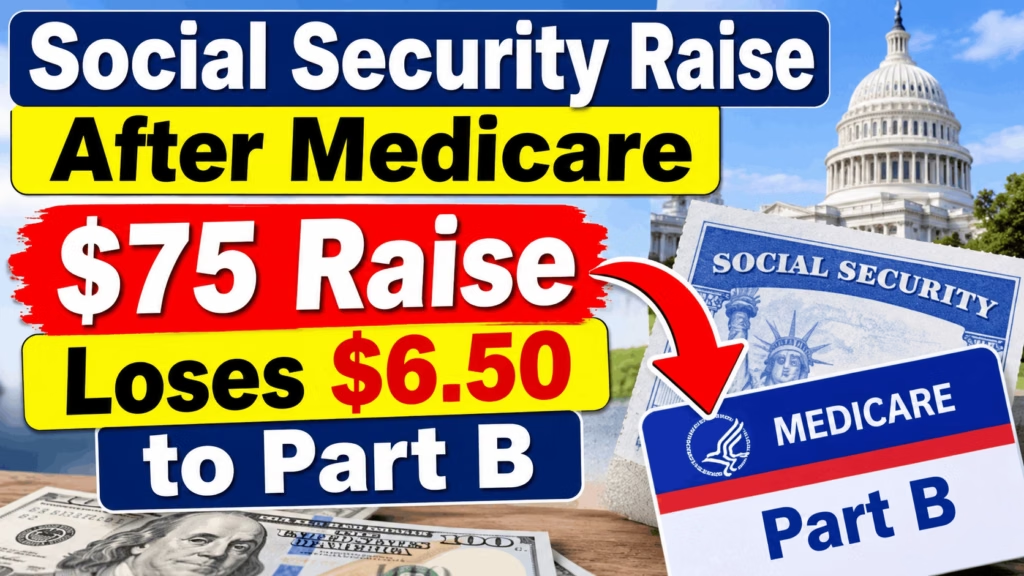
Before you build a budget around $75, keep one caution in mind. That figure is an SSA average, not a promise to every household. A retiree who gets $1,200 a month will see a raise closer to $43, and someone with a higher income may pay far more than the standard $209.40 for Part B. Your net check depends on three things: your benefit before the raise, the Part B premium that applies to you, and whether that premium is taken out of your Social Security payment at all.
2027 Social Security Raise and Medicare Part B Key Highlights
| Item | Figure | Source and date |
|---|---|---|
| 2027 COLA | 3.6 percent | SSA, October 14, 2026 |
| Average retired worker benefit | About $2,095 rising to $2,170, a gain of about $75 | SSA 2027 COLA fact sheet |
| Standard Part B premium | $209.40, up $6.50 (3.2 percent) from $202.90 | CMS, November 17, 2026 |
| Part B deductible | $292, up $9 from $283 | CMS, November 17, 2026 |
| Average net raise after Part B | About $68.50 a month, about $822 a year | Calculated from SSA and CMS figures |
| Share of the raise you keep | About 91 percent | Calculated |
| High-income surcharge starts above | $112,000 single, $224,000 joint (modified adjusted gross income) | CMS |
| First SSI payment with the raise | December 31, 2026 | SSA |
| Birthday-based payments with the raise | January 13, 20 and 27, 2027 | SSA 2027 schedule |
How Much of Your Social Security Raise Do You Keep After Medicare?
The formula is short. Multiply your monthly benefit before the raise by 3.6 percent to get your gross raise. Then subtract the increase in your Part B premium, which is $6.50 for people paying the standard amount. What is left is your net raise.
Using SSA’s own average, the gross raise is about $75, the Part B increase is $6.50, and the net raise is $68.50. Over a full year that is $900 in gross raise, $78 in extra Part B premiums, and $822 that actually reaches your bank account. Your total Part B bill for 2027 will be $2,512.80 for the year at the standard rate, compared with $2,434.80 this year.
The share Medicare takes is not the same for everyone, because the $6.50 is a flat dollar amount while the raise grows with your benefit. A smaller check gives up a bigger slice.
| Monthly benefit before raise | Gross raise at 3.6 percent | Net raise after $6.50 Part B increase | Share of raise taken by Part B |
|---|---|---|---|
| $1,000 | $36.00 | $29.50 | 18.1 percent |
| $1,500 | $54.00 | $47.50 | 12.0 percent |
| $2,000 | $72.00 | $65.50 | 9.0 percent |
| $2,095 (SSA average) | About $75 | About $68.50 | 8.7 percent |
| $2,500 | $90.00 | $83.50 | 7.2 percent |
| $3,000 | $108.00 | $101.50 | 6.0 percent |
| $4,000 | $144.00 | $137.50 | 4.5 percent |
These rows assume you pay the standard premium and it is deducted from your Social Security payment. The dollar figures come from our own arithmetic, not from SSA.
SSA also publishes estimated averages for other groups, and the Part B math changes a little for each.
| Group | Average before raise | Average after raise | Gross raise | Net raise after Part B |
|---|---|---|---|---|
| All retired workers | $2,095 | $2,170 | $75 | $68.50 |
| Aged couple, both receiving benefits | $3,238 | $3,355 | $117 | $104.00 (two Part B increases of $6.50) |
| Aged widow or widower alone | $1,936 | $2,005 | $69 | $62.50 |
| Disabled worker (average) | $1,642 | $1,701 | $59 | $52.50 |
The disabled worker figures come from SSA’s benefit effect table as reported by IBTimes, and they were based on data through August 2026. The couple and widow figures come from SSA’s 2027 fact sheet. The net column is our calculation and assumes everyone in the row pays the standard Part B premium out of their benefit.
Medicare Part B Premium 2027: $209.40 Standard Premium and $292 Deductible
CMS released the 2027 Medicare Part A and Part B amounts on November 17, and the new rates take effect on January 1, 2027. The agency said the increase in the Part B premium and deductible is mainly due to projected growth in health care spending. The standard monthly premium is $209.40, which is $6.50 more than the $202.90 paid in 2026. The annual Part B deductible rises $9 to $292.
Earlier projections were close. The 2026 Medicare Trustees Report had pointed to $209.50, so the final number came in ten cents lower. Some articles written before November 17 still quote $209.50 or a $6.60 increase. The final CMS number is $209.40 and $6.50.
Part A matters less for most people, because about 99 percent of beneficiaries have no Part A premium. For those who do, CMS set the 2027 premium at $328 a month for people with 30 to 39 quarters of coverage and $597 for people with fewer than 30. The Part A inpatient hospital deductible rises $40 to $1,776 per benefit period.
Higher earners pay more for Part B through the income-related monthly adjustment amount, known as IRMAA. CMS says about 9 percent of people with Part B pay it. The 2027 total monthly premiums for full Part B coverage are:
| Single filers (MAGI) | Joint filers (MAGI) | Total monthly Part B premium |
|---|---|---|
| $112,000 or less | $224,000 or less | $209.40 |
| Above $112,000 up to $141,000 | Above $224,000 up to $282,000 | $293.10 |
| Above $141,000 up to $177,000 | Above $282,000 up to $354,000 | $418.80 |
| Above $177,000 up to $212,000 | Above $354,000 up to $424,000 | $544.40 |
| Above $212,000 and below $500,000 | Above $424,000 and below $750,000 | $670.00 |
| $500,000 or more | $750,000 or more | $711.80 |
Married people who live together but file separate returns face a tighter schedule: $670.00 above $112,000 and below $388,000, and $711.80 at $388,000 or more. IRMAA is generally based on a tax return from two years earlier, so the 2027 bracket reflects your 2025 income unless you successfully appeal.
Medicare Advantage members should note that the Part B premium still applies when you are enrolled in an Advantage plan, unless your plan or a state program covers it.
Hold Harmless Rule 2027: Does It Protect Your Social Security Raise?
The hold harmless rule is a federal protection that stops a Part B increase from shrinking your net Social Security payment below last year’s level. It applies when the dollar increase in the premium is larger than the dollar increase in your benefit, and it only works for people whose Part B premium is deducted from their Social Security check.
In 2027 this rule will matter far less than usual. A premium increase of $6.50 only exceeds a 3.6 percent raise when the benefit before the raise is below about $180 a month ($6.50 divided by 0.036). That threshold is our own calculation, and it compares with roughly $639 in 2026, when Part B jumped $17.90 and the COLA was 2.8 percent, according to AARP. Very few retirees will fall below $180, so for nearly everyone the full $6.50 increase will come out of the January payment.
The rule does not cover people who are new to Part B, people who pay IRMAA, people whose premium is not deducted from Social Security, and people whose state Medicaid program pays the premium. SSA states that the provision does not apply if you pay an IRMAA.
Who Keeps Less Than $68.50? IRMAA, New Enrollees and Direct Payers
The $68.50 figure is a middle-of-the-road estimate. Several groups will land lower.
High earners who pay IRMAA see a larger Part B bill, and the hold harmless rule does not cushion them. A single filer in the first bracket pays $293.10 for Part B in 2027, which is $83.70 above the standard premium. Part D plans also add an income-related amount for these households, from $15.40 a month in the first bracket to $96.40 in the top one.
People turning 65 in 2027 are not protected by hold harmless, because they are new to Part B. They also will not get a COLA on a benefit they did not have in 2026, so their first check reflects their own starting benefit minus the 2027 premium.
People who pay Part B by quarterly bill, or who do not yet collect Social Security, see no deduction at all, so there is nothing to subtract from the raise. They pay the $209.40 directly.
Retirees with small checks give up the highest share, as the table above shows. Someone at $1,000 a month keeps $29.50 of a $36 raise, while someone at $3,000 keeps $101.50 of $108.
Finally, income taxes are separate. Up to 85 percent of Social Security benefits can be taxable depending on your total income, so the net raise in this article is before any federal or state income tax.
Why the 2027 Raise Beats 2026 After Medicare
The gap between this year and last year is large, and it is the main reason this January feels different.
| January 2026 | January 2027 | |
|---|---|---|
| COLA | 2.8 percent | 3.6 percent |
| Average gross raise | $56 | About $75 |
| Part B increase | $17.90 | $6.50 |
| Average net raise | $38.10 | About $68.50 |
| Share of the raise kept | About 68 percent | About 91 percent |
Part B had risen $17.90 to $202.90 in 2026 after climbing to $185 the year before. A 3.2 percent increase for 2027 is far milder. SSA’s 3.6 percent COLA is also the largest since the 8.7 percent adjustment of January 2023, and the 3.6 percent came from the average CPI-W rising from 317.265 in the third quarter of 2025 to about 328.746 in the third quarter of 2026.
A bigger raise does not mean retirees are getting ahead. A reported all-items inflation measure for the year ending in September came in at 3.7 percent, slightly above the COLA, and Medicare deductibles, Part A hospital costs and many other bills are rising too. The 2027 raise is real, but it is mostly catching up.
Social Security Payment Schedule January 2027: When the Raise Arrives
The raise applies to benefits for December 2026, which are paid in January 2027. Your Part B premium for the new year is also deducted from that first payment, so January’s deposit is the first one that shows both changes together.
| Group | Payment with the 3.6 percent raise |
|---|---|
| SSI recipients | Thursday, December 31, 2026 (January SSI paid early because January 1 is a holiday) |
| Started Social Security before May 1997, or get both Social Security and SSI | The 3rd-of-the-month group is listed for December 31, 2026 in the 2027 schedule tables we reviewed, because January 3 falls on a Sunday and January 1 is a holiday. Confirm in SSA’s published schedule |
| Birthdays on the 1st through the 10th | Wednesday, January 13, 2027 |
| Birthdays on the 11th through the 20th | Wednesday, January 20, 2027 |
| Birthdays on the 21st through the 31st | Wednesday, January 27, 2027 |
For February, the Wednesday dates are February 10, 17 and 24. SSI recipients get the 3.6 percent increase too, with the maximum federal payment rising from $994 to $1,029 for an individual and from $1,491 to $1,544 for a couple. SSA says increased SSI payments begin December 31, 2026. SSA also says nearly 72 million people will see the COLA on their Social Security benefit, and about 7.3 million receive SSI.
How to Apply for Help With Your Part B Premium?
You cannot apply to avoid the 2027 increase, but three programs can lower what you pay or protect what you keep.
First, the Medicare Savings Programs. These are run by state Medicaid offices and pay the Part B premium for people with limited income. The Qualified Medicare Beneficiary program also covers Part A premiums, deductibles and coinsurance. The Specified Low-Income Medicare Beneficiary and Qualifying Individual programs cover only the Part B premium. The federal 2026 monthly income limits listed on Medicare.gov are below, and many states set higher limits or drop the asset test. Medicare.gov still shows 2026 limits, and we did not find 2027 limits published yet, so check with your state.
| Program | Individual monthly income limit | Couple monthly income limit |
|---|---|---|
| QMB | $1,350 | $1,824 |
| SLMB | $1,616 | $2,184 |
| QI | $1,816 | $2,455 |
The 2026 resource limits are $9,950 for an individual and $14,910 for a couple. To apply, contact your state Medicaid office. The Qualifying Individual program is first come, first served and requires a new application each year.
Second, Extra Help for Part D prescription costs. People who qualify for a Medicare Savings Program generally get Extra Help automatically. Others can apply through SSA.
Third, if your income dropped because of a life-changing event such as retirement, a marriage, a divorce or the death of a spouse, you can ask SSA to reconsider an IRMAA decision using Form SSA-44. If you pay a Part B surcharge and your income has fallen, this can lower your premium.
Processing Time: How Long Each Step Takes
| Step | Timing |
|---|---|
| COLA notice | SSA says the 2027 benefit amount appears in December, through a mailed notice and your my Social Security Message Center |
| New Part B premium | Effective January 1, 2027, taken from the January payment |
| First payment with the raise | December 31 for SSI, January 13, 20 or 27 for birthday groups |
| Medicare Savings Program decision | Set by each state. In Virginia, SLMB and QI coverage starts the first of the month you apply, and Illinois lists backdating for up to three more months |
| QI program | Approved first come, first served until yearly funds run out |
| IRMAA appeal (SSA-44) | We could not confirm an official decision timeline, so ask your local office |
How to Check Your Net 2027 Social Security Payment?
Look for three numbers on your 2027 notice: your gross benefit, your Medicare Part B premium and your net payment. The net amount is what will land in your bank account. Create or sign in to your my Social Security account to see the notice online. SSA set November 18 as the cutoff to create an account and receive the 2027 COLA notice online instead of by mail, so if you missed it, a paper notice should still be sent. Compare the notice with the calculator result. If the Part B amount on your notice is not $209.40 and you do not pay IRMAA, call SSA at 1-800-772-1213 or use the official links below.
A simple way to prepare is to write down your current net deposit now, then add the net raise from the calculator to get your expected January figure. If your bank account is tight in the first months of the year, remember that the January payment can arrive on different dates for different groups, so recurring bills should be matched to your own date. Households with two retirees should run the numbers twice, once for each person, because each spouse pays a separate Part B premium and each has a different benefit.
Social Security Raise Calculator 2027
The accompanying calculator takes your monthly benefit before the raise, the COLA percentage (3.6 by default), your current and 2027 Part B deductions, and whether hold harmless could apply. It then shows your gross raise, your net raise, your yearly gain and the share of the raise Medicare takes. It includes quick buttons for the standard premium and each IRMAA bracket total from CMS. The IRMAA buttons fill only the 2027 premium, so type your own current deduction in the 2026 box. The calculator is a planning tool and does not include income tax, Part D or Medicare Advantage costs.
Social Security Raise After Medicare Calculator
Uses the 3.6 percent 2027 COLA (SSA) and the $209.40 standard Part B premium (CMS). Planning estimate only.
The IRMAA buttons fill only the 2027 box. Type your own current deduction in the 2026 box (for the standard premium it is 202.90).
| Gross raise (benefit x COLA) | |
| Part B increase applied | |
| Net raise per year | |
| Share of raise you keep | |
| Check before Part B (new benefit) | |
| Estimated net check, 2026 deduction | |
| Estimated net check, 2027 deduction |
Does not include income tax withholding, Part D or Medicare Advantage premiums, or other deductions. For two spouses, run the calculator once for each person.
Official Sources and Links
| Source | What it covers | Link |
|---|---|---|
| SSA COLA page | Official 2027 COLA and fact sheet | https://www.ssa.gov/cola/ |
| SSA 2027 COLA fact sheet | Averages, SSI, work limits | https://www.ssa.gov/cola/factsheets/2027.html |
| SSA benefit effect table | Average benefit before and after COLA | https://www.ssa.gov/OACT/COLA/colaeffect.html |
| my Social Security (login and registration) | Sign in, create an account, see your notice and Message Center | https://www.ssa.gov/myaccount/ |
| CMS 2027 Parts A and B fact sheet | Premium, deductible, IRMAA tables | https://www.cms.gov/newsroom/fact-sheets/2027-medicare-parts-b-premiums-deductibles |
| Medicare Savings Programs | Income limits and how to apply | https://www.medicare.gov/medicare-savings-programs |
| State Medicaid office finder | Where to apply | https://www.medicaid.gov/about-us/where-can-people-get-help-medicaid-chip |
| Extra Help application | Part D prescription cost help | https://secure.ssa.gov/i1020/start |
| IRMAA appeal form | SSA-44 life-changing event request | https://www.ssa.gov/forms/ssa-44.pdf |
FAQs About the 2027 Social Security Raise and Medicare
How much is the Social Security raise after Medicare in 2027?
For the average retired worker it is about $68.50 a month. SSA estimates a $75 gross raise and CMS set a $6.50 Part B increase. That adds up to roughly $822 over the year before income taxes.
How much will Medicare Part B cost in 2027?
The standard premium is $209.40 a month, up from $202.90, with a $292 deductible. Higher earners pay between $293.10 and $711.80 a month depending on income.
Will Part B take my whole raise?
Not at the standard premium. The $6.50 increase is smaller than the raise for anyone with a pre-raise benefit above about $180 a month. For most retirees Medicare takes between 4 and 18 percent of the raise, depending on the size of the check.
What is the hold harmless rule and does it apply?
It prevents a Part B increase from lowering your net Social Security payment. It generally applies only if your premium comes out of your Social Security check, you are not new to Part B and you do not pay IRMAA. Because the increase is only $6.50, it will rarely change your 2027 check.
When will I see the new amount?
SSA says the 2027 amount appears in December in a mailed notice and your my Social Security Message Center. The first payment with the raise is December 31 for SSI recipients and January 13, 20 or 27 for most people paid by birthday.
Is the $75 raise the same for everyone?
No. It is an average for retired workers. Your raise is 3.6 percent of your own benefit, so a $1,500 benefit gains $54 and a $3,000 benefit gains $108, before Part B.
Does the COLA apply to SSI?
Yes. SSI payment standards rise 3.6 percent, from $994 to $1,029 for an individual and from $1,491 to $1,544 for a couple. SSI recipients get the higher payment starting December 31, 2026.
Can I get help paying the Part B premium?
Possibly. If your income and resources fall under your state’s limits, a Medicare Savings Program can pay the premium. Apply through your state Medicaid office.
Is the $75 Social Security raise before or after Medicare?
It is before Medicare. SSA’s $75 is the gross average raise. After the $6.50 Part B increase, the net is about $68.50.
Why is my Social Security check smaller than the announced raise?
Usually because Part B is deducted from your check and went up. Other possible reasons are a higher IRMAA premium, a Part D surcharge, voluntary tax withholding, or the fact that your raise is less than the national average.
Will Medicare Part B go up again in 2027?
Yes, CMS already announced it. The standard premium goes from $202.90 to $209.40 on January 1, 2027, an increase of $6.50 or 3.2 percent.
Is a 3.6 percent COLA a good raise?
It is the largest in four years and bigger than the 2.8 percent of 2026. SSA’s own history shows 8.7 percent in 2023, 3.2 percent in 2024, 2.5 percent in 2025 and 2.8 percent in 2026. A reported all-items inflation reading of 3.7 percent for the year ending September is slightly higher, so the raise mostly keeps pace.
Can I drop Part B to keep my full raise?
You can, but most people should think twice. If you later enroll without qualifying coverage from a current employer, the Part B late enrollment penalty adds 10 percent for each full 12-month period you could have had Part B, and it lasts as long as you have Part B. Ask Medicare before you drop it.
How much does Part B cost for high-income retirees in 2027?
Between $293.10 and $711.80 a month for full coverage, depending on your income and filing status.
What is the maximum Social Security benefit in 2027?
SSA lists the maximum benefit for a worker retiring at full retirement age at $4,188 a month in 2027, up from $4,152. The maximum taxable earnings amount rises to $192,300.
Conclusion
The average retiree’s Social Security raise after Medicare is about $68.50 a month in 2027, with Medicare taking only about 9 percent of the $75 gross raise. That is a much better outcome than the 32 percent that disappeared in 2026. Still, a number that works for the average household may not work for yours. Check your December notice, compare the Part B line with $209.40, and run your own figures through the calculator. If you are on a low income, look into a Medicare Savings Program, and if you pay a surcharge after a big drop in income, ask SSA to review it. We will keep this guide updated each month as SSA, CMS and state agencies publish new details.

1 thought on “Social Security Raise After Medicare: $75 Raise Loses $6.50 to Part B”