SSI vs SSDI vs Social Security: Nearly every week, someone walks into a Social Security field office or calls the national helpline believing they applied for the wrong program, or discovers months into a claim that they were never eligible for the benefit they assumed they were getting. SSI, SSDI, and Social Security retirement all come from the same agency, get discussed in the same breath, and are frequently confused for one another, but they are three legally distinct programs with different funding sources, different eligibility rules, and different dollar amounts attached in 2026. Understanding which one actually applies to your situation, before you spend months waiting on a claim built around the wrong assumption, is the single most useful thing a beneficiary or applicant can do early in the process. This guide breaks down what separates Supplemental Security Income, Social Security Disability Insurance, and Social Security retirement and survivor benefits, using the latest 2026 figures for each. We’ll be updating this article monthly as benefit amounts, income limits, and pending legislation change.
The confusion has real consequences right now. A bipartisan push in Congress, including the SSI Savings Penalty Elimination Act and the broader SSI Restoration Act, is trying to raise the SSI resource limit for the first time since 1989, when it was set at 2,000 dollars for an individual and 3,000 dollars for a couple. As of late 2026, neither bill has passed, and applicants routinely lose SSI eligibility over savings that would never affect an SSDI or retirement claim, because those two programs do not use a resource test at all. That single difference, a strict asset limit on SSI with no equivalent limit on SSDI or retirement benefits, is responsible for a large share of the confusion this article exists to clear up. Add in the 2.8 percent cost of living adjustment that took effect in January 2026, along with updated work credit values, substantial gainful activity thresholds, and a higher Social Security wage base, and even people who have received benefits for years can find last year’s numbers no longer match what they see on their statement.
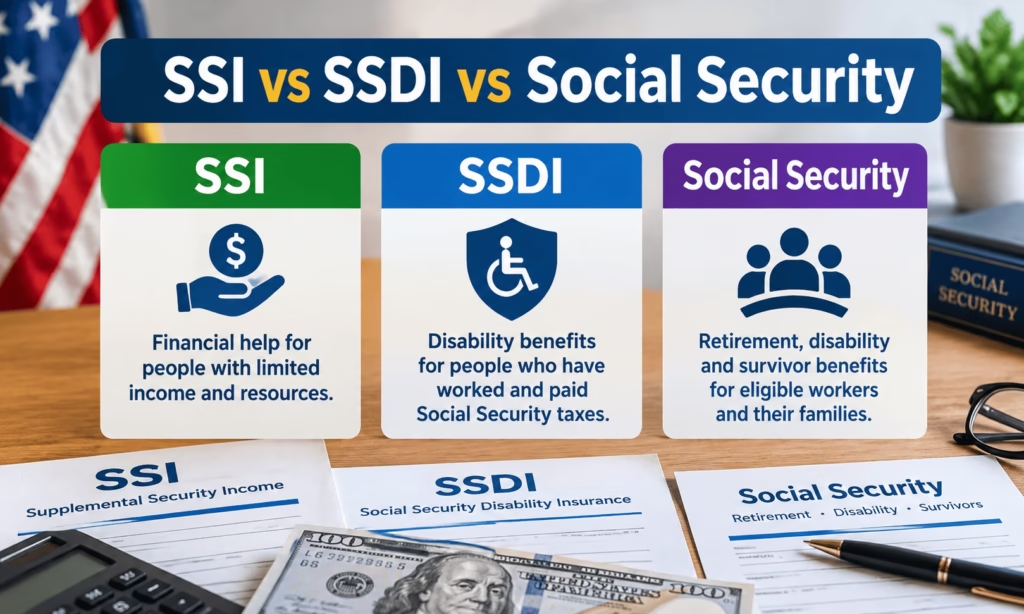
SSI vs SSDI vs Social Security Key Highlights
| Feature | SSI | SSDI | Social Security Retirement |
|---|---|---|---|
| Legal basis | Title XVI of the Social Security Act | Title II of the Social Security Act | Title II of the Social Security Act |
| Funded by | General U.S. Treasury revenue | Payroll (FICA) taxes | Payroll (FICA) taxes |
| Work history required | No | Yes, work credits needed | Yes, work credits needed |
| Resource or asset limit | Yes, 2,000 dollars individual, 3,000 dollars couple | No resource limit | No resource limit |
| Medical disability required | Yes, unless aged 65 or older | Yes | No |
| 2026 maximum federal payment | 994 dollars individual, 1,491 dollars couple | 4,152 dollars at full retirement age equivalent | 5,181 dollars at age 70 |
| 2026 average payment | Varies by state supplement | 1,634.70 dollars average | 2,071 dollars average |
| Waiting period | None for payments once approved | 5 months from disability onset | None, but reduced if claimed before full retirement age |
What Is SSI (Supplemental Security Income)?
SSI is a needs-based program designed for people who are blind, disabled, or age 65 and older, and who have limited income and very limited resources. It does not require any work history at all, which is why children with qualifying disabilities and adults who never worked, or worked too little to earn Social Security credits, can still qualify. Because SSI is funded from general tax revenue rather than payroll taxes, the program comes with strict financial eligibility rules attached. In 2026, the countable resource limit remains 2,000 dollars for an individual and 3,000 dollars for a couple, unchanged since 1989. Countable resources include cash, bank balances, and most investments, while a primary home, one vehicle, and burial funds up to certain limits are generally excluded. Monthly income above certain thresholds also reduces or eliminates the SSI payment, and the maximum federal benefit rate in 2026 is 994 dollars for an individual and 1,491 dollars for a couple, though many states add a supplemental payment on top of the federal amount.
SNAP Benefits Cut October 2026: State-by-State Impact
Social Security COLA 2027 Announcement Date & October 2026 Payment Schedule
What Is SSDI (Social Security Disability Insurance)?
SSDI is an earned benefit for workers who have paid Social Security taxes long enough to build up sufficient work credits and who then become unable to work due to a severe, long-term medical condition. In 2026, one work credit is earned for every 1,890 dollars of covered earnings, up to a maximum of four credits per year, and most adults need 40 credits total, with 20 of those earned in the 10 years immediately before becoming disabled, though the requirement is lower for younger workers. SSDI has no resource or asset limit whatsoever, so a worker with substantial savings can still qualify as long as the medical and work credit requirements are met. The program does require that your condition prevents substantial gainful activity, defined in 2026 as monthly earnings above 1,690 dollars for most applicants or 2,830 dollars for applicants who are statutorily blind. There is also a 5 month waiting period from the date your disability began before the first payment is issued, and a trial work period allowing up to 1,210 dollars per month in test earnings without immediately losing benefits. The average SSDI payment in 2026 is 1,634.70 dollars, with a maximum around 4,152 dollars for the highest lifetime earners.
What Is Social Security Retirement and Survivor Benefits
Social Security retirement benefits are the program most people think of first, and they are also an earned benefit funded through payroll taxes, requiring the same general 40 work credits as SSDI, but they carry no medical or disability requirement of any kind. Instead, eligibility is based purely on age and your work record. You can claim as early as age 62, though your monthly benefit is permanently reduced for claiming before full retirement age, which is 67 for anyone born in 1960 or later. Delaying benefits past full retirement age increases your monthly amount by roughly 8 percent per year up to age 70, where the benefit maxes out. In 2026, the maximum taxable earnings subject to Social Security tax rose to 184,500 dollars, and someone who earned at or above that cap for 35 years and claims at full retirement age can receive up to about 4,152 dollars a month, rising to roughly 5,181 dollars if they wait until age 70. The average retired worker collects 2,071 dollars a month in 2026. Survivor benefits, a related piece of the same Title II program, pay a portion of a deceased worker’s benefit to a qualifying spouse, ex-spouse, or dependent child, again with no resource test attached.
Side by Side Eligibility Comparison
| Requirement | SSI | SSDI | Social Security Retirement |
|---|---|---|---|
| Minimum age | None for disabled applicants, 65 for aged category | No minimum, but must have enough work credits | 62 for reduced benefits |
| Disability required | Yes, or age 65 plus | Yes | No |
| Work credits needed | None | Generally 40, 20 in the last 10 years | Generally 40 |
| Income limits | Strict, varies by state and living situation | Limited to substantial gainful activity threshold | Earnings test only if claiming before full retirement age |
| Citizenship or residency | U.S. citizen or qualifying noncitizen, must reside in U.S. | U.S. work history required, citizenship not always required | U.S. work history required |
| Medicaid or Medicare | Usually qualifies for Medicaid automatically | Medicare after a 24 month waiting period | Medicare eligibility begins at 65 |
How to Apply for SSI, SSDI, or Social Security Retirement
Each program is applied for through the same agency but the process differs slightly depending on which benefit fits your situation.
For SSI, you can start an application online at ssa.gov for the initial part of the process, but SSI claims generally require a phone or in-person interview with a Social Security representative to complete the financial and living-arrangement details that determine your payment amount. Be ready to document your income, resources, and living situation in detail, since these are the factors that decide both eligibility and payment level.
For SSDI, the application can be completed entirely online at ssa.gov if you are between 18 and full retirement age, have not applied for disability benefits recently, and are not currently receiving benefits on your own Social Security record. You will need detailed medical records, treatment history, and information about your work history for the last several years, since SSA uses this to evaluate both your medical eligibility and your insured status.
For Social Security retirement, the application is the most straightforward of the three and can be completed online, by phone, or in person, typically starting three to four months before you want benefits to begin. You will choose your claiming age as part of the application, and SSA will show you estimated benefit amounts for different starting ages before you finalize your choice.
Processing Time: How Long Each Claim Takes
Social Security retirement claims are generally the fastest to process, often resolved within a few weeks since there is no medical review involved and the calculation is based on your existing earnings record. SSI and SSDI claims both require a disability determination, which is handled by a state Disability Determination Services office working on SSA’s behalf, and this step is where most of the delay happens. As of mid-2026, SSA reported average initial disability decisions taking around 186 days, though this varies significantly depending on the complexity of the medical evidence and the specific state agency handling the case. If an initial claim is denied and appealed to a hearing before an administrative law judge, the wait can extend well beyond a year in many parts of the country, since hearing backlogs remain a persistent challenge for the agency.
Social Security and SSI Payment Schedule by Birthday
Social Security COLA 2027 Date, Expected Increase, and What It Means for Your Check
Payment Schedule for Each Program
SSI follows its own schedule, separate from SSDI and retirement benefits. SSI payments are issued on the first of each month, or the prior business day if the first falls on a weekend or federal holiday. SSDI and Social Security retirement benefits follow the birth date based schedule, paid on the second, third, or fourth Wednesday of the month depending on your birth date, unless you started receiving benefits before May 1997 or also receive SSI, in which case payment is issued on the third of the month.
Can You Receive More Than One of These at the Same Time
Yes, in specific situations. A person can receive both SSDI and SSI concurrently if their SSDI payment is low enough that they still meet SSI’s strict income and resource limits, a combination sometimes called concurrent benefits. This is common among workers who qualify for SSDI based on a limited work history, resulting in a small monthly SSDI check that still leaves them under the SSI income threshold. On the other hand, you cannot receive SSDI and Social Security retirement benefits as two separate full payments at the same time, since SSDI automatically converts to a retirement benefit at full retirement age, generally at the same dollar amount you were already receiving. Survivor benefits can sometimes be combined with your own retirement benefit in certain circumstances, though SSA pays whichever single benefit is higher rather than stacking them.
What Could Change in 2026 and Beyond
The most significant pending change affects SSI specifically. The SSI Savings Penalty Elimination Act would raise the resource limit from 2,000 dollars to 10,000 dollars for individuals and from 3,000 dollars to 20,000 dollars for couples, indexing the figures to inflation going forward so they do not freeze again for another 35 years. A broader companion bill, the SSI Restoration Act, would go further, raising the federal payment toward 100 percent of the poverty line, increasing income disregards, and eliminating the current rule that reduces SSI payments when a family member provides free food or housing. Neither bill had passed as of late 2026, and both remain in committee in the House and Senate. SSDI and Social Security retirement are not affected by these particular bills, since neither program uses a resource test, though all three programs continue to see their dollar thresholds adjusted annually for inflation and wage growth.
Which Program Actually Fits Your Situation
If you have a significant work history and a medical condition that prevents you from working, SSDI is generally the correct starting point, regardless of your savings or resources. If you have little or no work history, or your SSDI amount is very low, and you also have limited income and resources, SSI may apply either on its own or alongside a small SSDI payment. If you are simply reaching retirement age with no disability involved, Social Security retirement is the relevant program, and your only real decision is what age to claim. People sometimes apply for the wrong program simply because they assume “Social Security” is one single thing, when in practice the eligibility path depends entirely on your age, work record, medical situation, and financial resources.
SSI, SSDI, or Social Security Eligibility Calculator
SSI vs SSDI vs Social Security Eligibility Calculator
Answer a few questions about your age, work history, and finances to see which program you are more likely to fit.
Your details
Your results
Official Resources
| Resource | What It’s For | Link |
|---|---|---|
| Apply for SSI or SSDI online | Start a disability or SSI claim | ssa.gov/apply |
| Apply for retirement benefits | Start a retirement benefit claim | ssa.gov/benefits/retirement |
| my Social Security account | Check your earnings record, credits, and estimated benefits | ssa.gov/myaccount |
| Check your application status | Track a pending SSI, SSDI, or retirement claim | ssa.gov/myaccount/status |
| Find your local Social Security office | In-person interviews and document submission | ssa.gov/locator |
| Disability Determination process overview | Understand how medical decisions are made | ssa.gov/disability |
FAQs
What is the main difference between SSI and SSDI?
SSI is a needs-based program funded by general tax revenue with no work history requirement but strict income and resource limits, while SSDI is an earned benefit funded by payroll taxes that requires enough work credits but has no resource limit at all.
Can I apply for both SSDI and Social Security retirement?
No, SSDI automatically converts into a Social Security retirement benefit once you reach full retirement age, generally at the same monthly amount, so you cannot receive both as separate ongoing payments.
Do I need a disability to get Social Security retirement benefits?
No, Social Security retirement is based purely on your age and work record, with no medical or disability requirement involved.
What is the resource limit for SSI in 2026?
The SSI resource limit remains 2,000 dollars for an individual and 3,000 dollars for a couple in 2026, unchanged since 1989, though bills in Congress are proposing to raise these limits.
How many work credits do I need for SSDI?
Most adults need 40 work credits, with at least 20 earned in the 10 years before becoming disabled, though younger workers can qualify with fewer credits depending on their age.
Is there a waiting period before SSDI payments begin?
Yes, SSDI has a 5 month waiting period from the established onset of your disability before your first payment is issued.
Can I receive SSI and SSDI at the same time?
Yes, this is called concurrent benefits and applies when your SSDI payment is low enough that you still meet SSI’s income and resource limits.
What is the average Social Security retirement payment in 2026?
The average retired worker receives about 2,071 dollars per month in 2026, while the maximum benefit at full retirement age is around 4,152 dollars and about 5,181 dollars for those who delay claiming until age 70.
Does SSDI have an income limit like SSI does?
SSDI does not have a resource limit, but it does limit how much you can earn from work, capped at the substantial gainful activity threshold of 1,690 dollars per month for most beneficiaries in 2026, or 2,830 dollars for blind beneficiaries.
Which pays more, SSI or SSDI?
SSDI generally pays more than SSI for most beneficiaries, since SSDI is based on your past earnings and can reach several thousand dollars a month for higher earners, while SSI is capped at a flat federal maximum of 994 dollars for an individual in 2026.
Can you switch from SSI to SSDI?
Yes, if your work history and medical condition later qualify you for SSDI, you can be approved for SSDI while continuing to receive SSI as a supplement if your SSDI amount remains below the SSI income threshold.
Does SSDI count as Social Security for tax purposes?
Yes, SSDI benefits are taxed the same way Social Security retirement benefits are, based on your combined income, while SSI is not taxable since it is a needs-based benefit rather than an earned one.
What happens to my SSDI when I turn 67?
Your SSDI benefit converts automatically into a Social Security retirement benefit at your full retirement age, and the dollar amount generally stays the same.
Can children receive SSI or SSDI?
Children can qualify for SSI based on disability and their family’s limited income and resources, while SSDI generally requires the applicant’s own work history, so a child would typically only receive SSDI style benefits as a dependent on a parent’s record rather than their own claim.
Conclusion
SSI, SSDI, and Social Security retirement all sit under the same federal agency, but they answer very different questions. SSI asks whether you have limited income and resources and a qualifying disability or age. SSDI asks whether you worked long enough and paid enough into the system before a medical condition stopped you from working. Social Security retirement simply asks how old you are and how much you earned over your career. Knowing which question actually applies to you before you file can save months of unnecessary waiting, and with SSI’s resource limit still frozen at 1989 levels while reform bills sit in committee, that distinction matters more in 2026 than it has in years. Check your own work credits and estimated benefits through your my Social Security account before applying, so you start the process with a clear picture of which program actually fits your circumstances.
2027 Social Security COLA Could Be Lower Than Expected: Latest Estimates
SNAP Payment Dates by State: When Your EBT Card Gets Deposited