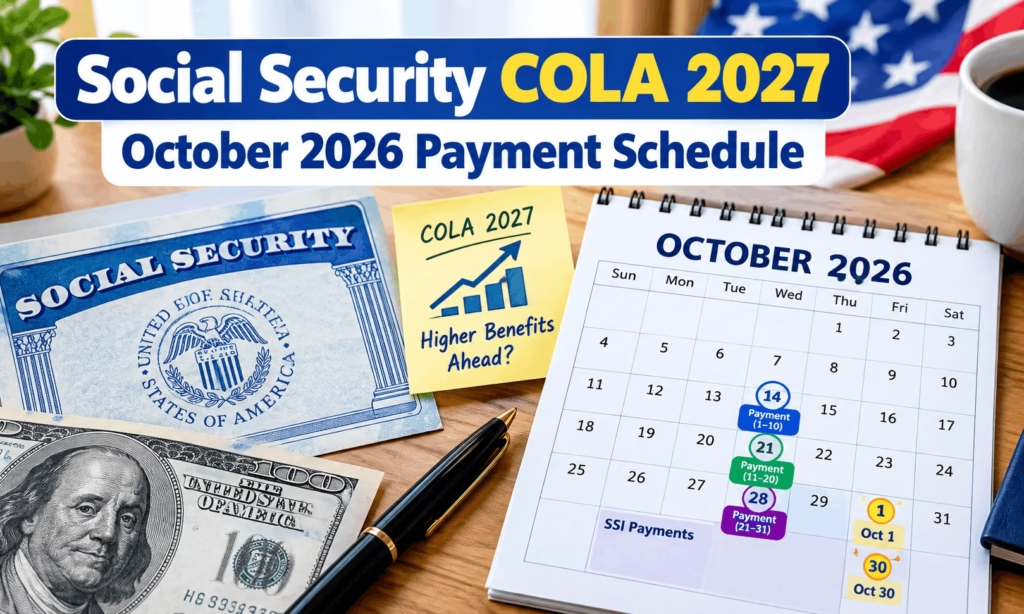
The Social Security COLA forecast 2027 has been sliding since spring. The Senior Citizens League (TSCL) opened its monthly forecasting round in May at 3.9%, cut it to 3.8% in June, held it there in July, lowered it to 3.6% in August, and trimmed it again to 3.5% after the August inflation report on September 11. That is still well above this year’s 2.8% raise, so retirees are not looking at a bad result. But the drift lower is a reminder that a forecast is not a paycheck, and the number that counts will not be known until October 14, when September prices are released and the Social Security Administration announces the official cost-of-living adjustment.
The slide has a simple cause. Inflation as measured by CPI-W, the index that sets the COLA, jumped to 4.4% in May, then cooled to 3.5% in June, 3.4% in July, and 3.5% in August. Forecasts built during the spike were too high once prices calmed, so they came down. For anyone budgeting for 2027, that matters more than the decimal point. Below you will find the month by month path, a rough guide to what September needs to show for each outcome, the dollar effect on different benefit levels, and a scenario calculator. We will be updating this article monthly.

Social Security COLA Forecast 2027 Key Highlights and Dates
| Item | Latest detail |
|---|---|
| Current TSCL forecast for the 2027 COLA | 3.5% (final projection, issued September 11) |
| Other estimates after August data | 3.5% from Mary Johnson, 3.6% from AARP |
| 2026 COLA for comparison | 2.8% |
| TSCL forecast in May | 3.9% |
| CPI-W yearly change, July | 3.4% |
| CPI-W yearly change, August | 3.5% |
| Average of July and August CPI-W index readings | 327.793 |
| Last data point needed | September CPI-W, released October 14 |
| Official announcement | Wednesday, October 14, 2026 |
| Average benefit used by TSCL | $1,940.08 per month |
| Increase at 3.5% | About $67.90 per month |
| Projected 2027 Part B premium | $209.50, up from $202.90 |
The Month by Month Path of the 2027 COLA Forecast
TSCL publishes a new estimate each month after the Bureau of Labor Statistics releases fresh inflation data. Here is how its number has moved, alongside the inflation readings behind it.
| Forecast date | TSCL 2027 COLA estimate | Average benefit increase it implied |
|---|---|---|
| May 12 | 3.9% | About $81 per month |
| June 10 | 3.8% | Not restated here |
| July 14 | 3.8% | Not restated here |
| August 12 | 3.6% | $69.75 (from $1,937.53 to $2,007.28) |
| September 11 | 3.5% | $67.90 (from $1,940.08 to $2,007.98) |
| Month | CPI-W change from a year earlier |
|---|---|
| May | 4.4% (fastest since April 2023) |
| June | 3.5% |
| July | 3.4% |
| August | 3.5% |
Other forecasters were even further apart in early summer. One tracker reported estimates ranging from 3.8% at TSCL to 4.7% from Mary Johnson in early July, when energy prices were pushing inflation higher. By mid August, after the July report, the range narrowed to about 3.2% to 3.6%. After August data, most estimates cluster at 3.5% to 3.6%. That narrowing is the healthiest sign in the forecast: the models are converging on a number as the data fills in.
2027 Social Security COLA Could Be Lower Than Expected: Latest Estimates
SNAP Payment Dates by State: When Your EBT Card Gets Deposited
SSI vs SSDI vs Social Security: What’s the Difference and Who Qualifies?
Child Tax Credit 2026 Eligibility: Are You Getting the Full $2,200?
What Happens If Alberta Votes Yes? Inside Canada’s October 19 Independence Referendum
2027 COLA Increase Announcement Date, Estimated Raise, Payment Schedule & Calculator
Why the Social Security COLA Forecast 2027 Is Falling?
There are three reasons the estimate has come down.
First, the May spike faded. CPI-W rose 0.7% in a single month in May, pushing the yearly rate to 4.4%. Forecasts made in that window assumed elevated inflation would persist. It did not. By July, the index was flat for the month and the yearly rate had dropped to 3.4%.
Second, only three months count. The formula ignores everything before July. Even a high reading in May has no direct effect on the final number, so a model that leans on year to date data has to unwind that influence as the July, August, and September readings arrive. TSCL says it redesigned its model to lean less on its own earlier predictions, which is why its path has been steady rather than jumpy, moving a tenth or two per month.
Third, August was warm but not hot. The August report showed the energy index rising 2.1% for the month, with gasoline up 3.9%, which accounted for more than a third of the monthly increase in the overall index. Even so, the yearly CPI-W rate came in at 3.5%, only a tenth above July. The model had been expecting more, so it shaved a tenth off the projection.
The price pressure has not gone away. Mary Johnson noted that some categories, such as outpatient hospital care at 5.8%, are still climbing quickly. The forecast is falling because the pace slowed, not because prices dropped.
What September Inflation Needs to Show for Each COLA Outcome
The official COLA compares the average CPI-W for July, August, and September 2026 with the same three months in 2025. July and August are known. As of the last report, the average of those two index readings is 327.793. Only September is missing.
Here is a rough rule of thumb. The COLA is close to the average of the three monthly yearly changes. With July at 3.4% and August at 3.5%, you can estimate what September would need to show. These figures are approximations, not the official calculation, because the agency uses index levels and rounds the result to one decimal.
| If September CPI-W rises by roughly | The COLA would land near |
|---|---|
| 3.0% | 3.3% |
| 3.3% | 3.4% |
| 3.6% | 3.5% |
| 3.9% | 3.6% |
| 4.2% | 3.7% |
In plain terms, a September that looks like August, around 3.5%, points to a COLA of 3.5%. A cooler September pulls it toward 3.4%. A hotter one nudges it toward 3.6% or 3.7%. The September Federal Reserve rate increase, reported this month, is unlikely to change the September price reading in any meaningful way, since monetary policy works with a delay. Analysts suggest tighter policy would show up, if at all, in the data that sets the 2028 COLA.
What the COLA Means for Different Benefit Levels
A percentage looks the same for everyone, but the dollars do not. Here is what each outcome means at several benefit levels.
| Monthly benefit now | At 3.4% | At 3.5% | At 3.6% |
|---|---|---|---|
| $1,200 | $40.80 | $42.00 | $43.20 |
| $1,940.08 (TSCL average) | $65.96 | $67.90 | $69.84 |
| $2,400 | $81.60 | $84.00 | $86.40 |
| $3,200 | $108.80 | $112.00 | $115.20 |
| $4,000 | $136.00 | $140.00 | $144.00 |
To find your own new amount at 3.5%, multiply your benefit by 1.035. A $2,000 benefit becomes $2,070. The difference between the low and high forecast on an average check is only about $4 a month, so budgeting off 3.5% is reasonable, and a shortfall of a tenth of a point will not upend your plans.
For comparison, the 2026 raise of 2.8% added about $56 to the average check, according to reports earlier this year. The 2027 raise, if it holds at 3.5%, would add roughly $12 more per month than that.
Medicare, Federal Pensions and Other Programs Tied to the COLA
The Social Security number spills into several other programs, which is worth knowing if your income comes from more than one source.
Medicare Part B: The 2026 Trustees Report projects a standard premium of $209.50 in 2027, up 3.25% from $202.90. For most people, that amount is deducted from the Social Security check. On an average benefit, the higher premium would trim the $67.90 increase to about $61.30. Long range projections in the report suggest the standard Part B premium could reach about $360.60 by 2035, according to analysis of the Trustees data, so the premium will likely take a larger bite over time. Part D premiums and income related surcharges can also reduce the net gain.
FERS retirees: The Federal Employees Retirement System uses a sliding rule. When inflation is above 3%, the FERS COLA is generally one percentage point lower than the CPI increase. A 3.5% Social Security COLA would generally produce a 2.5% FERS COLA. Retirees under the older CSRS system receive the full increase.
Other programs: Supplemental Security Income moves by the same percentage. Some other federal benefits are also tied to the Social Security COLA, so check the rules for the program you receive.
Why a 3.5% COLA Can Still Feel Too Small
Social Security’s COLA uses the CPI-W, an index built around the spending of urban wage earners and clerical workers. Retirees spend a bigger share of their budgets on health care and housing. Advocates have long argued for switching to the CPI-E, an experimental index that weights those categories more heavily, though the government has not adopted it.
TSCL’s 2026 buying power study says benefits are worth about 86.3 cents on the dollar compared with 2016. The group estimates payments would need to rise 15.7%, or $295.85 a month for the average beneficiary, to recover the lost value. Its 2026 senior survey found 89% thought this year’s COLA was too low. In TSCL’s words about the forecast, seniors will probably be disappointed in the long run whether the announcement lands a little above or below the prediction.
Supporters of the current system point out that the COLA is automatic, protects against inflation over decades, and rises with prices without a vote in Congress. Both views can be true: an automatic adjustment is valuable, and it can still fall behind the costs a particular retiree faces.
A Longer Worry: The Trust Fund and Proposals to Change the COLA
Commentary this week pointed out that the Social Security trust funds have been paying out more than they take in. If Congress does nothing, several analysts say the reserves could run out within a few years and payments would fall to roughly 78% of scheduled benefits, which would turn a $2,000 benefit into about $1,560 and erase the value of a COLA. Check the Trustees Report for the official timeline, since the projection changes each year.
One proposal from the Committee for a Responsible Federal Budget would replace the percentage COLA with a flat dollar increase. By one analysis, about 80% of recipients would receive a smaller raise than under the current formula. It is a proposal, not law, and any change would need Congress. Still, it shows the COLA itself is part of the reform debate, so keep an eye on legislation.
How to Plan Before the October 14 Announcement
You do not need to wait for the announcement to plan. A few sensible steps:
Budget off 3.4% to 3.5% and treat anything above as a bonus. That keeps you safe if September is cool.
Build in the Part B increase. Subtract about $6.60 from your expected raise if the premium comes out of your check.
Look at your own inflation. If your costs are mostly rent, health care, and insurance, your personal inflation may be higher than the CPI-W. Track those categories separately.
Check your tax picture. The income thresholds that make Social Security benefits taxable, $25,000 for single filers and $32,000 for joint filers, are not indexed. A larger check can push more of your benefit into taxable income.
Social Security and SSI Payment Schedule by Birthday
Social Security COLA 2027 Date, Expected Increase, and What It Means for Your Check
Medicaid Eligibility 2026: Income Limits and How to Apply
Social Security’s 2027 COLA Could Outpace This Year’s Raise — Here’s How Helpful It Really Is
Social Security’s Trump Bump-Fueled 2027 COLA Is Set to Make History 2 Different Ways
How to Check Your New Benefit After the Announcement
Nothing needs to be filed. The increase is automatic. To see your amount:
- Sign in to your personal my Social Security account on the agency website, or register if you have not yet. Registration uses a login.gov or ID.me credential.
- Open the message center in December to find your COLA notice.
- Look for three numbers: the new gross benefit, the Medicare premium deducted, and the net payment.
- Confirm your address and direct deposit information are correct.
- Call the agency or visit a local office if any figure looks wrong.
Processing Time: When Does the Increase Show Up?
The announcement is October 14. The new rates begin with the benefit paid in January 2027, which covers December. The agency mails or posts notices in December, and online notices in my Social Security often arrive before paper letters. If a Medicare premium change applies to you, the notice shows it. There is no waiting period and no claim to process.
Payment Schedule for the First 2027 Check
| Group | January 2027 payment date |
|---|---|
| Birthday 1st through 10th | Wednesday, January 13 |
| Birthday 11th through 20th | Wednesday, January 20 |
| Birthday 21st through 31st | Wednesday, January 27 |
| Benefits started before May 1997, or Social Security and SSI together | Generally the 3rd of the month |
| SSI recipients | Generally the 1st, paid early when the 1st is a holiday |
January 1, 2027 is a holiday, so SSI payments dated that day would normally arrive on the last business day of December. Check the agency’s payment calendar for your date.
Use the COLA Scenario Calculator
Enter your benefit, the July and August CPI-W changes, and a guess for September. The calculator estimates the COLA using the rule of thumb described above, shows your new benefit, and includes an optional FERS estimate.
2027 COLA Scenario Calculator
Rough estimate. The official COLA uses index levels and is announced October 14, 2026. Taxes and other deductions are not included.
Official Resources and Links
| Resource | What it covers | Link |
|---|---|---|
| Social Security COLA page | Official COLA history and announcement | https://www.ssa.gov/oact/cola/ |
| my Social Security (login and registration) | Benefits, notices, messages | https://www.ssa.gov/myaccount/ |
| BLS Consumer Price Index | Inflation data | https://www.bls.gov/cpi/ |
| BLS CPI release schedule | Exact release date and time | https://www.bls.gov/schedule/news_release/cpi.htm |
| Social Security Trustees Reports | Program finances | https://www.ssa.gov/oact/TR/ |
| Medicare costs | Part B and Part D premiums | https://www.medicare.gov/basics/costs/medicare-costs |
| Office of Personnel Management retirement | FERS and CSRS COLA information | https://www.opm.gov/retirement-center/ |
| The Senior Citizens League | Monthly forecasts | https://seniorsleague.org |
FAQs
Why is the 2027 COLA forecast going down?
Because inflation cooled after a May spike. CPI-W rose 4.4% in May, then eased to 3.5% in June, 3.4% in July, and 3.5% in August, so models trimmed their projections.
What is the latest Social Security COLA forecast for 2027?
TSCL and Mary Johnson estimate 3.5%. AARP estimates 3.6%.
When is the official 2027 COLA announced?
On October 14, 2026, when September inflation data is released.
Could the COLA still change?
Yes. September CPI-W is the last input, so the final number could be a tenth or two higher or lower.
How much more will my check be at 3.5%?
Multiply your benefit by 0.035. The average benefit of $1,940.08 rises by about $67.90.
Will the COLA be higher than 2026?
Very likely. The 2026 COLA was 2.8%, and even a cool September should leave the 2027 figure above that.
How does the COLA affect federal retirees?
FERS retirees generally receive a COLA one point lower than the CPI increase when inflation is above 3%, so 3.5% would translate to about 2.5%. CSRS retirees get the full amount.
Does Medicare Part B reduce my raise?
Often, yes. The projected premium rises $6.60, which reduces the net gain for people who pay through their benefit.
Why do retirees say COLAs fall short?
The CPI-W tracks urban workers’ spending, and TSCL estimates benefits are worth about 86.3 cents on the dollar compared with 2016.
Do I need to apply for the COLA?
No. It is added automatically.
How much will Social Security increase in 2027?
The current best estimate is 3.5%, with a range of 3.4% to 3.6%, pending the October 14 announcement.
Will Social Security go up in January 2027?
Yes. The new COLA is applied to benefits paid starting in January 2027.
How is the Social Security COLA calculated?
By comparing the average CPI-W for July through September this year with the same period last year and rounding to the nearest tenth of a percent.
What was the Social Security COLA for 2026?
It was 2.8%.
What is CPI-E and why do people want it?
It is an experimental index that weights health care and housing more heavily, which advocates say better reflects what older people spend.
Are Social Security benefits going to be cut?
The COLA itself does not cut benefits. Long term funding shortfalls are described in the Trustees Report, and changes would require action by Congress.
Conclusion
The Social Security COLA forecast 2027 has slid from 3.9% in May to 3.5% today, mostly because inflation cooled from its May spike. That is still a solid raise compared with 2.8% this year, and the range from 3.4% to 3.6% is narrow enough to plan around. Budget off 3.4% to 3.5%, subtract the higher Part B premium, and treat any extra as a bonus. Wait for the official announcement on October 14, then sign in to your my Social Security account in December to confirm the exact figure on your notice.
SNAP Benefits Cut October 2026: State-by-State Impact
Social Security COLA 2027 Announcement Date & October 2026 Payment Schedule
How to Report a Missing Social Security or SSI Payment?
Social Security 2027 COLA Notices: When They Arrive and What They’ll Show
2027 Social Security COLA vs Inflation: The One Thing We Already Know Before October 14
Social Security COLA Buying Power: Will the Raise Beat Inflation?