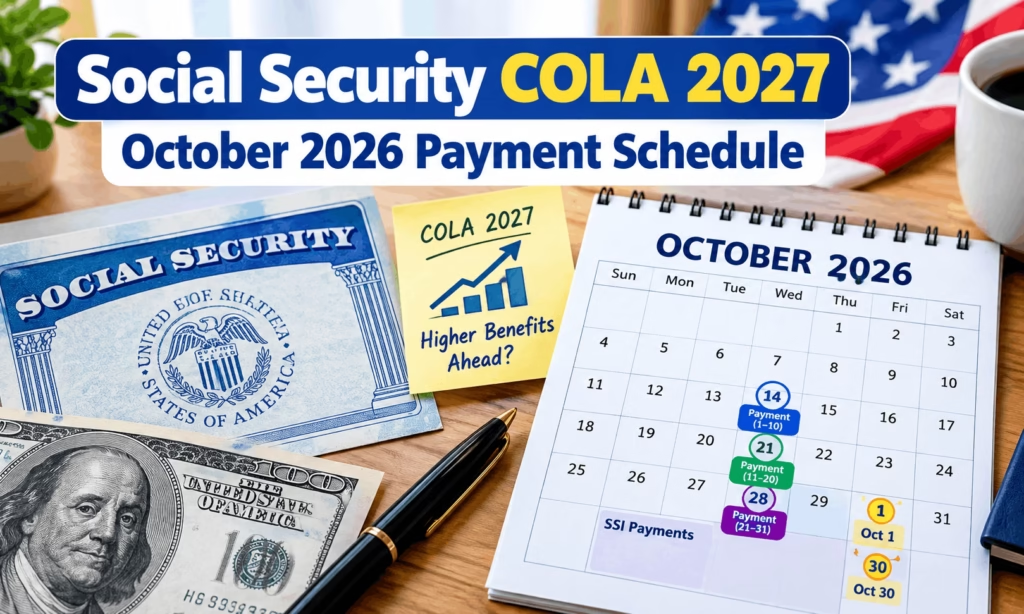
A new wave of the Social Security COLA scam is reaching retirees just as the official 2027 raise nears. Criminals are sending calls, letters, texts, ads, and social media posts that promise to “boost,” “maximize,” or “unlock” a bigger monthly payment, then ask for a fee, a Social Security number, or bank details. The Social Security Administration’s Office of the Inspector General (OIG) issued a warning on September 21 titled as a plain instruction not to pay for promises of increased benefits, and it told Money that the offers are part of a seasonal rise in reported fraud. The timing is no accident. The agency will announce the 2027 cost-of-living adjustment on October 14, and forecasters expect about 3.5%, so millions of people are watching for news about their checks.
The COLA is applied automatically, and nobody can pay, apply, or negotiate for a larger one. Benefit amounts follow federal law and your earnings record. A message that says otherwise is a trap, and the risk goes beyond the fee. Someone who hands over a Social Security number and bank information can lose control of their benefits account. Below you will find how the scheme works, the newest variations, a red flag table, what to do if you already responded, official links, and a calculator that checks whether an offer is even possible. We will be updating this article monthly.
Social Security COLA Scam Key Highlights and Dates
| Item | Latest detail |
|---|---|
| OIG scam alert on paid promises of higher benefits | September 21, 2026 |
| OIG alert on prize and direct deposit scheme | September 9, 2026 |
| Official 2027 COLA announcement | Wednesday, October 14, 2026 |
| Current forecast for the 2027 COLA | About 3.5% (range 3.4% to 3.6%) |
| COLA notices from the agency | Mailed or posted online in December |
| First payments with the new amount | January 2027 |
| Consumer losses to imposter scams in 2025 (FTC) | About $3.5 billion |
| Consumer losses to government impostors in 2025 (FTC) | About $920 million |
| Agency phone number | 1-800-772-1213 |
| Where to report Social Security scams | oig.ssa.gov and ssa.gov/scam |
| Cost to receive the COLA | Nothing |
Why the Social Security COLA Scam Spikes Before the Announcement?
Fraudsters follow headlines. In the weeks before the COLA announcement, news coverage of the raise is heavy, seniors are searching for answers, and confusion is easy to exploit. The OIG says the fake offers often appear to come straight from Social Security, and that the seasonal pattern repeats each year.
The Council for Retirement Security warned in late August that scammers were emailing, texting, and calling to say people must “claim” or “activate” their increase. The agency’s own scam page, updated in July, lists the same trick: a claim that you need to give personal information or make a payment to get a cost-of-living adjustment or other benefit increase.
Public interest is the fuel. Right now, forecasts of a raise of roughly $68 a month for the average retiree, and a wave of articles about the coming number, give a scammer a ready-made story: “Your raise is waiting, just verify your details.”
How the Bigger Check Scam Works?
The pattern is consistent, and knowing it helps you spot a new version.
First comes the hook. A call, letter, text, ad, or social media post says you are eligible for a higher payment, a “special adjustment,” or help to maximize your benefit.
Second, the request to verify. The scammer asks you to confirm what you currently receive, along with your name, address, and Social Security number. That information makes you sound real to the next person who calls.
Third, the fee or the data grab. Some victims are told to pay an administrative fee. Others are sent to a realistic looking website or form that collects account details, supposedly to calculate or process the larger payment.
Fourth, the takeover. With a Social Security number and bank information, a criminal may be able to change the deposit account tied to a real beneficiary’s record. Haywood Talcove, who leads the government group at LexisNexis Risk Solutions, told Money that once details are altered, the real person can struggle to prove who they are. He described it as making the real person look like the criminal.
The result can be a missing payment, a frozen account, and weeks of effort to prove your identity. That is why the risk is bigger than the fee.
The Newest Variations Seniors Are Seeing
A few versions are circulating now.
Fake benefit boost letters. The OIG has warned that criminals mail letters telling people to call a toll-free number to activate an increase such as a COLA. The agency does send real COLA notices, but they do not require you to call anyone.
Prize and direct deposit offers. On September 9, the OIG warned of a scheme that used fake prize offers to convince victims to redirect their Social Security deposits to prepaid debit accounts. The criminals then cut the victims off from their own monthly payments.
Text messages with links. A text says your benefit has increased and includes a link to “view” or “approve” the change. The link goes to a fake site that collects your login or Social Security number.
Social media impostors. The agency notes that scammers copy its logos, colors, and language to create fake accounts that look official. It also warns that scammers are now using artificial intelligence to make messages and voices more convincing.
Ads and websites promising secret strategies. Some pitches claim a paid service can negotiate a bigger check or unlock hidden money. The OIG’s message is blunt: there is no secret method, and there is no negotiation.
Older hoaxes come back too. In 2024, the agency had to debunk online rumors of a $600 boost in June benefits, which pushed traffic to sites that collected clicks and personal data.
Red Flags Versus What the Real Agency Does
| Scam sign | What the real agency does |
|---|---|
| Says you must apply for, claim, or activate the COLA | Adds the COLA automatically |
| Asks for a fee to unlock or speed up an increase | Never charges for benefit increases |
| Asks for your Social Security number or bank details by text, email, or social media | Does not ask for sensitive information through those channels |
| Pressures you to act right now | Gives you time and a way to appeal |
| Demands payment by gift card, prepaid card, wire, cash, or crypto | Mails a letter with payment options and appeal rights if you owe money |
| Threatens arrest or says your number will be suspended | Does not threaten arrest or suspend a Social Security number |
| Sends a link or number and tells you to use it | Directs you to your own my Social Security account |
| Promises a payment much larger than the announced COLA | Applies one percentage set by law to everyone |
A note on phone calls. The agency may call you in some situations, such as when you have an open claim or have asked for help. What it will not do is threaten you, demand immediate payment, or ask you to pay in a hard to trace way. If in doubt, hang up and call 1-800-772-1213 yourself.
What the 2027 COLA Will Really Do for Your Check?
Here is a useful yardstick. If the COLA lands at 3.5%, a $1,940 benefit rises by about $68 a month. A $2,500 benefit rises by about $87.50, and a $3,200 benefit rises by $112. The Medicare Part B premium is projected to rise by $6.60 to $209.50, which would trim the net gain for people who pay through their check.
Anyone promising $200, $500, or $1,000 more per month is promising something the COLA cannot deliver. That mismatch is one of the simplest tests you can run, and the calculator below does it for you.
Real Ways to Raise Your Benefit, and None of Them Cost a Fee
There are legitimate ways to increase what you receive over time, and none of them involve a caller or a paid unlocking service.
Delay claiming. For people born in 1943 or later, waiting past full retirement age to claim earns delayed retirement credits of about 8% per year until age 70.
Check your earnings record. Your benefit is based on your highest 35 years of earnings. If a year is missing or wrong, you can ask the agency to correct it, free of charge.
Work longer or earn more. Higher earnings in a year that replaces a lower one in your top 35 can raise your future benefit.
Look at spousal, survivor, and other benefits you might qualify for. The agency can explain eligibility at no charge.
Ask questions at no cost. You can call the agency, visit a local office, or use your online account. If a company asks you to pay for these services, be skeptical.
What to Do If You Already Responded to a Scam?
Move quickly and in this order.
- Call your bank right away if you shared account details or made a payment. Ask about freezing, changing, or closing the affected account.
- Contact the agency at 1-800-772-1213 and tell them what happened, so your record can be protected. If you cannot get through or fix it online or by phone, go to a local Social Security office in person, as Talcove recommends.
- Sign in to your my Social Security account, or create one if you never have, and check that your address and direct deposit details are unchanged. Setting up your own account can also stop a criminal from opening one in your name.
- Report the scam at ssa.gov/scam or oig.ssa.gov. Reports feed the data the agency uses to warn others and to build cases.
- Visit IdentityTheft.gov for a personalized recovery plan if your Social Security number or other personal details were exposed. Consider a credit freeze and fraud alerts.
- Keep records of the calls, texts, letters, and websites, including phone numbers, dates, and screenshots.
How to Report a Social Security COLA Scam?
Reporting takes a few minutes and helps investigators.
- Go to oig.ssa.gov and select the option to report Social Security fraud.
- Describe how you were contacted, what was said, the phone number or website, and whether any money or information was given.
- Add details such as dates, amounts, and how you paid.
- Also file a report with the Federal Trade Commission at ReportFraud.ftc.gov.
- Forward suspicious emails and share the warning with family members who may be targeted.
Processing Time: How Long Does Recovery Take?
There is no single timeline. If only a suspicious call or text happened and you gave nothing, the safest steps take minutes: hang up, delete, and check your account. If you gave out a Social Security number or bank information, act the same day. Banks can often stop a payment or secure an account quickly, while fixing a benefits record can take longer, depending on the situation. If a payment was diverted, ask the agency what options exist to reissue it, and keep asking for a written record of your case. The sooner you report, the sooner the process can begin.
Will Medicare Part B Hikes Erase Your Social Security COLA?
What Happens If Alberta Votes Yes? Inside Canada’s October 19 Independence Referendum
2027 COLA Increase Announcement Date, Estimated Raise, Payment Schedule & Calculator
Payment Schedule: What the Real COLA Looks Like
A real increase follows a predictable path. The announcement comes October 14. Notices arrive in December, by mail or in your my Social Security message center. The new amount shows up in January 2027 payments on your usual date.
| Group | January 2027 payment date |
|---|---|
| Birthday 1st through 10th | Wednesday, January 13 |
| Birthday 11th through 20th | Wednesday, January 20 |
| Birthday 21st through 31st | Wednesday, January 27 |
| Benefits started before May 1997, or both Social Security and SSI | Generally the 3rd |
| SSI recipients | Generally the 1st, paid early when it falls on a holiday |
A message that offers an early COLA, a bonus payment, or a special date outside this pattern is a warning sign. If someone claims you must confirm details before a “bonus payment,” do not respond.
Use the Scam Reality Check Calculator
Enter your monthly benefit, the extra amount an offer promises, and any fee asked. The calculator compares the promise with the realistic COLA range of 3.4% to 3.6% and tells you how far out of line the offer is.
Social Security Offer Reality Check
Uses the forecast COLA range of 3.4% to 3.6%. The official 2027 COLA is announced October 14, 2026. The COLA needs no fee, no application, and no phone call. Report scams at oig.ssa.gov.
Official Resources and Links
| Resource | What it covers | Link |
|---|---|---|
| Social Security scam information | How to spot and avoid scams | https://www.ssa.gov/scam/ |
| Office of the Inspector General | Report Social Security fraud and read alerts | https://oig.ssa.gov |
| my Social Security (login and registration) | Check your benefit, notices, and direct deposit | https://www.ssa.gov/myaccount/ |
| Social Security COLA page | Official COLA information | https://www.ssa.gov/oact/cola/ |
| Official SSA social media accounts | Verify real accounts | https://www.ssa.gov/socialmedia |
| FTC fraud reporting | Report scams | https://reportfraud.ftc.gov |
| IdentityTheft.gov | Recovery plan for identity theft | https://www.identitytheft.gov |
| Social Security phone line | Confirm any contact | 1-800-772-1213 |
FAQs
Do I have to apply for the COLA?
No. It is applied automatically to retirement, survivor, disability, and SSI payments. Anyone asking you to apply is not from the agency.
Can I pay to get a higher Social Security check?
No. There is no fee that raises your benefit, and there is no negotiation. Amounts are set by law using your earnings record and other factors.
How do I know if a Social Security text is real?
Treat unsolicited texts about benefit increases as suspicious. The agency does not ask for sensitive information by text, email, or social media. Do not click the link.
When is the 2027 COLA announced?
On October 14, 2026.
How much will the 2027 COLA be?
Forecasts point to about 3.5%, and the official number will be confirmed October 14.
Will Social Security call me?
Sometimes, if you have business open with the agency. It will not threaten you or demand payment in gift cards, wires, or crypto. If unsure, hang up and call the agency yourself.
What if I gave my Social Security number to a scammer?
Contact your bank, call 1-800-772-1213, check your my Social Security account, report at ssa.gov/scam, and visit IdentityTheft.gov.
Can a scammer change my direct deposit?
It can happen if they get your personal and account details. Check your account often and act fast if something looks different.
Why did I get a letter telling me to call a number to activate an increase?
It is a known scam tactic. The COLA does not need activation.
Where do I report a Social Security scam?
At oig.ssa.gov or ssa.gov/scam, and also at ReportFraud.ftc.gov.
Is the Social Security COLA scam real?
Yes. The OIG issued a warning on September 21 about paid promises of higher benefits and said it is part of a seasonal rise in fraud.
Does Social Security send letters about the COLA?
Yes, the agency sends a real notice, but it never tells you to call a number to activate the increase. You can also see it in your online account.
How do scammers get my information?
They may use stolen data, public records, or a call or website where you share details. Never confirm personal information to someone who contacts you first.
What are the signs of a Social Security scam call?
Threats, urgency, requests for payment by gift card or wire, requests for your Social Security number, and promises of extra money.
Can I lose my Social Security benefits to a scam?
Payments can be diverted if criminals change your deposit details. Acting quickly and monitoring your account helps limit the harm.
Is it safe to create a my Social Security account?
Yes, and it is recommended. Having your own account can prevent a criminal from creating one with your information.
Conclusion
The Social Security COLA scam works because the real news is good: a raise of about 3.5% is coming, and people want details. But the raise arrives on its own, with no fee, no application, and no phone call required. Treat any unsolicited offer to boost your check as a scam, especially if it asks for money or personal details. Sign in to your own my Social Security account to review your benefit, wait for the October 14 announcement, look for your notice in December, and report anything suspicious at oig.ssa.gov. Share these warning signs with a parent, grandparent, or neighbor who may be a target.
2027 Social Security COLA vs Inflation: The One Thing We Already Know Before October 14
Social Security’s Trump Bump-Fueled 2027 COLA Is Set to Make History 2 Different Ways
Social Security’s 2027 COLA Could Outpace This Year’s Raise — Here’s How Helpful It Really Is