
2027 Social Security COLA: Social Security benefits will rise 3.6% in January 2027, the largest cost-of-living adjustment (COLA) since 2023. The Social Security Administration (SSA) announced the increase on October 14, 2026, and it will reach about 72 million beneficiaries. But a Cost-of-Living Adjustment percentage is not the same as a raise in your bank account. Medicare premiums are usually taken out of the check before it arrives, and that bill for 2027 has not been finalized yet.
That is why this November matters more than October did. The next few weeks decide what your first 2027 payment actually looks like. Your Cost-of-Living Adjustment notice starts appearing online in late November, the Medicare open enrollment window closes on December 7, and the Centers for Medicare & Medicaid Services (CMS) is expected to publish the official 2027 Part B premium any day now. Payment dates also shift around the holidays, including an early deposit on December 31.

2027 Social Security COLA
This article is based on SSA announcements and the government sources linked below, as of November 14, 2026. It covers the Cost-of-Living Adjustment and the other 2027 numbers, what Medicare will probably cost, the payment dates between now and January, and what you can do before the end of the year. A table of official links and a FAQ section follow the main text.
The 2027 COLA at a Glance
The SSA says the 3.6% Cost-of-Living Adjustment is based on the rise in the Consumer Price Index for Urban Wage Earners and Clerical Workers (CPI-W) from the third quarter of 2025 through the third quarter of 2026. It applies to Social Security and Supplemental Security Income (SSI) benefits, reaching a total of 76 million Americans. For comparison, the 2026 COLA was 2.8%.
From the SSA’s 2027 fact sheet:
| Item | 2026 | 2027 |
| Cost-of-Living Adjustment | 2.8% | 3.6% |
| Average retired worker benefit | $2,095 (before Cost-of-Living Adjustment) | $2,170 (after Cost-of-Living Adjustment) |
| Maximum benefit, worker retiring at full retirement age | $4,152/mo | $4,188/mo |
| Maximum taxable earnings | $184,500 | $192,300 |
| Earnings limit, under full retirement age | $24,480/yr | $25,560/yr |
| Earnings limit, year you reach full retirement age | $65,160/yr | $67,920/yr |
| SSI federal payment standard, individual | $994/mo | $1,029/mo |
| SSI federal payment standard, couple | $1,491/mo | $1,544/mo |
The SSA estimates the average retired worker will get about $75 more per month. The earnings-limit rules are unchanged: before full retirement age, $1 in benefits is withheld for every $2 earned above the limit, and in the year you reach full retirement age, $1 is withheld for every $3 above the limit. From the month you reach full retirement age, there is no earnings limit.
The Cost-of-Living Adjustment does not affect your November 2026 payment. The increase starts with benefits payable in January 2027.
Why Medicare Matters for Your Raise?
Most beneficiaries who have Medicare Part B have the premium deducted directly from their Social Security benefit. So the number that lands in your account is your benefit after the Cost-of-Living Adjustment, minus the Part B premium and any other deductions.
What is confirmed and what is not?
Confirmed for 2026. The standard Part B premium is $202.90 a month and the annual deductible is $283.
Not yet official for 2027. CMS typically announces the next year’s Part B premium, deductible and income-related adjustment (IRMAA) brackets in the fall, usually in mid-November. These are projections, not final amounts.
Official for 2027, Part D. CMS has finalized some 2027 Part D numbers. The out-of-pocket cap on covered drugs rises to $2,400, from $2,100 in 2026. The standard deductible rises to $700, from $615. The national base beneficiary premium is $41.33 a month, announced July 28, 2026. That base premium is a benchmark used to calculate plan premiums, not what everyone pays; CMS projects the average stand-alone Part D premium at $36 in 2027.
A rough picture of the net effect
If the projected Part B premium holds, it would rise about $6.60 a month. Set against the average $75 Cost-of-Living Adjustment, the average retiree would keep most of the increase. This is an illustration only, and your own numbers will differ based on your benefit, your plan, and your income.
Two points to keep in mind:
- Most people are protected by Medicare’s “hold harmless” rule, which generally prevents a Part B premium increase from reducing your Social Security check below the prior year’s amount. It does not cover the IRMAA portion of a premium, and it generally does not protect people new to Medicare that year.
- Your SSA Cost-of-Living Adjustment notice will show your exact new benefit and your deductions, so use it instead of estimating from the percentage.
IRMAA: The Income-Based Surcharge
If your income is above a set level, you pay an extra income-related monthly adjustment amount (IRMAA) on top of your Part B and Part D premiums. The 2026 brackets start above $109,000 for individual tax returns and $218,000 for joint returns, according to CMS’s 2026 figures.
The SSA’s Cost-of-Living Adjustment announcement noted that people who may pay IRMAA should make sure the address the agency has on file is current, so they receive their notices. If your income has dropped because of a life-changing event, such as retirement, marriage, divorce or the loss of income-producing property, you can ask the SSA to lower your IRMAA. The SSA has a page for this request.
Medicare Open Enrollment Ends December 7
Medicare’s annual open enrollment runs October 15 to December 7, 2026, and changes take effect January 1, 2027. This is the window to review your Medicare Advantage or Part D plan, because plan costs and coverage change each year. Two reasons to look closely this year:
- The Part D cap is rising. With the cap at $2,400, people with high drug costs could pay an extra $300 before reaching catastrophic coverage.
- Premium stabilization is changing. News reports describe the end of a temporary federal program that held down stand-alone Part D premiums. CMS’s own projection is that the average stand-alone premium rises by less than $1 in 2027, but individual plans can differ a lot.
Medicare Advantage members also get an additional window from January 1 to March 31, 2027 to make one change.
Payment Dates: November, December and January
Social Security retirement and disability payments follow your birth date. For most people who started benefits after May 1997, the SSA pays on the second, third or fourth Wednesday of the month, depending on whether your birthday falls on the 1st-10th, 11th-20th or 21st-31st. If you started before May 1997, or receive both Social Security and SSI, your Social Security payment arrives on the 3rd.
SSI is paid on the 1st. When a payment date falls on a weekend or federal holiday, the SSA pays on the prior business day.
Applying those official rules to the calendar gives these dates:
| Group | November 2026 | December 2026 | January 2027 |
| Birthday 1st-10th | Nov 10 (moved up; Nov 11 is Veterans Day) | Dec 9 | Jan 13 |
| Birthday 11th-20th | Nov 18 | Dec 16 | Jan 20 |
| Birthday 21st-31st | Nov 25 | Dec 23 | Jan 27 |
| Before May 1997, or Social Security + SSI | Nov 3 | Dec 3 | Dec 31, 2026 (moved up) |
| SSI | Oct 30 (paid early) | Dec 1 and Dec 31 | Paid Dec 31, 2026 |
2027 Social Security COLA – A few notes
- The November 10 and November 3 dates have already passed. Upcoming payments are November 18 and 25.
- Because November 1 fell on a Sunday, the November SSI payment came early, on October 30. That means SSI recipients get two payments in December: one on December 1, and the January 2027 payment on December 31, since January 1 is New Year’s Day.
- January 3, 2027 is a Sunday, so the payment normally made on the 3rd for pre-May 1997 beneficiaries is also moved up to December 31.
- The SSA says if you do not get your payment on the expected date, wait three additional mailing days before contacting it.
If you are in a group paid on or before January 3, check your COLA notice and my Social Security account to see exactly which payment includes the increase.
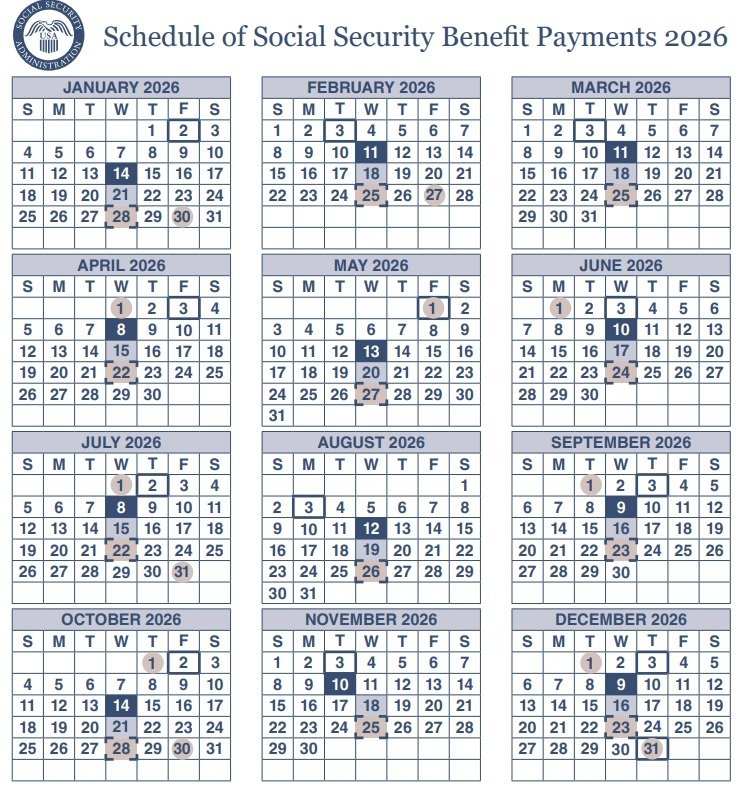
The dates above are derived from the SSA’s published rules and the calendar. The SSA’s full 2027 schedule is linked in the table below, and you can confirm your own date in your my Social Security account.
When Your COLA Notice Arrives?
The SSA says people with a personal my Social Security account can view their COLA notice online starting in late November, up to three weeks before a paper notice would arrive. Those who have not opted for online messages will receive the notice by mail in December. The notice is a simplified one-page letter with exact dates and dollar amounts for your new benefit and any deductions.
Medicare beneficiaries will see their new 2027 benefit amount in the December mailed notice and in my Social Security’s Message Center.
What to Do Before the End of the Year?
- Create or sign in to your my Social Security account. It gives you the fastest access to your COLA notice and payment information.
- Update your address, phone and direct deposit. This matters most if you may owe IRMAA, since notices are mailed.
- Watch for the CMS announcement. The official 2027 Part B premium, deductible and IRMAA brackets are expected mid-November. Compare them with the projected $209.50.
- Review your Medicare plan before December 7. Check your drugs against your plan’s formulary, premiums and any changes for 2027.
- Ask about IRMAA if your income dropped. Use the SSA’s request to lower IRMAA after a life-changing event.
- Check your withholding. If you have taxes withheld from your benefits, the SSA has a page to request or change withholding.
- Beware of scams. Be skeptical of messages claiming you must act to receive your COLA. The SSA’s fraud reporting page is linked below.
Official Sources
| Resource | Link |
| SSA: COLA information | https://www.ssa.gov/news/en/cola/index.html |
| SSA: 2027 COLA fact sheet | https://www.ssa.gov/news/en/cola/factsheets/2027.html |
| SSA: COLA summary | https://www.ssa.gov/oact/cola/colasummary.html |
| SSA: 2027 payment schedule (PDF) | https://www.ssa.gov/pubs/EN-05-10031-2027.pdf |
| SSA: Medicare | https://www.ssa.gov/medicare |
| SSA: Request to lower IRMAA | https://www.ssa.gov/medicare/lower-irmaa |
| SSA: Sign up for Medicare | https://www.ssa.gov/medicare/sign-up |
| my Social Security | https://secure.ssa.gov/myssa/myhub |
| CMS newsroom | https://www.cms.gov/newsroom |
| 2026 Medicare Trustees Report | https://www.cms.gov/oact/tr/2026 |
| CMS 2027 Rate Announcement (PDF) | https://www.cms.gov/files/document/2027-announcement.pdf |
| Medicare.gov | https://www.medicare.gov |
| SSA: Report fraud | https://secure.ssa.gov/oig/fraud/ |
| Primary Source | https://www.ssa.gov/news/en/cola/index.html |
Frequently Asked Questions
What is the Social Security COLA for 2027?
3.6%, announced by the SSA on October 14, 2026. The increase begins with benefits payable in January 2027.
How much more will I get?
The SSA estimates the average retired worker benefit rises about $75 a month, from $2,095 to $2,170. Your increase depends on your own benefit, and your COLA notice will show the exact amount.
Will my November or December 2026 check include the COLA?
No. The COLA starts with January 2027 benefits.
What is the 2027 Medicare Part B premium?
CMS has not published the official figure as of my last check on November 12. The 2026 Medicare Trustees Report projects about $209.50 a month, up from $202.90 in 2026. Treat that as an estimate until CMS announces the final number.
Will Medicare take back my COLA?
Part of it, possibly. Most people with Part B have the premium deducted from their benefit. But the increase in the premium is expected to be much smaller than the COLA for most people, and the hold harmless rule protects many from a net decrease. It does not apply to IRMAA or to people new to Medicare.
What changes for Medicare Part D in 2027?
The out-of-pocket cap rises to $2,400 from $2,100, and the standard deductible rises to $700 from $615. The national base beneficiary premium is $41.33.
When does Medicare open enrollment end?
December 7, 2026. Changes take effect January 1, 2027.
When are the next Social Security payments?
For most people, November 18 or 25 and then December 9, 16 or 23, depending on birthday. Those paid on the 3rd get paid December 3. SSI is paid December 1. See the table above.
Why do I get a payment on December 31?
January 1, 2027 is a federal holiday, so the SSA moves the SSI payment for January up to December 31. Social Security payments normally made on January 3, a Sunday, are also moved up to that date.
When will I see my COLA notice?
Online in my Social Security starting in late November, or by mail in December if you have not opted for online messages.
What if my income is high?
You may pay IRMAA on top of the standard Part B and Part D premiums. The 2027 brackets were not yet published as of November 12. If your income dropped because of a life-changing event, you can ask the SSA to lower it.
Did the earnings limit change?
Yes. For 2027 it is $25,560 a year if you are under full retirement age, and $67,920 in the year you reach full retirement age.
What is the maximum Social Security benefit in 2027?
$4,188 a month for a worker retiring at full retirement age, per the SSA’s fact sheet. Most people receive less.
How do I avoid COLA scams?
Do not click links or give personal information in unexpected messages. The SSA does not need you to apply for the COLA. Report suspected fraud through the SSA’s fraud page.

4 thoughts on “2027 Social Security COLA: Medicare and Payment Dates”