
SNAP Rule 2026: If you or someone in your family uses SNAP (food stamps), a new federal proposal could change who qualifies. The SNAP rule 2026 is a USDA proposal, published on November 10, 2026, that would sharply limit a policy called broad-based categorical eligibility (BBCE). This guide explains what the rule does, who could lose benefits, and what you can do before the comment deadline.
USDA estimates the proposed SNAP Rule 2026 would end benefits for about 6.3 million people (roughly 18% of SNAP participants) by fiscal year 2029. It is only a proposal. Nothing has changed for current SNAP households yet, and the public can comment until December 10, 2026.
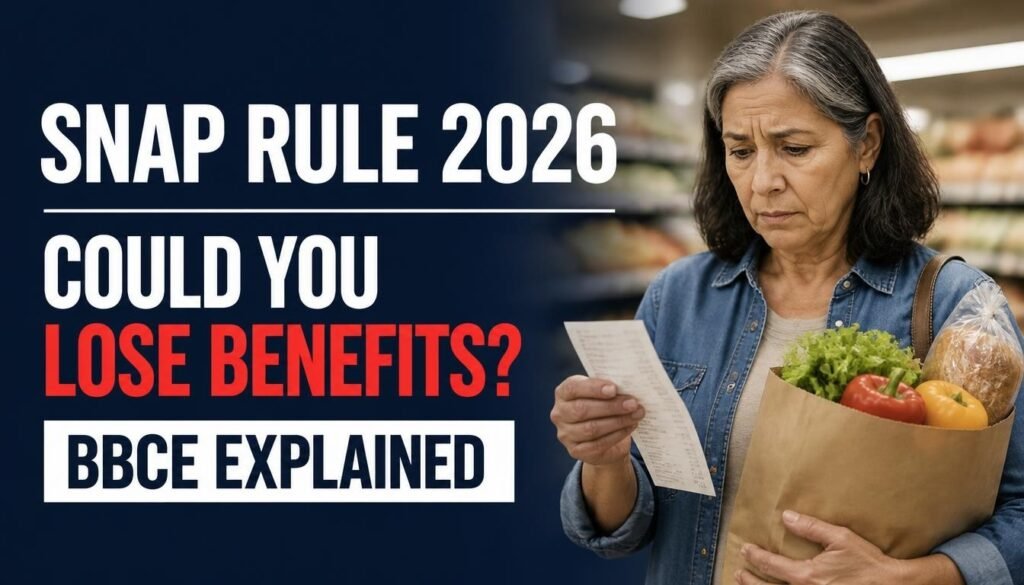
SNAP Rule 2026 : Highlight
- What changes: Automatic SNAP eligibility would come only from receiving TANF cash assistance, not from noncash TANF-funded services such as child care help or job training.
- Who is most at risk: Households that qualify today only through BBCE, meaning their gross income is above 130% of the federal poverty line (about $35,500 a year for a family of three) or their savings are above the standard asset limit.
- Children: About 1.8 million children would lose automatic eligibility for free school meals.
- Status: Proposed, not final. Comments are due December 10, 2026 at 11:59 PM EST under docket FNA-2026-0661.
- Cost to the government: USDA projects about $44.6 billion less in federal SNAP spending over fiscal years 2027 to 2031.
What the USDA Proposed SNAP Rule 2026?
The proposal is titled “Supplemental Nutrition Assistance Program: Reforming Categorical Eligibility.” It was issued by USDA’s Food and Nutrition Administration and published in the Federal Register on November 10, 2026.
The SNAP Rule 2026 would limit categorical eligibility to households that receive TANF “assistance,” as defined in federal regulation 45 CFR 260.31. It would also stop states from using noncash or in-kind benefits and services, such as child care, training or other services, to make a household eligible. USDA says this moves SNAP back toward the approach it used in 1985, when only cash assistance qualified a household.
| Today (with BBCE) | Under the proposed rule | |
|---|---|---|
| Automatic path to SNAP | Receiving cash or noncash TANF or state-funded services | Receiving TANF cash assistance only |
| Gross income limit | Federal limit is 130% of poverty; many states set it higher, up to 200% | Federal 130% limit applies to households that no longer qualify automatically |
| Asset test | Many states waive or raise it | Federal asset limit applies again, broadly $3,000 for most households |
| State paperwork | Many states collect but do not verify asset information | More verification and administrative work for states |
USDA’s own paperwork estimate assumes 45 state agencies currently use expanded categorical eligibility and collect, but do not verify, resource information from households.
What Is Broad-Based Categorical Eligibility (BBCE)?
Broad-based categorical eligibility (BBCE) is a state option that lets a household qualify for SNAP because it receives a noncash benefit or service funded by TANF (Temporary Assistance for Needy Families) or by state maintenance-of-effort money. Examples include a child care subsidy, job training or an informational brochure and hotline. Households that qualify this way can skip some of SNAP’s standard income and asset tests.
States began adopting BBCE in 2000. Most use it to loosen or remove the asset limit, and many also raise the gross income limit. More than 40 states now use it. The net income test, set at 100% of the poverty line, still applies in every state.
2027 Social Security COLA: Medicare and Payment Dates
Child Tax Credit 2026: Do You Get the Full $2,200?
Alaska PFD Payment Date 2026: When Will You Get Your $1,200?
Social Security 2026 Claiming Age: New Age Names, Same Check
Federal rules vs. BBCE
| Test | Standard federal rule | With BBCE (varies by state) |
|---|---|---|
| Gross income limit | 130% of the federal poverty line | Up to 200% in some states |
| Asset limit | Broadly $3,000 for most households | Waived or raised in many states |
| Net income limit | 100% of the poverty line | 100% of the poverty line (unchanged) |
How much states differ?
| State | Gross income limit (% of poverty line) | Asset limit |
|---|---|---|
| Alabama | 130% | No limit |
| Nebraska | 165% | $25,000 in liquid assets |
| Michigan | 200% | No limit |
| Minnesota | 200% | No limit |
| Montana | 200% | No limit |
| Nevada | 200% | No limit |
| Wisconsin | 200% | No limit |
Why states use it?
Advocates say BBCE lets working families take a raise without losing all their food aid at once, and lets low-income households keep modest savings. USDA research cited by the Food Research & Action Center found BBCE cuts state administrative costs by about 7% per case by simplifying eligibility checks and reducing churn. Supporters of the new rule argue it was never meant to widen who qualifies.
Who Could Lose SNAP Benefits Under the New Rule?
The households at risk are those that qualify for SNAP today only through BBCE. Their gross income or savings are above the standard federal limits, but their state lets them in because they receive a noncash TANF-funded service. Advocates such as the Center on Budget and Policy Priorities say this group is mainly working families with children, seniors and people with disabilities. USDA estimates that 17.6% to 18% of participants, about 6.3 million people, would lose eligibility.
Example: a working family near the income line
This is an illustration, not a real case. A family of three lives in a state with a 200% gross income limit. A parent takes a better-paying job, and the household’s gross income rises just above 130% of the poverty line, or about $35,500 a year. Today the state’s BBCE policy can keep the family on SNAP. Under the proposed rule, a household that only qualifies through noncash TANF-funded services would be tested against the federal limit, and the family could be cut off even though its income is still modest.
What about seniors and people with disabilities?
Under regular federal rules, households with an elderly or disabled member do not have to meet the gross income test, but they must still pass the net income test. They can also apply under regular SNAP rules if they do not qualify through BBCE. For many older adults, the bigger risk is likely to be the asset limit, which the federal rules set at a different level for households with an elderly or disabled member. Check your state’s current limits.
Which states could feel it most?
About 45 state agencies use expanded categorical eligibility, so the effect would be national. Minnesota, which expanded BBCE in 2010 and has about 440,000 SNAP participants, is one state where local reporting says some households could lose benefits.
Impact on Free School Meals and WIC
SNAP eligibility is linked to other programs for low-income families, so the rule would reach beyond grocery benefits. USDA estimates about 1.8 million children would lose automatic eligibility for free school meals. USDA says nearly all of them would still qualify for free or reduced-price meals if their families apply separately, which adds a paperwork step.
The rule would also affect WIC, the nutrition program for low-income mothers and young children. About 16,500 pregnant women, mothers, infants and children would have to apply for WIC directly, and another 5,500 participants would no longer be eligible, according to the proposal as reported by CNN.
Is the SNAP Rule Final? Timeline and Comment Deadline
No. The SNAP rule 2026 is a proposed rule, so benefits have not been reduced yet. USDA must review public comments before it can issue a final rule, and a final rule could still differ from the proposal.
| Date | What happened or happens next |
|---|---|
| 2019 | The Trump administration proposed a similar rule to end BBCE. USDA then estimated 3.1 million people would lose benefits. |
| 2021 | The Biden administration withdrew the 2019 proposal. |
| November 10, 2026 | USDA publishes the new proposed rule in the Federal Register and opens public comment. |
| December 10, 2026 | Comment period ends at 11:59 PM EST. |
| After comments close | USDA reviews comments and decides whether to issue a final rule. |
| Fiscal year 2029 | USDA’s projection for when about 6.3 million people could have lost benefits, if the rule is finalized. |
Supporters vs. Critics: The Two Sides
The USDA’s case
- BBCE was created to cut paperwork, not to widen who qualifies for SNAP.
- Limiting it would target benefits to “truly needy” households, in USDA’s words.
- USDA projects about $44.6 billion less in federal SNAP spending over fiscal years 2027 to 2031, and $5.2 billion less in state spending over five years.
- The proposal cites a widely reported Minnesota case of a millionaire who received food stamps through BBCE.
The critics’ case
- Groups such as the Center on Budget and Policy Priorities and the Food Research & Action Center say the change would cut off working families, seniors and people with disabilities.
- Without BBCE, a small raise that lifts gross income just over 130% of the poverty line can wipe out a household’s SNAP benefit.
- The rule adds paperwork for families and states, which critics say could push out eligible people and raise state error rates.
- Critics also point to USDA research showing BBCE lowers state administrative costs.
For context, a Congressional Budget Office estimate reported earlier put the savings from restricting BBCE at roughly $11 billion over ten years, a much smaller figure than USDA’s projection for the proposed rule. The two numbers cover different scopes and time frames, so compare them carefully.
What You Can Do Now?
- Stay calm and keep your benefits on schedule. Nothing changes unless a final rule is issued.
- Check your state’s BBCE policy. USDA’s BBCE page lists each state’s gross income and asset limits.
- Keep your records. Save recent pay stubs, bank statements and any notices about TANF-funded services such as child care or job training.
- Recertify on time. Respond to every notice from your state SNAP office so a missed deadline does not cost you benefits.
- Ask your state SNAP office how the proposal would apply to your household.
- Plan a backup. If a child could lose automatic school meal eligibility, families can apply for free or reduced-price meals directly. Food banks and the 211 helpline can point you to local help.
How to submit a public comment?
Comments are due by December 10, 2026 at 11:59 PM EST. Use any of these options:
- Online: Go to Regulations.gov and search docket FNA-2026-0661.
- Email: Send your comment to sm.fn.snappdbrules@usda.gov and put the docket ID, FNA-2026-0661, and the title “Supplemental Nutrition Assistance Program: Reforming Categorical Eligibility” in the subject line.
- Mail: Send it to the SNAP Program Development Division in Beltsville, Maryland.
USDA says comments, including the name of the person who submits them, become part of the public record. Personal stories about how SNAP helps your household, and specific numbers, tend to be the most useful.
Other SNAP Changes in 2026 to Watch
The BBCE proposal is not the only SNAP change in play.
- Second proposed rule on work requirements. USDA published a separate proposed rule on November 10, 2026 to carry out the expanded SNAP work requirements from the 2025 federal tax and spending law.
- Falling enrollment. SNAP enrollment has dropped by more than 5 million people, including an estimated 2 million children, since the One Big Beautiful Bill Act was signed in July 2025.
- Work rules for adults. Many adult recipients must work, volunteer or take part in job training for at least 80 hours a month, or face a limit of three months of benefits in any 36-month period.
- Immigrant eligibility. The 2025 law narrowed SNAP for some noncitizens, including refugees and asylees who were previously eligible.
- State costs. Beginning in fiscal year 2027, the federal share of state SNAP administrative costs drops from 50% to 25%, which could push some states to tighten rules.
Official Links and Sources
- Federal Register: Reforming Categorical Eligibility (proposed rule)
- Regulations.gov docket FNA-2026-0661 (submit a comment)
- USDA: Proposed Rule, SNAP Reforming Categorical Eligibility
- USDA: Broad-Based Categorical Eligibility by state
- Center on Budget and Policy Priorities: statement on the proposed rule
- Food Research & Action Center: BBCE fact sheet (June 2026)
- CNN via ABC30: Nearly 1 in 5 food stamp recipients could lose benefits
- Gray News: Trump moves to cut SNAP benefits for 6.3 million people
- Philadelphia Inquirer: Trump administration proposal to restrict SNAP eligibility
- Spokesman-Recorder: USDA proposal and Minnesota
- Medical Daily: proposed USDA rule and free school meals
Faq’s on SNAP Rule 2026 :-
What is the SNAP rule 2026?
It is a USDA proposed rule, published November 10, 2026, that would limit broad-based categorical eligibility so that only households receiving TANF cash assistance qualify automatically for SNAP.
What is broad-based categorical eligibility (BBCE)?
BBCE is a state option that lets households receiving noncash TANF-funded or state-funded services qualify for SNAP without meeting the standard gross income and asset tests. More than 40 states use it.
Will I lose my SNAP benefits?
Not right now. The rule is only proposed. If it is finalized, households that qualify only through BBCE, because their income or savings exceed the standard federal limits, would be most at risk.
How many people could lose SNAP benefits?
USDA estimates about 6.3 million people, or roughly 18% of participants, by fiscal year 2029.
When would the SNAP rule take effect?
It cannot take effect until USDA reviews public comments and issues a final rule. No start date applies to a proposal.
Does the SNAP rule affect free school meals?
Yes. USDA estimates about 1.8 million children would lose automatic eligibility for free school meals, though nearly all would still qualify if their families apply separately.
Can seniors and people with disabilities still get SNAP?
Yes. Households with an elderly or disabled member can apply under regular SNAP rules. They do not need to meet the gross income test but must meet the net income test and the asset rules.
What is the SNAP gross income limit?
The federal limit is 130% of the poverty line, about $35,500 a year for a family of three. States that use BBCE can set it higher, up to 200% of the poverty line.
Is SNAP the same as food stamps?
Yes. SNAP, the Supplemental Nutrition Assistance Program, is the formal name for what many people still call food stamps.
How do I comment on the SNAP proposed rule?
Submit a comment at Regulations.gov under docket FNA-2026-0661 or email sm.fn.snappdbrules@usda.gov by December 10, 2026 at 11:59 PM EST.
Also Read :-
Cash App Settlement Check Not Received? Check Status and Reissue Process?
GOP Convention Fact Check: What Held Up?
$90 Medicare Rebate: Who Got It, Who Didn’t?
Social Security & SSI Pay Dates by Birthday: When you will get your benefit?
